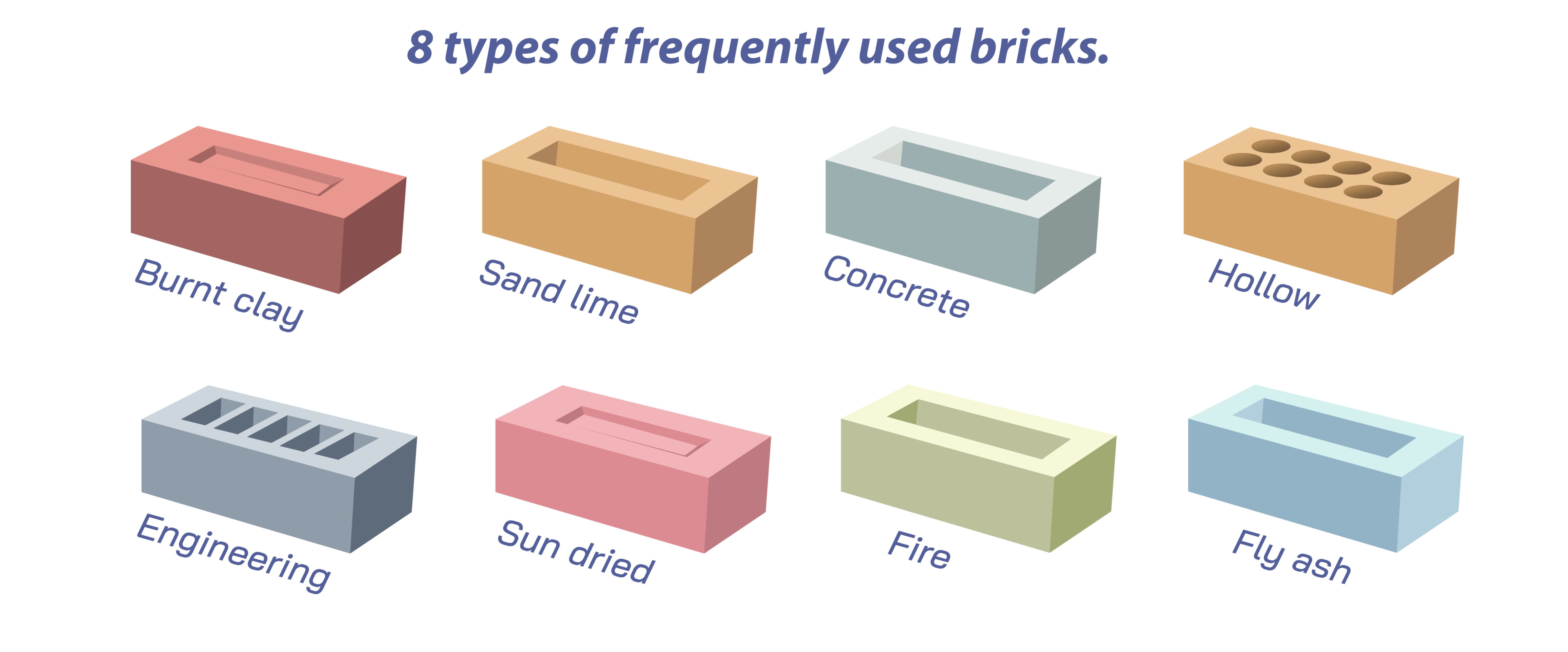
Types of Bricks Used Frequently — Construction Material Guide
Bricks remain one of the most fundamental building materials in construction, and their significance has persisted across centuries because of their durability, uniformity, thermal properties, and adaptability to diverse architectural requirements. When discussing the types of bricks used frequently in the construction industry, it becomes clear that bricks are far more than simple rectangular units. They represent a complex intersection of geology, engineering, craftsmanship, climate considerations, and structural demands. Each type of brick is characterized by the materials from which it is made, the process by which it is formed, and the performance expectations placed upon it in structural and non-structural applications. Understanding these brick varieties requires examining their composition, strength profiles, thermal behavior, moisture performance, aesthetic qualities, and how they adapt to different segments of the construction process. Whether used in load-bearing walls, facades, pavements, interior partitions, ornamental work, fire-resistant structures, or long-span architectural designs, bricks support an immense range of purposes. The diversity of brick types reflects the evolution of construction itself, capturing the balance between tradition and modern innovation within the built environment.
Clay bricks are among the most frequently used bricks globally, and their popularity stems from the reliability and performance of natural clay as a raw material. Prepared and molded from clay rich in aluminum silicates, these bricks undergo a process of drying and firing that transforms raw earth into a strong, durable, and resilient building material. Clay bricks carry exceptional compressive strength, making them suitable for structures that depend on load-bearing capabilities. Their properties stem not only from the clay itself but also from the firing temperature, moisture content, and chemical additives used during the manufacturing process. Once fired, clay bricks exhibit excellent resistance to weathering, erosion, and temperature fluctuations. They provide reliable insulation because the microscopic pores within the brick regulate the transfer of heat. This thermal inertia allows clay bricks to moderate internal building temperatures, contributing to comfortable indoor environments in hot or cold climates. Their visual appeal, characterized by natural colors ranging from warm red and deep brown to pale yellow or earthy orange, allows architects to integrate clay bricks into traditional or modern designs seamlessly. Clay bricks thus represent a harmonious combination of strength, longevity, and aesthetic adaptability.
Beyond standard clay bricks, fly ash bricks have emerged as one of the most significant modern alternatives. Produced using fly ash, a byproduct of coal combustion in thermal power plants, these bricks reflect the growing emphasis on sustainable and environmentally responsible construction. Fly ash bricks consist of fly ash, sand, cement, and water, cast into uniform molds and cured under controlled conditions. This manufacturing process reduces dependence on fired clay while repurposing industrial waste that would otherwise contribute to environmental pollution. Fly ash bricks possess precise dimensions, smooth surfaces, and consistent weight, reducing the need for excessive mortar and minimizing onsite labor. Their structural advantages include excellent compressive strength, resistance to efflorescence, and low water absorption rates, which help maintain structural integrity over long periods. Because they are lighter compared to traditional clay bricks, they reduce the overall dead load on building structures, enabling more efficient design of foundations and columns. Their thermal and acoustic insulation properties, combined with their eco-friendly attributes, make fly ash bricks a preferred choice in sustainable construction practices.
Concrete bricks represent another frequently used category, especially in contemporary construction where uniformity, strength, and versatility are essential. These bricks are manufactured using a mixture of cement, sand, aggregates, and water, molded under mechanical pressure to achieve compacted density. Unlike clay bricks, concrete bricks do not undergo a firing process; their strength derives from the curing of cement through hydration. Concrete bricks are available in a wide variety of textures, colors, and shapes, making them ideal for aesthetic facades, exterior cladding, or decorative applications. Their precise shape and size allow efficient masonry work and reduce wastage. Concrete bricks exhibit excellent compressive strength and are highly resistant to fire, moisture, and environmental wear. Their low porosity reduces water absorption, limiting issues such as dampness or efflorescence. In load-bearing applications, they contribute to strong, monolithic construction systems, while in non-structural partitions, they offer outstanding durability and architectural flexibility. Their ability to incorporate pigments and surface treatments allows designers to create visually striking facades without compromising structural integrity.
Sand-lime bricks form a specialized category known for their exceptional dimensional accuracy, elegant appearance, and unique composition. Made from a mixture of sand, lime, and water, these bricks undergo a chemical process called autoclaving, where high pressure and steam cause the components to bond through the formation of calcium silicate. Sand-lime bricks offer outstanding compressive strength, sharp edges, and smooth surfaces, making them ideal for architectural finishes where precision and aesthetic refinement are essential. Their pale, uniform color lends itself to minimalist or modern architectural designs. Because of their dense structure, sand-lime bricks exhibit reduced thermal expansion and excellent acoustic performance. They resist insect infestation and mold growth, while their high load-bearing capacity makes them suitable for multi-story buildings and heavily stressed masonry systems. Their clean appearance often eliminates the need for plastering, reducing construction costs while maintaining visual quality.
Engineering bricks are another frequently used type, distinguished by their emphasis on mechanical performance rather than aesthetic qualities. These bricks are manufactured using high-quality clay and fired at extremely high temperatures, resulting in dense, strong units with low porosity. Engineering bricks are categorized based on strength and water absorption levels, making them indispensable in structures requiring high durability under challenging conditions. Because of their resistance to frost, moisture, and chemical exposure, engineering bricks are often used in foundations, retaining walls, sewerage systems, basements, and areas where structural reliability is critical. Their ability to withstand repeated cycles of wetting and drying makes them especially suitable for outdoor environments exposed to weathering. The high compressive strength of engineering bricks ensures stability in heavy load applications, cementing their role as essential components in infrastructural and civil engineering projects.
Fire bricks, also known as refractory bricks, represent a category designed specifically for high-temperature applications. These bricks are manufactured using heat-resistant materials such as alumina and silica, enabling them to withstand extreme temperatures without cracking, melting, or degrading. Fire bricks are employed in the construction of furnaces, fireplaces, ovens, chimneys, industrial kilns, and insulation systems where direct exposure to flame or heat makes standard bricks unsuitable. The structural composition of fire bricks ensures low thermal conductivity, protecting surrounding structures from heat damage. Their durability under thermal shock—rapid heating and cooling—distinguishes them from conventional masonry units, making them indispensable in industrial settings and specialized architectural installations.
Perforated and hollow bricks occupy another frequently used category, especially in modern construction that prioritizes reduced weight and improved thermal performance. These bricks contain carefully designed openings that reduce mass, enhance insulation, and facilitate the installation of wiring or plumbing. Hollow bricks help minimize the dead load on structures, making them ideal for high-rise buildings where weight optimization is crucial. Their thermal insulation properties contribute to energy-efficient construction, reducing the transfer of heat and improving indoor comfort. The air spaces within the brick act as barriers to sound transmission, offering acoustic benefits as well. These bricks also enhance speed of construction due to their lighter weight and larger size compared to traditional solid bricks.
Handmade bricks and extruded bricks offer distinct aesthetic benefits used frequently in architectural projects that require traditional textures or artisanal finishes. Handmade bricks retain irregularities and rough textures that reflect centuries-old craftsmanship, making them ideal for heritage reconstruction, decorative facades, and buildings that seek a rustic or historical appearance. Extruded bricks, produced through mechanical extrusion processes, offer uniformity and precision suitable for contemporary designs. These variations demonstrate how brick types cater not only to structural requirements but also to artistic and cultural expressions within architecture.
In terms of performance criteria, frequently used bricks must meet expectations related to strength, durability, environmental compatibility, cost efficiency, and local climate adaptations. Regions with abundant clay resources naturally favor fired clay bricks, while areas with industrial waste materials increasingly adopt fly ash bricks as sustainable options. Coastal regions may rely more heavily on engineering bricks due to their low porosity and resistance to saltwater corrosion. Hot climates may favor hollow bricks because of their superior insulation. These regional adaptations highlight the interconnectedness between environmental conditions, resource availability, and construction techniques.
The choice of brick type is also influenced by evolving construction practices. With the rise of green building standards, architects and engineers explore materials that reduce carbon footprint, improve energy efficiency, and minimize resource wastage. Fly ash bricks, hollow bricks, and sand-lime bricks align well with sustainability goals because of their low environmental impact, efficient manufacturing, and reduced reliance on natural firing processes. Additionally, modern construction emphasizes speed, precision, and modularity, making machine-made bricks increasingly popular due to their uniformity and compatibility with automated building methods. Nevertheless, traditional clay bricks continue to dominate because of their proven longevity, cultural familiarity, and adaptability to diverse building styles.
Each frequently used brick type contributes distinct advantages that shape construction outcomes. Whether chosen for their structural performance, aesthetic appeal, environmental benefits, or specialized functionality, bricks form the essential foundation of walls, pavements, facades, and architectural elements across the built environment. They represent the intersection of tradition, engineering innovation, and practical design. Understanding the characteristics of these brick varieties enables more informed decisions in construction planning, structural design, thermal consideration, and architectural expression. The versatility of bricks demonstrates why they continue to be indispensable in construction, bridging ancient building practices with modern architectural demands and ensuring that structures remain strong, durable, and visually compelling for generations.