Ammonium Bicarbonate — Structure, Properties, and Common Uses
Fundamental Identity and Structural Characteristics of Ammonium Bicarbonate
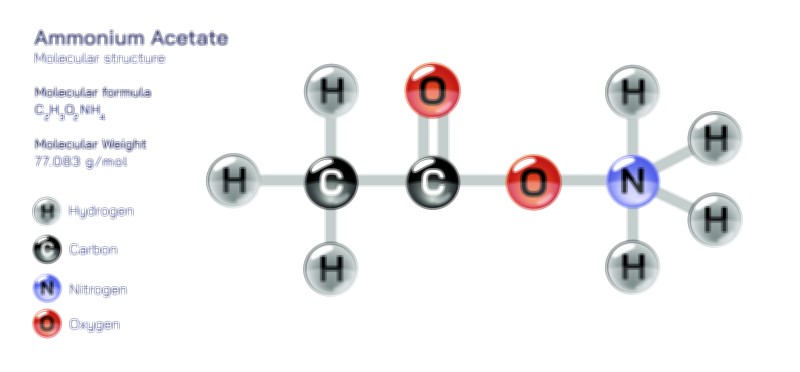
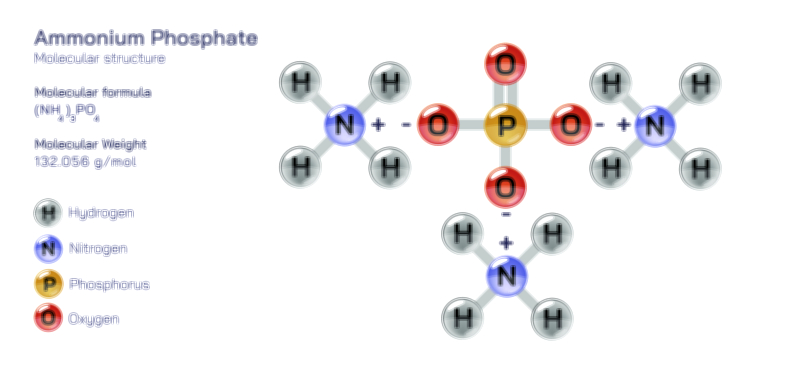
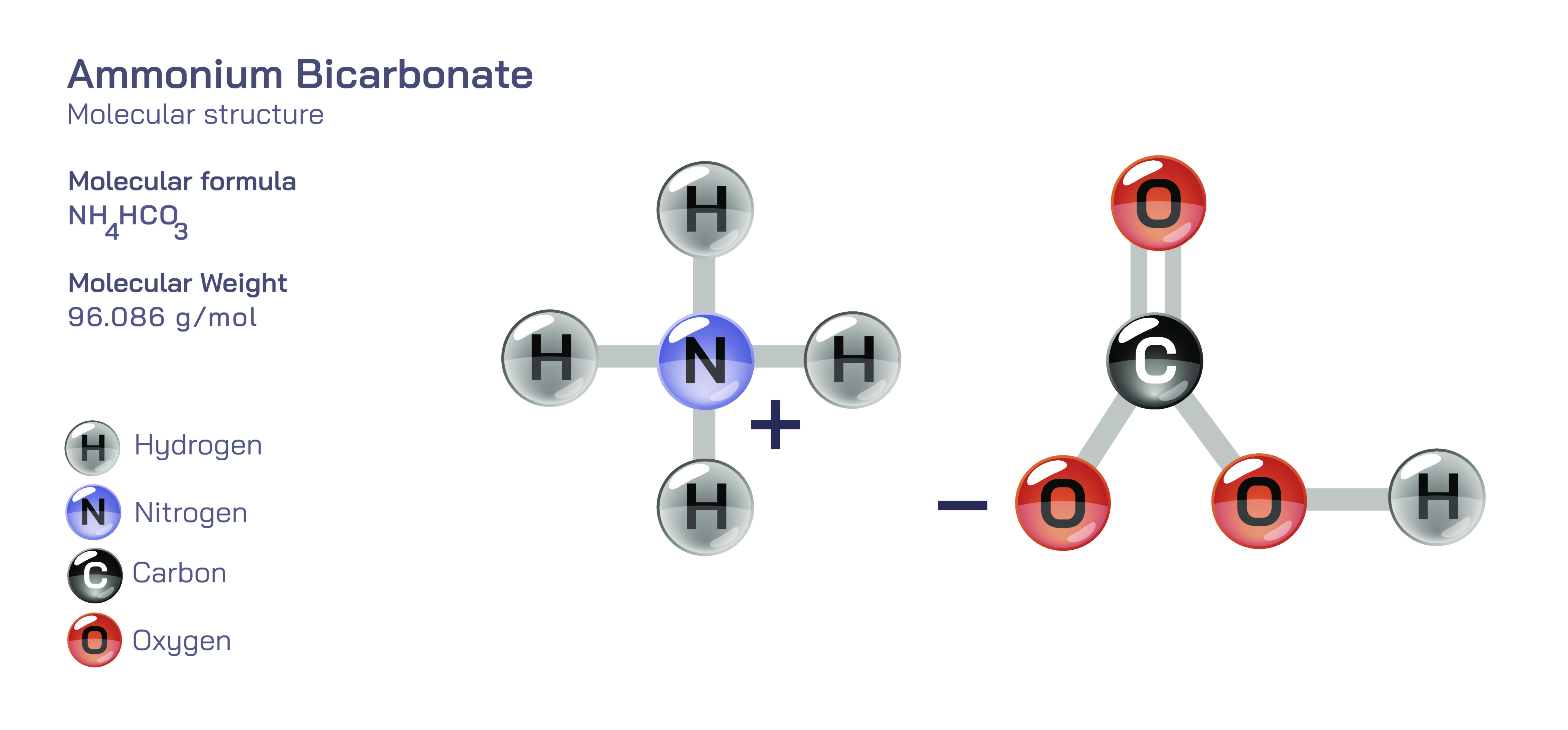
Ammonium bicarbonate, represented chemically as NH₄HCO₃, is an inorganic salt composed of the ammonium cation (NH₄⁺) and the bicarbonate anion (HCO₃⁻). It appears as a white, crystalline, and slightly opaque powder with a mild ammonia-like odor due to its partial decomposition in air. Structurally, ammonium bicarbonate represents a delicate balance between ionic and covalent interactions. The NH₄⁺ ion is a tetrahedral species in which a central nitrogen atom is bonded to four hydrogen atoms, carrying a positive charge through protonation of ammonia. The bicarbonate ion, by contrast, consists of a central carbon atom double-bonded to one oxygen atom and singly bonded to two others—one carrying a negative charge and the other connected through a hydrogen that mediates acid-base behavior. The crystalline lattice arranges these ions in repeating patterns stabilized by hydrogen bonding, electrostatic attraction, and intermolecular forces. This intrinsic structural simplicity allows ammonium bicarbonate to decompose easily and therefore function effectively in applications requiring controlled release of gaseous products such as CO₂ and NH₃.
Chemical Behavior, Stability, and Thermal Decomposition
One of the most defining characteristics of ammonium bicarbonate is its instability under heat. Even mild warming is enough to initiate decomposition into ammonia gas, carbon dioxide, and water vapor. This decomposition is fully reversible at low temperatures but becomes increasingly irreversible as heat intensifies or moisture is introduced. Because of this behavior, ammonium bicarbonate cannot be stored for long periods under warm or humid conditions, nor can it be used in processes that require sustained high temperatures. In aqueous solutions, it dissolves readily, forming mildly alkaline solutions that can release carbon dioxide upon acidification. The bicarbonate ion participates in acid–base equilibria, reacting with acids to produce carbon dioxide and with bases to form carbonate salts. These predictable transformations make ammonium bicarbonate a useful reagent in chemistry laboratories, where it can serve as a source of ammonia or carbon dioxide. Its reactivity also explains why it has historically been used in baking and agricultural treatments that rely on gas release or pH adjustment.
Physical Properties and Behavior Under Environmental Conditions
Ammonium bicarbonate exists as a lightweight, crystalline powder with moderate solubility in water and very limited solubility in organic solvents. It decomposes slowly at room temperature, emitting traces of ammonia that give it a slightly pungent odor. Its sensitivity to heat and humidity makes it highly reactive to environmental conditions; exposure to warm air causes it to break down, leading to weight loss, clumping, and diminished effectiveness in its applications. The compound’s low melting point—combined with its tendency to decompose rather than liquefy—further supports its use in processes where the release of gaseous products is desirable. Because of its volatility, it must be packaged in sealed containers and stored at cool temperatures to extend its shelf life. Despite its delicate nature, ammonium bicarbonate remains a remarkably versatile substance, valued for applications where temporary, controlled, or gentle aeration is required.
Applications in Food Processing and Baking
One of the traditional and most well-known uses of ammonium bicarbonate is as a leavening agent in baking. Often referred to as “baker’s ammonia” or “hartshorn,” it has been used for centuries to produce light, crisp textures in pastries, cookies, crackers, and flatbreads. When heated during baking, ammonium bicarbonate decomposes rapidly, releasing carbon dioxide that lifts the dough and gives it an airy structure. Because this decomposition leaves no solid residue, it is especially useful for thin or dry baked goods that can easily release gaseous byproducts. However, for thicker items such as cakes or breads, the ammonia may not fully escape, leading to undesirable odors or flavors. For this reason, its culinary use is largely limited to specific products where its unique properties offer a distinct advantage over modern baking powders.
Industrial and Agricultural Uses Beyond the Kitchen
In addition to food processing, ammonium bicarbonate finds widespread use in agriculture as a nitrogen-rich fertilizer. It provides an accessible form of nitrogen to plants and soil, though its volatility limits its effectiveness in warm climates or poorly sealed storage conditions. When applied to soil, it increases nitrogen availability, promoting plant growth and supporting agricultural yields. In chemical manufacturing, ammonium bicarbonate serves as an intermediate or reagent in producing dyes, catalysts, ceramics, and pharmaceutical compounds. It is also used in certain fire extinguisher formulations, where its thermal decomposition contributes to extinguishing flames by releasing carbon dioxide. Industrial cleaning operations occasionally use solutions containing ammonium bicarbonate to remove scale or residues from processing equipment, taking advantage of its ability to break down surface deposits without introducing harsh chemicals.
Role in Laboratory Chemistry and Controlled Gas Release
In laboratory environments, ammonium bicarbonate is valued for its predictable decomposition and mild alkaline properties. It is frequently employed in mass spectrometry sample preparation, particularly in proteomics, where its volatility ensures minimal residue after evaporation. Biochemical assays benefit from ammonium bicarbonate buffers, which maintain suitable pH conditions while leaving no interference after thermal removal. The compound is also used to generate controlled atmospheres rich in carbon dioxide or ammonia for experimental purposes. Its dual release of CO₂ and NH₃ under heat allows researchers to replicate specific environmental conditions or manipulate reaction equilibria in studies ranging from polymer science to catalysis.
Illustrating the Structure and Functional Behavior of Ammonium Bicarbonate
A vector illustration of ammonium bicarbonate often highlights the ionic pairing between the ammonium cation and the bicarbonate anion, showing the tetrahedral geometry of NH₄⁺ and the trigonal planar arrangement of the carbonate core in HCO₃⁻. Visuals may include diagrams depicting its thermal decomposition pathway, releasing gaseous ammonia and carbon dioxide. Food-related illustrations often show ammonium bicarbonate reacting during baking, expanding dough through gas release. Agricultural images might present the compound being applied to soil as a nitrogen source. These visual explanations help connect molecular structure and chemical behavior to the wide range of real-world uses that rely on this compound’s unique properties.