Zinc Carbonate — Structure, Properties, and Industrial Applications
Fundamental Identity and Structural Characteristics of Zinc Carbonate
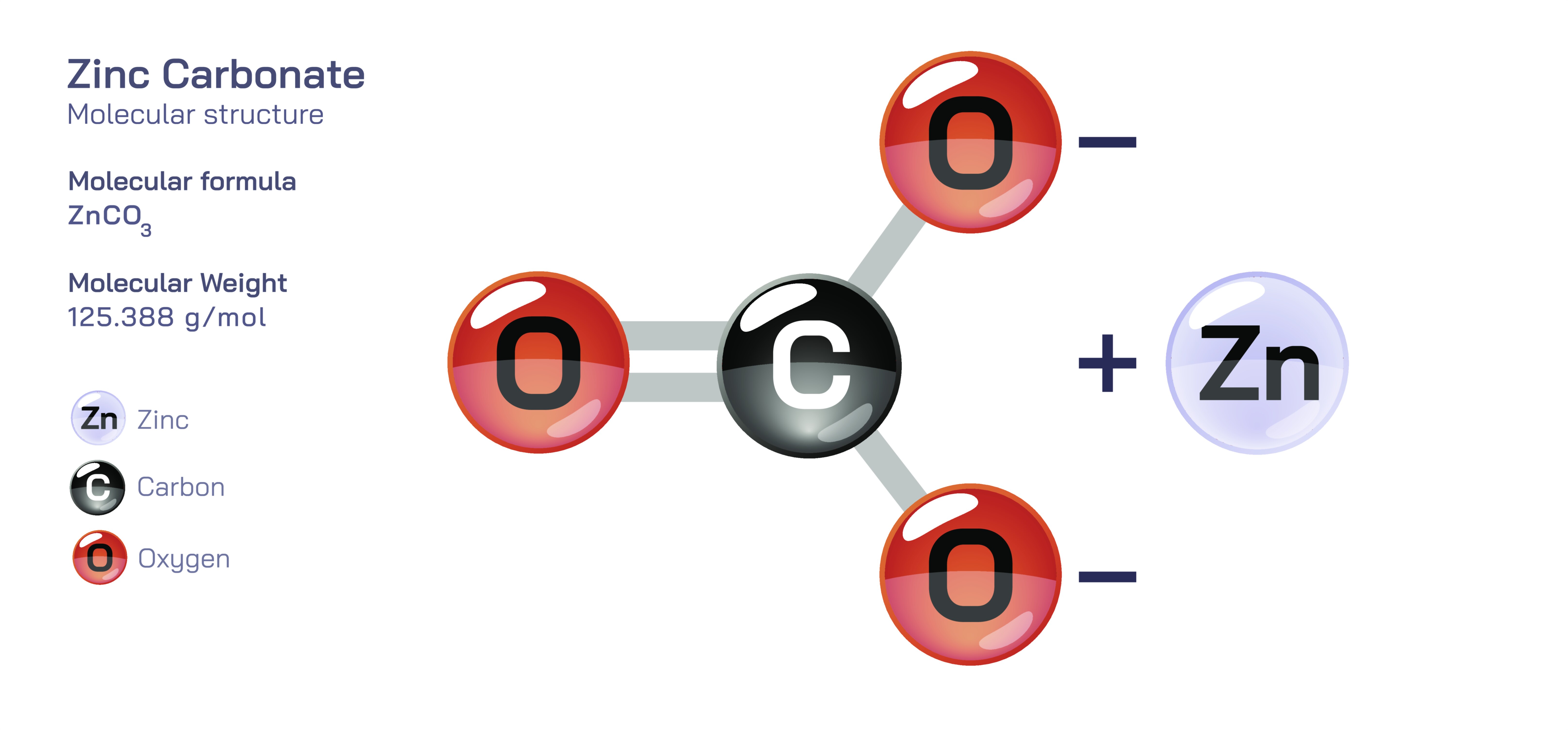
Zinc carbonate, commonly represented by the formula ZnCO₃, is an inorganic compound that occurs naturally as the mineral smithsonite. It appears as a white to off-white solid in its pure form, though natural samples often display greenish, bluish, or brownish hues due to trace impurities. Structurally, zinc carbonate consists of Zn²⁺ ions bonded to carbonate anions (CO₃²⁻), which adopt a trigonal planar geometry with a central carbon atom surrounded by three oxygen atoms arranged symmetrically. In the solid state, these carbonate units coordinate with zinc ions to form a stable crystal lattice whose arrangement depends on natural formation conditions or synthetic preparation methods. The bonding in zinc carbonate involves both ionic and covalent components: the zinc–oxygen interactions have significant ionic character, while the internal structure of the carbonate ion is strongly covalent and stabilized through resonance. This combination of structural robustness and chemical accessibility allows zinc carbonate to function as a precursor to numerous zinc compounds while retaining stability under typical environmental conditions.
Chemical Behavior, Bonding Patterns, and Reactivity
The chemical behavior of zinc carbonate is defined by its moderate stability and predictable reactions under thermal or acidic conditions. When exposed to acids, zinc carbonate readily decomposes, producing water, carbon dioxide gas, and the corresponding zinc salt—such as zinc sulfate, zinc nitrate, or zinc chloride—depending on the acid used. This reaction pathway reflects the inherent reactivity of the carbonate ion, which easily releases CO₂ upon protonation. Thermal decomposition provides another important transformation route: heating zinc carbonate yields zinc oxide, a valuable industrial compound, while releasing carbon dioxide gas. This decomposition is commonly utilized in manufacturing processes where high-purity zinc oxide is required. Although zinc carbonate is largely insoluble in water, it can dissolve in strong bases due to the formation of zincate complexes. This amphoteric response arises from zinc’s ability to interact with hydroxide ions, forming soluble species under high alkalinity. These reactivity patterns make zinc carbonate useful in laboratory synthesis, environmental chemistry, and industrial production workflows that require controlled transformation into other zinc compounds.
Physical Properties and Stability of Zinc Carbonate
Zinc carbonate appears as a fine, powdery solid with low density and a smooth texture, characteristics that make it easy to blend into formulations for pharmaceuticals, cosmetic products, and industrial mixtures. It is relatively insoluble in water, contributing to its stability in natural environments and commercial applications. The compound decomposes rather than melting, releasing carbon dioxide at elevated temperatures. Its modest hardness and gentle abrasive properties make it suitable for use in specialized polishing agents and dentifrices. Because zinc carbonate maintains chemical integrity under neutral conditions while responding quickly to acids and heat, it serves as a convenient intermediate for controlled reactions. These physical traits—low solubility, thermal decomposability, and mild abrasiveness—underpin much of its usefulness across industries, from materials processing to personal care products.
Industrial, Environmental, and Commercial Applications
Zinc carbonate holds a prominent role in industries that require safe, stable, versatile zinc compounds. One of its primary applications is as a precursor in the production of zinc oxide. Heating ZnCO₃ produces ZnO with desirable purity and particle characteristics, supporting its use in rubber vulcanization, ceramics, pigments, sunscreens, adhesives, and electronic materials. In pharmaceuticals and nutraceuticals, zinc carbonate serves as a zinc supplement, providing bioavailable zinc without excessive acidity. Its low toxicity and neutral taste profile allow incorporation into tablets, syrups, and fortified foods.
In the rubber and polymer industries, zinc carbonate acts as an activator in vulcanization processes, enhancing durability, elasticity, and performance of rubber products. In coatings and paints, it functions as a corrosion inhibitor, slowing down oxidation and contributing to long-lasting protective layers on metal surfaces. In agriculture, zinc carbonate is used in fertilizers and soil conditioners to correct zinc-deficient soils, supporting plant metabolism, enzyme function, and crop yields.
Environmental applications include its use in water treatment, where zinc carbonate participates in neutralization reactions or serves as a precursor for zinc-based adsorbents that remove contaminants from wastewater. Its predictable reactivity and safe environmental profile make it suitable for systems requiring controlled release of zinc ions or stable buffering capacity.
Role in Chemical Synthesis and Material Preparation
From a synthetic chemistry perspective, zinc carbonate offers a convenient, clean source of zinc ions that can be converted into other zinc salts without leaving harmful residues. Its decomposition into zinc oxide is widely used in producing catalysts, ceramic coatings, and electronic materials. In pigment manufacturing, zinc carbonate appears in specialty blends, providing brightness enhancement and improved structural stability. Certain cosmetic and skincare formulations also use zinc carbonate for its soothing, protective, and mild antiseptic qualities. In analytical chemistry, controlled precipitation of zinc carbonate serves as a method for separating zinc from other ions, illustrating its role as both a reagent and diagnostic tool. These multi-functional uses underscore how zinc carbonate operates not only as an end-product but also as an important intermediate in material science and industrial chemistry.
Illustrating the Structure and Applications of Zinc Carbonate
A vector illustration of zinc carbonate typically highlights the carbonate ion’s trigonal planar geometry alongside the coordinating zinc ions arranged around it. Diagrams may depict the extended lattice that forms through repetition of these fundamental units, showing how ionic and covalent interactions create a stable crystalline framework. Industrial illustrations often portray zinc carbonate as part of processing stages—such as its thermal conversion into zinc oxide, its use in rubber compounding, or its incorporation into pharmaceutical tablets. Environmental diagrams may illustrate its dissolution in acidic conditions or its role as a zinc source in fertilizers. These visual representations help clarify how structural chemistry relates directly to functional behavior, demonstrating why zinc carbonate remains an essential compound across scientific, commercial, and industrial domains.