Ammonium Sulfate — Structure, Properties, and Agricultural Applications
Understanding the Composition and Structure of Ammonium Sulfate
Ammonium sulfate is a widely used inorganic chemical compound with the formula
(
𝑁
𝐻
4
)
2
𝑆
𝑂
4
(NH
4
)
2
SO
4
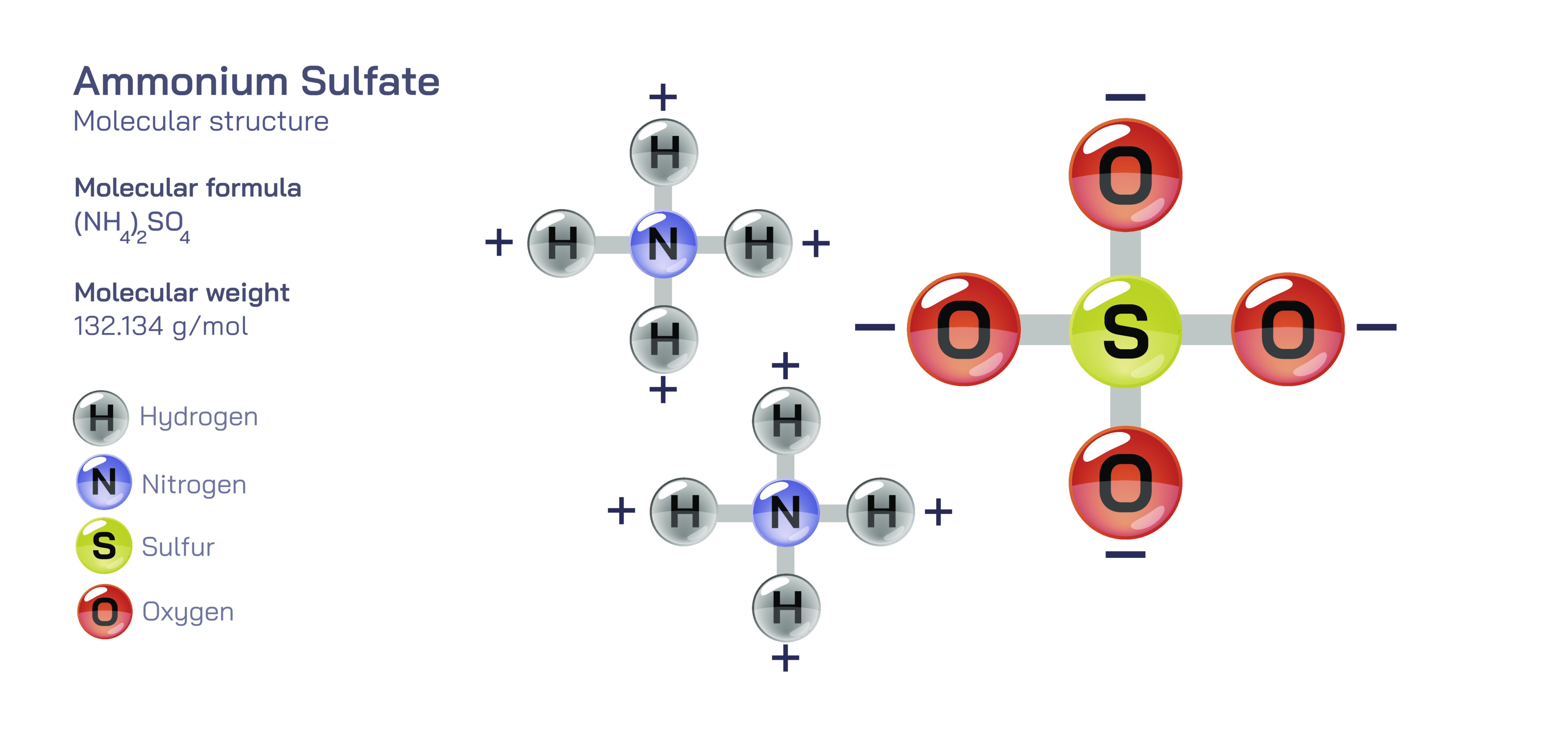
, consisting of two ammonium ions and one sulfate ion bound together in an ionic lattice. Its crystalline structure is stable, colorless to white in appearance, and often forms small granules or crystalline solids that dissolve readily in water. At the molecular level, the compound displays strong ionic interactions because the positively charged ammonium ions surround the negatively charged sulfate ion, creating a tightly bonded lattice that contributes to the compound’s high melting point, durability, and handling safety. A vector illustration of ammonium sulfate typically highlights its molecular geometry by displaying the tetrahedral arrangement of the sulfate group surrounded symmetrically by ammonium ions. This structure helps viewers understand the balance of charges and the arrangement of atoms that determine how the molecule behaves in water, soil, and industrial environments. By translating this chemical structure into clear visual form, illustrations help learners and professionals recognize why ammonium sulfate performs reliably in both agricultural and chemical contexts.
Physical and Chemical Properties That Define Its Performance
Ammonium sulfate demonstrates a range of physical and chemical properties that explain its behavior in solutions, soils, industrial mixtures, and supply chains. It dissolves easily in water, producing ammonium and sulfate ions that interact readily with other compounds and nutrients. The compound does not volatilize easily under normal environmental conditions, making it stable during transportation and storage. It has a relatively low pH effect when dissolved, depending on soil conditions, because the ammonium ion contributes acidity as it converts to nitrate through microbial processes. This acidifying effect can be beneficial for alkaline soils where nutrient availability increases with lower pH levels. Ammonium sulfate is also non-flammable, exhibits high solubility at moderate temperatures, and remains chemically stable in both dry and moist environments. These characteristics make it a predictable and controlled source of nitrogen and sulfur—two essential nutrients required by plants. Vector illustrations that display the behavior of ammonium sulfate in water often show the dissociation of ions, emphasizing how the compound quickly transitions from solid crystals into nutrient-rich ions available for plant uptake.
Role of Ammonium Sulfate as a Nitrogen Fertilizer
Ammonium sulfate is best known for its role as an agricultural fertilizer, particularly valued for providing nitrogen in ammonium form along with sulfur in sulfate form—two nutrients critical for plant growth. Nitrogen supports leafy growth, protein synthesis, and chlorophyll development, while sulfur helps form amino acids, enzymes, vitamins, and improves overall metabolic functioning in plants. The dual-nutrient nature of ammonium sulfate makes it particularly beneficial in agricultural systems that require both nitrogen and sulfur supplementation, especially in regions where soil sulfur levels are declining due to reduced atmospheric deposition. Because the nitrogen in ammonium sulfate exists in ammonium form, it tends to bind with soil particles rather than leach rapidly, giving it a more stable presence in the soil compared to nitrate-based fertilizers. This makes it effective in minimizing nitrogen loss in high-rainfall or sandy soils. A vector illustration related to agricultural usage often depicts ammonium sulfate as granules being incorporated into soil, with arrows indicating nutrient release into plant roots, showing the breakdown of the fertilizer into ions that nourish crops through the growing season.
Soil Interactions and the pH-Adjusting Behavior of Ammonium Sulfate
Ammonium sulfate has a measurable acidifying effect on soil, which occurs as soil microbes convert ammonium into nitrate through the process of nitrification. This transformation releases hydrogen ions into the soil, lowering pH gradually over time. This property makes ammonium sulfate particularly useful for crops that prefer slightly acidic to moderately acidic environments, such as potatoes, blueberries, rice, and many garden vegetables. In alkaline or calcareous soils, the acidifying effect improves nutrient solubility, allowing plants to access phosphorus, micronutrients, and other minerals more effectively. Conversely, in already acidic soils, excessive or repeated use of ammonium sulfate can drive pH downward more than desired, requiring lime applications to rebalance the soil. A vector diagram in this context typically illustrates how ammonium ions bind to soil particles and undergo microbial transformation, visually linking soil chemistry to plant nutrient availability. These illustrations make clear the delicate interplay between fertilizer chemistry, soil biology, and agricultural productivity.
Industrial and Non-Agricultural Uses of Ammonium Sulfate
While agriculture remains the largest consumer of ammonium sulfate, the compound also plays significant roles across multiple industries. It is commonly used as a food additive in bread-making to regulate acidity and improve dough quality. The compound appears in the pharmaceutical sector during protein purification processes where it enables controlled precipitation of biological molecules, helping researchers and manufacturers isolate enzymes or therapeutic proteins. Ammonium sulfate also serves in water treatment where it acts as a reagent in chlorination processes, stabilizing dissolved chlorine and improving disinfection efficiency. The textile industry employs it in dyeing processes, while laboratories use it for controlled crystallization of organic compounds. These diverse applications stem from the compound’s stability, predictable solubility, and ease of handling. Vector illustrations addressing industrial contexts often depict ammonium sulfate in different environments—laboratory flasks, industrial tanks, or food processing lines—demonstrating its versatility beyond agricultural fields.
Environmental Considerations and Sustainable Use of Ammonium Sulfate
Although ammonium sulfate is widely used and generally safe, sustainable application requires an understanding of environmental impacts. Because the nitrogen component can convert to nitrate, improper application or overuse can still contribute to groundwater pollution, especially in coarse or saturated soils. The acidifying effect, while beneficial to many soils, must be monitored to avoid long-term degradation of soil structure or microbial biodiversity. However, when applied responsibly, ammonium sulfate supports efficient nutrient cycling, crop productivity, and soil improvement. It often plays a key role in integrated nutrient management systems that balance organic and inorganic inputs. Vector diagrams illustrating sustainability concepts often show ammonium sulfate within a broader nutrient cycle, emphasizing timing, dosage, and soil-testing strategies that support responsible agricultural practices.
Illustrating Ammonium Sulfate Structure and Applications Through Vector Graphics
A vector illustration of ammonium sulfate typically merges structural chemistry with real-world usage. It may depict the sulfate tetrahedron centrally, surrounded by ammonium ions, highlighting the ionic nature of the compound. Additional visuals often portray the dissolution of the crystal structure into ions, soil absorption pathways, plant uptake, and agricultural field applications. These graphical representations help simplify concepts that can otherwise feel abstract, making it easier to understand how molecular structure influences chemical behavior and how that behavior translates into practical agricultural benefits.