Zinc Iodide — Structure, Properties, and Chemical Applications
Fundamental Identity and Structural Characteristics of Zinc Iodide
Zinc iodide, represented by the formula ZnI₂, is an inorganic compound composed of zinc ions and iodide ions, forming a salt with distinct structural and chemical characteristics. Unlike many other zinc halides, zinc iodide displays stronger covalent tendencies due to the large, polarizable nature of the iodide ion. This results in structural variations and bonding features that set it apart from its chloride, bromide, or fluoride counterparts. In the solid state, ZnI₂ forms complex polymeric structures in which each zinc ion is typically coordinated by four iodide ions in a tetrahedral arrangement. These tetrahedra link together to form extended chains or networks, giving the compound a lattice that combines ionic and covalent attributes. In solution, ZnI₂ dissociates readily into Zn²⁺ and I⁻ ions, making it highly soluble in water and other polar solvents. The presence of large iodide anions also contributes to increased softness and flexibility in the lattice compared to other halides, reflecting the unique interaction between zinc and iodine. These structural traits influence the compound’s reactivity, optical behavior, and ability to form complexes, making zinc iodide valuable in laboratory synthesis, imaging formulations, and chemical processing.
Chemical Bonding, Coordination Behavior, and Reactivity Patterns
The bonding in zinc iodide highlights the interplay between ionic and covalent forces. While Zn²⁺ and I⁻ form a salt-like structure, the large size and high polarizability of iodide ions lead to significant covalent character, resulting in more directional bonding around the zinc center. This is evident in the formation of ZnI₄ tetrahedra, which connect to form extended polymeric chains rather than the more strictly ionic lattices seen in zinc chloride or zinc bromide. In solution, zinc iodide readily forms complexes with additional iodide ions or ligands such as ammonia, producing species like ZnI₄²⁻. These complex ions demonstrate the compound’s flexibility in coordination chemistry, allowing it to participate in reactions where ligand exchange, ion pairing, or coordination number changes play important roles. When heated, zinc iodide decomposes to form zinc compounds and iodine vapor, a behavior characteristic of halides containing heavy halogen atoms. It also reacts with strong bases to produce zinc hydroxide and with oxidizing agents capable of converting iodide to iodine. These reactivity patterns make zinc iodide a useful reagent in organic and inorganic synthesis, where its solubility and coordinating ability enable controlled transformations.
Physical Properties and Their Practical Implications
Zinc iodide typically appears as a white to colorless crystalline solid that dissolves readily in water, ethanol, and certain other polar solvents. Its high solubility is partly due to the significant hydration energy of Zn²⁺ ions and the dispersive interactions that stabilize iodide ions in solution. The compound has a relatively high melting point but decomposes before boiling, making it unsuitable for high-temperature vapor-phase applications. In aqueous solutions, zinc iodide displays high electrical conductivity because of its complete dissociation into ions. One of its notable physical features is its strong refractive index, which makes its solutions useful in density gradient preparations—particularly in biological and mineralogical applications where materials are separated based on density differences. Because iodide ions are sensitive to oxidation, zinc iodide solutions may gradually darken when exposed to air due to the formation of elemental iodine. This sensitivity requires proper storage conditions to preserve the compound’s purity and stability. Overall, its physical behaviors—solubility, refractive properties, and partial light sensitivity—support many of its uses in analytical chemistry and imaging science.
Industrial, Analytical, and Laboratory Uses of Zinc Iodide
Zinc iodide is widely utilized across scientific, industrial, and research settings because of its reactivity, solubility, and capacity to form stable complexes. In industrial processes, it serves as a catalyst or reagent in organic synthesis, assisting with reactions that involve iodination, dehydration, or substitution. Its ability to dissolve in multiple solvents also makes it an effective electrolyte in certain battery formulations and electrochemical systems. In analytical chemistry, zinc iodide plays a key role in density gradient solutions used for separating minerals, polymers, or biological tissues based on density differentials. Because ZnI₂ solutions can be prepared at very high densities while remaining transparent, they allow researchers to observe particles as they float or sink in controlled environments.
In imaging science, zinc iodide is a component of certain X-ray contrast media and radiographic formulations, where its high atomic number enhances absorption of X-rays. Though replaced largely by more modern iodinated compounds, its historical use demonstrates how its physical characteristics—particularly iodide’s interaction with electromagnetic radiation—serve practical diagnostic roles. In synthesis, zinc iodide functions as a Lewis acid, promoting reactions in which electron-rich components must be activated or polarized. It also finds use in textile processing, galvanization chemistry, and as a component in certain corrosion-inhibiting mixtures. These wide-ranging applications highlight the compound’s adaptability and chemical reliability across numerous scientific fields.
Environmental and Chemical Considerations in Handling Zinc Iodide
Zinc iodide requires careful handling due to the reactivity of iodide ions and the potential formation of iodine under oxidative conditions. Although zinc and iodide ions themselves are not highly toxic at low concentrations, excessive release into the environment can disrupt aquatic ecosystems. Iodine formation can also stain materials and affect laboratory results if not properly contained. From a chemical standpoint, zinc iodide must be stored in moisture-free, oxygen-limited environments to prevent decomposition or discoloration. When used in industrial applications, waste solutions containing Zn²⁺ and I⁻ must be treated to prevent environmental contamination, typically through precipitation or ion-exchange methods that recover zinc or convert iodide into less reactive forms. These considerations ensure that zinc iodide remains safe and effective while minimizing ecological impact.
Illustrating the Structure and Functional Behavior of Zinc Iodide
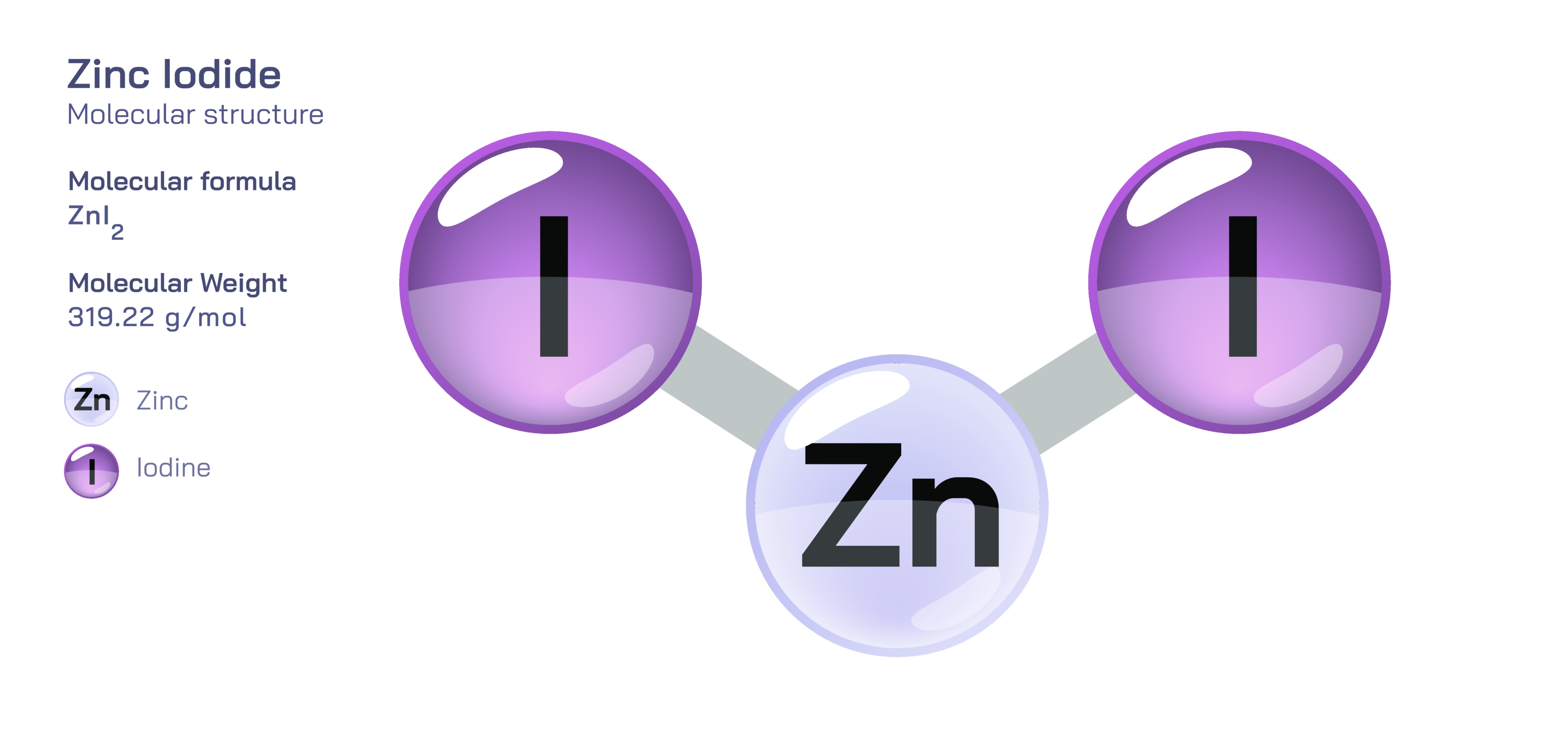
Scientific illustrations of zinc iodide often depict its tetrahedral ZnI₄ units, showing zinc at the center coordinated by four iodine atoms. These tetrahedra link into extended structures, visually highlighting the partial covalent character that distinguishes ZnI₂ from other zinc halides. Diagrams may also illustrate the dissociation of zinc iodide into ions in solution, along with the formation of complex ions such as ZnI₄²⁻. In industrial or laboratory contexts, illustrations often show how zinc iodide is used in density gradient columns, where suspended particles position themselves according to density. Imaging-related diagrams may depict how iodide’s high atomic number contributes to X-ray contrast enhancement. These visual representations help clarify how zinc iodide’s unique structural and chemical characteristics enable its many applications, linking microscopic behavior to practical functions.