Ammonia — Structure, Properties, and Industrial Applications
Fundamental Identity and Structural Characteristics of Ammonia
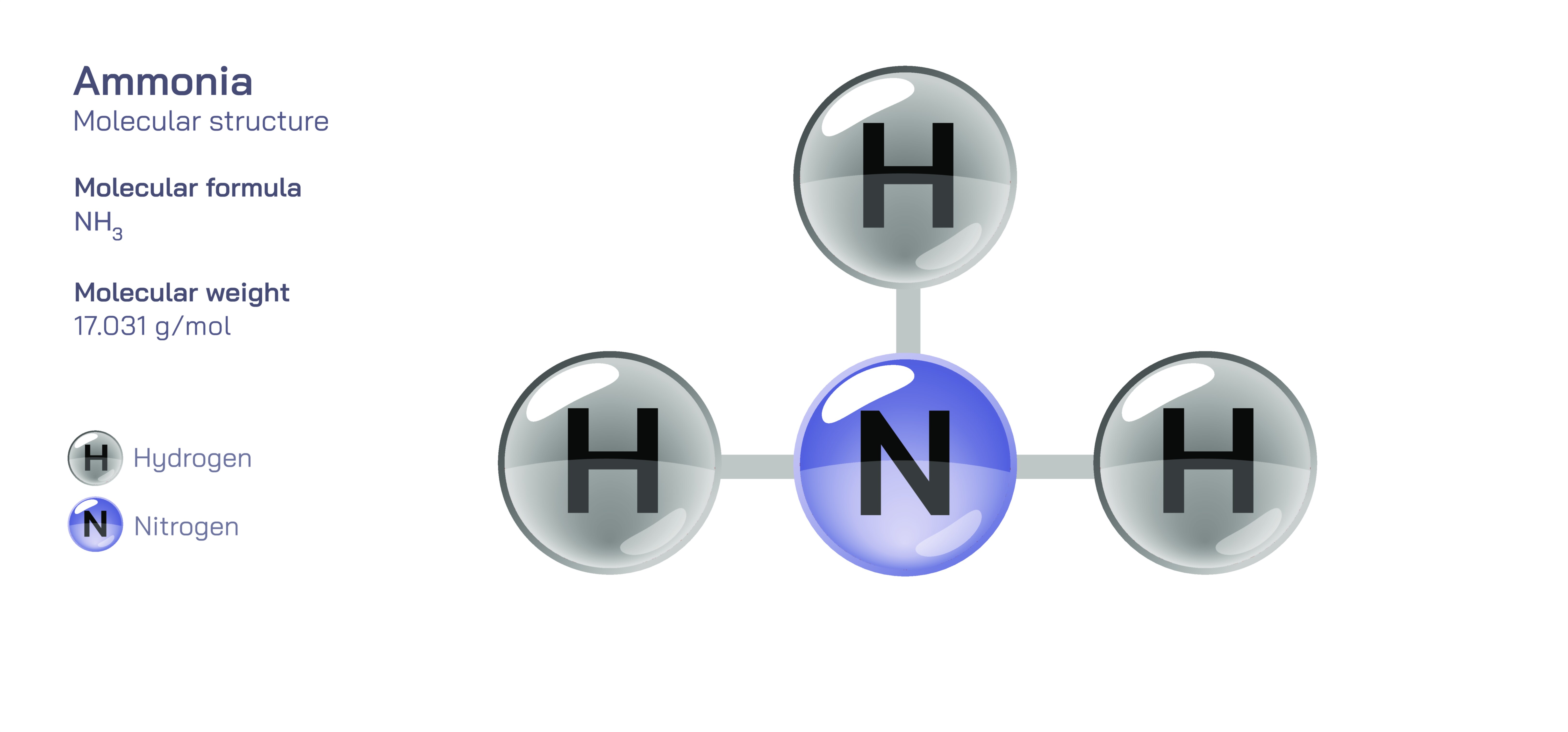
Ammonia, represented by the chemical formula NH₃, is one of the most essential and abundantly produced industrial chemicals in the world. It exists as a colorless gas with a sharp, pungent odor and possesses a simple yet highly influential molecular structure. At the center of the ammonia molecule lies a nitrogen atom bonded to three hydrogen atoms through covalent N–H bonds, forming a trigonal pyramidal geometry. This geometry emerges from the presence of a lone pair of electrons on the nitrogen atom, which pushes the three hydrogen atoms into a pyramid-like arrangement. The lone pair also contributes significantly to ammonia’s polarity, making the molecule capable of strong intermolecular hydrogen bonding and enabling it to dissolve readily in water. In aqueous solution, ammonia forms ammonium hydroxide (NH₄OH), a weak base that contributes to its chemical reactivity and industrial utility. This fundamental structure—simple yet remarkably reactive—allows ammonia to participate in acid–base reactions, coordinate with metal ions, and serve as a precursor to a vast range of nitrogen-containing compounds essential to life, agriculture, and industry.
Chemical Behavior, Basicity, and Reactive Potential
The reactivity of ammonia is largely defined by the lone electron pair on the nitrogen atom, which enables the molecule to act as a strong Lewis base. This lone pair allows ammonia to donate electrons readily, forming coordination complexes with transition metals and reacting with acids to produce ammonium salts such as ammonium chloride and ammonium sulfate. Ammonia dissolves exothermically in water, forming a weakly basic solution that partially ionizes into ammonium and hydroxide ions. This weak base behavior allows ammonia to neutralize strong acids while maintaining reversibility under controlled conditions. Under high pressure and temperature, ammonia undergoes oxidation reactions to produce nitric acid, nitric oxide, and various nitrogen oxides—key intermediates in fertilizer and explosive manufacturing. Ammonia also participates in reductive amination, nucleophilic substitution, and fuel-related reactions when used in combustion mixtures. Its versatility as both a reactant and base makes it integral across synthetic pathways, laboratory procedures, and manufacturing sectors.
717. Ammonia’s relatively low molecular weight, high enthalpy of vaporization, and zero ozone depletion potential have made it an environmentally favorable alternative to synthetic refrigerants. In nature, ammonia plays a vital role in the nitrogen cycle, produced through the decomposition of organic matter, excreted by living organisms, and transformed into nitrate and nitrite by soil bacteria. Despite its central biological role, gaseous ammonia can be hazardous at high concentrations, causing irritation to the eyes, lungs, and skin. However, its distinct odor and high water solubility enable early detection and rapid absorption into moisture-rich environments. These characteristics define ammonia’s presence in both natural ecological systems and human-designed industrial processes.
Role in Agriculture and Fertilizer Production
Ammonia’s most influential application is in agriculture, where it forms the foundation of global nitrogen-based fertilizer production. Through the Haber–Bosch process, atmospheric nitrogen reacts with hydrogen under high pressure and temperature to form synthetic ammonia—a breakthrough that revolutionized food production and remains essential to modern farming. Ammonia can be applied directly to soil as anhydrous ammonia or converted into various fertilizers such as urea, ammonium sulfate, ammonium nitrate, and diammonium phosphate. These fertilizers supply plants with nitrogen, a critical nutrient required for chlorophyll production, protein synthesis, and overall growth. Without synthetic ammonia, global agriculture would be unable to support the world’s population at present scales. In addition to direct fertilizer use, ammonia plays a major role in improving soil fertility, boosting crop yields, and sustaining food security across regions dependent on intensive farming.
Industrial and Chemical Manufacturing Applications
Beyond fertilizers, ammonia serves as a cornerstone in chemical synthesis and manufacturing. It is used to produce nitric acid via the Ostwald process, a key intermediate in explosives, dyes, and specialty chemicals. Ammonia is also essential in manufacturing synthetic fibers such as nylon and rayon, pharmaceuticals, cleaning agents, and resins. Its ability to form coordination complexes makes it valuable in metal treatment, extraction, and electroplating. In the petrochemical industry, ammonia helps neutralize acidic components and reduce sulfur emissions. It also acts as a reducing agent in selective catalytic reduction (SCR) systems used to minimize nitrogen oxide emissions from power plants and diesel engines. Ammonia’s stability at low temperatures and its capacity to absorb heat efficiently support its use in large-scale refrigeration systems found in cold storage warehouses, ice rinks, and food processing plants. These applications highlight ammonia’s role as a multifunctional industrial backbone supporting energy, manufacturing, transportation, and environmental technologies.
Environmental and Energy Sector Applications
As global industries shift toward sustainable energy alternatives, ammonia is gaining renewed attention as a potential carbon-free fuel and hydrogen carrier. Because ammonia contains no carbon, its combustion or catalytic decomposition does not produce carbon dioxide, making it a promising candidate for clean energy strategies. Ammonia can be cracked into nitrogen and hydrogen and transported internationally as a stable, energy-dense hydrogen carrier. Power plants and marine engines are beginning experimental trials using ammonia as a direct fuel source, aiming to reduce dependence on fossil fuels. Additionally, ammonia-based refrigeration contributes to greener cooling technologies due to its zero global warming potential. In environmental chemistry, ammonia is used in wastewater treatment to adjust pH and assist in biological nutrient removal. These emerging roles demonstrate how ammonia’s chemical flexibility continues to drive innovation toward sustainable, energy-efficient applications.
Illustrating the Structure and Applications of Ammonia
A vector illustration of ammonia often depicts the trigonal pyramidal geometry of the NH₃ molecule, showing nitrogen at the center with three hydrogen atoms forming a pyramid-like arrangement. Visuals may highlight the lone electron pair on nitrogen, emphasizing polarity and hydrogen-bonding capability. Additional diagrams often represent ammonia in industrial contexts, such as fertilizer production plants, refrigeration cycles, SCR emission control systems, or agricultural application fields. Biological illustrations may show ammonia within the nitrogen cycle, transitioning between soil, plants, and microbes. These visuals connect molecular structure with real-world functionality, demonstrating how a small, simple molecule shapes global agriculture, manufacturing, and emerging energy technologies.