Gold karats are used worldwide to describe the purity of gold and the proportion of pure gold present in a gold object. The karat system provides a standardized method to classify gold based on how much of the metal is actually gold and how much consists of other alloying metals. This system is essential in jewelry making, bullion trading, metallurgy, and consumer understanding, as gold’s properties change significantly depending on its purity level. From soft, highly pure 24K gold to harder, more durable 10K gold, each karat has distinct characteristics, uses, and advantages.
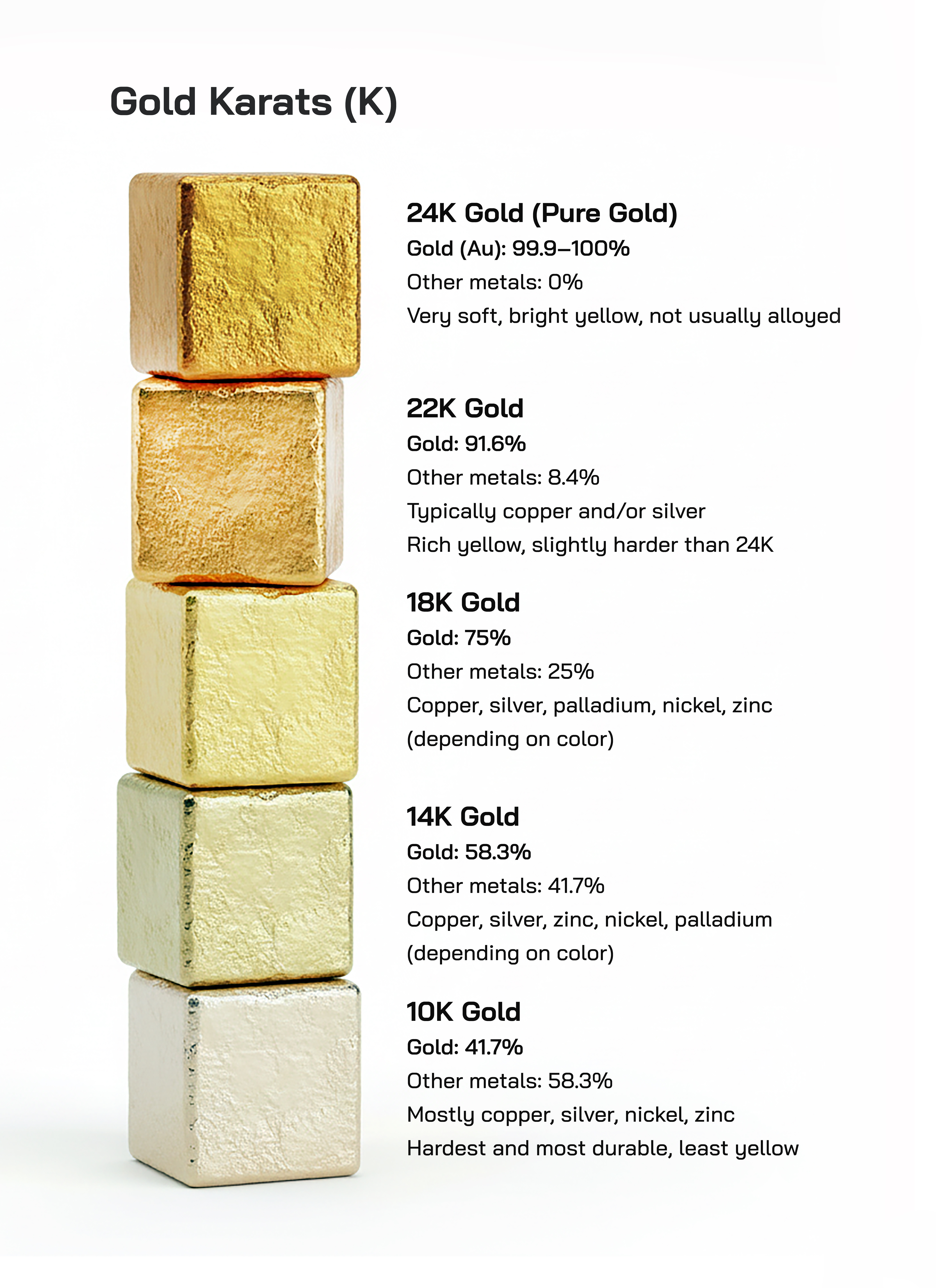
Pure gold is defined as 24 karat gold. This means that all 24 parts of the metal are gold, with purity ranging from about 99.9 percent to nearly 100 percent. Because of its extremely high purity, 24K gold has a bright, rich yellow color that is unmatched by lower karat gold. It is chemically stable, does not tarnish, and is highly resistant to corrosion. However, pure gold is also very soft and malleable. It can be easily scratched, bent, or deformed, which limits its suitability for items exposed to daily wear. As a result, 24K gold is most commonly used for gold bars, coins, ceremonial objects, and investment purposes rather than everyday jewelry.
22 karat gold contains approximately 91.6 percent gold, with the remaining portion made up of other metals, typically copper and silver. This small addition of alloying metals increases hardness while preserving much of gold’s natural color and luster. 22K gold retains a rich yellow appearance similar to pure gold but is slightly more durable. Because of this balance between purity and strength, 22K gold is widely used in traditional jewelry, especially in regions where high-purity gold ornaments are culturally significant. It is still relatively soft compared to lower karat gold and requires careful handling.
18 karat gold consists of 75 percent gold and 25 percent other metals. These alloying metals can include copper, silver, palladium, nickel, or zinc, depending on the desired color and properties. At this purity level, gold becomes significantly stronger and more resistant to wear while still maintaining a luxurious appearance. 18K gold is highly popular in fine jewelry because it offers an excellent balance between durability and high gold content. It is used in rings, necklaces, bracelets, and gemstone settings where both strength and beauty are essential. The ability to produce yellow, white, rose, and green gold at this karat level adds to its versatility.
14 karat gold contains approximately 58.3 percent gold and 41.7 percent alloy metals. The increased proportion of alloying elements makes 14K gold harder and more resistant to scratching and bending. While its color is slightly paler than higher karat gold, it remains attractive and suitable for a wide range of jewelry designs. 14K gold is especially popular for everyday jewelry because it combines durability, affordability, and aesthetic appeal. It is commonly used for engagement rings, wedding bands, bracelets, and earrings that are worn frequently.
10 karat gold has the lowest gold content commonly used in jewelry, containing about 41.7 percent gold and 58.3 percent other metals. This high alloy content makes 10K gold the hardest and most durable among standard gold jewelry grades. Its color is noticeably lighter and less yellow, reflecting the reduced gold proportion. While it lacks the richness of higher karat gold, 10K gold is highly resistant to wear and deformation, making it suitable for rugged or budget-conscious jewelry. In some regions, it represents the minimum karat legally classified as gold.
The reason gold is alloyed at lower karat levels lies in the physical nature of pure gold. Gold atoms are arranged in a way that allows layers to slide easily over one another, resulting in softness. Adding metals such as copper, silver, nickel, or palladium disrupts this structure, increasing hardness and strength. Each alloying metal also influences color, corrosion resistance, and skin compatibility. For example, copper adds strength and a reddish tone, while silver lightens color and improves workability.
Gold karats also influence practical use and maintenance. Higher karat gold is more resistant to chemical reactions and tarnish but is softer and more prone to mechanical damage. Lower karat gold is stronger and better suited for daily wear but may be more reactive due to alloy metals, requiring proper care. Understanding these trade-offs helps consumers choose the appropriate karat for specific purposes.
From an economic perspective, gold karats directly affect value. Higher karat gold contains more pure gold and therefore commands a higher price per gram. Investment gold typically favors higher purity, such as 24K, because it reflects intrinsic gold value. Jewelry pricing, however, also accounts for craftsmanship, design, and durability, which is why lower karat gold remains popular despite lower gold content.
Gold karats are also regulated and identified through hallmarking systems. Jewelry items are stamped with markings such as 24K, 22K, 18K, 14K, or 10K to indicate purity. These marks provide assurance to buyers and support transparency in the gold market. In some countries, purity is expressed in parts per thousand rather than karats, but the underlying concept remains the same.
In scientific and metallurgical contexts, the karat system illustrates how alloying alters material properties. Gold serves as a classic example of how purity affects hardness, color, conductivity, and usability. This makes gold karats an important educational topic in material science and applied metallurgy.
The concept of gold karats has evolved over centuries as human societies sought reliable ways to measure and standardize gold purity. Historically, early civilizations recognized that naturally occurring gold varied in hardness and color depending on impurities. Ancient goldsmiths learned through experience that mixing gold with other metals improved workability and durability. Over time, the need for a formal measurement system arose to protect trade, ensure fairness, and maintain consistent quality. The karat system gradually emerged as a proportional method based on parts of gold within an alloy, allowing artisans, traders, and consumers to communicate purity with clarity and confidence.
At the atomic level, variations in gold karats reflect changes in crystal lattice behavior. Pure gold atoms arrange themselves in a highly symmetrical structure that allows easy atomic movement under stress. This atomic mobility is responsible for gold’s softness and malleability. When alloying elements are introduced, atoms of different sizes and bonding strengths disrupt this lattice symmetry. This disruption creates internal resistance to deformation, increasing hardness and tensile strength. As karat value decreases, the density of lattice disruptions increases, resulting in progressively stronger but less ductile gold alloys.
Mechanical behavior under stress differs significantly across karat levels. High-karat gold exhibits excellent ductility but low yield strength, meaning it deforms easily under force. Lower-karat gold shows higher yield strength and greater resistance to permanent deformation. This distinction becomes especially important in jewelry engineering, where thin prongs, clasps, and hinges must withstand repeated stress cycles. Designers often select karat levels based not only on appearance or value but also on mechanical performance under real-world conditions.
Wear patterns also vary by karat. Higher-karat gold tends to wear by gradual smoothing, as material slowly displaces rather than fractures. Lower-karat gold, containing harder alloy metals, may resist wear longer but can develop micro-scratches due to differences in hardness between alloy components. Over extended periods, these microscopic wear mechanisms influence surface texture, polish retention, and maintenance requirements. This is why antique high-karat gold artifacts often retain smooth surfaces despite age, while lower-karat items may show sharper abrasion marks.
Cultural preferences have strongly shaped global karat standards. In regions where gold symbolizes wealth preservation and spiritual significance, higher karat gold is favored despite its softness. In contrast, societies emphasizing practicality and daily use tend to prefer lower karat gold for its durability. These cultural influences affect not only jewelry styles but also manufacturing techniques, retail standards, and consumer expectations. As a result, the same karat value may carry different social meanings depending on geographic and cultural context.
Industrial applications impose strict tolerances on gold karat composition. In electronics, even slight deviations in alloy composition can alter conductivity, bonding behavior, and corrosion resistance. Manufacturers specify precise karat formulations to ensure consistent performance across components. These industrial standards often exceed consumer jewelry requirements, highlighting how karat values serve both aesthetic and functional roles beyond ornamentation.
Gold recycling further illustrates the importance of karat classification. Recycled gold from mixed sources must be carefully analyzed and refined to restore precise purity levels. Karat identification allows refiners to determine processing methods, energy requirements, and economic yield. High-karat gold requires less intensive refining, while lower-karat alloys demand separation of multiple metals. This makes karat awareness essential in sustainable gold supply chains.
Authentication and fraud prevention also rely heavily on karat systems. Counterfeit gold items often attempt to mimic higher karat markings while containing significantly less gold. Advanced testing methods such as X-ray fluorescence analysis and ultrasonic density measurement verify karat authenticity without damaging the object. These technologies have become increasingly important as global gold markets expand and counterfeit risks grow.
From a regulatory standpoint, karat labeling laws protect consumers and maintain market integrity. Many countries impose strict penalties for misrepresentation of gold purity. Hallmarking authorities conduct routine inspections to ensure compliance with declared karat values. These regulations reinforce trust in gold markets and enable international trade by establishing universally recognized purity standards.
In emerging technologies, gold karats are being re-evaluated for specialized applications. Nanotechnology research explores gold alloys with tailored karat compositions to achieve specific electrical, optical, and catalytic properties. These innovations demonstrate that karat values are not merely traditional classifications but dynamic tools for material optimization in advanced science and engineering.
The future of gold karats may involve greater customization rather than standardized categories. As manufacturing techniques become more precise, alloys with unconventional compositions may be developed to meet specific performance criteria. While traditional karat values will remain essential for commerce and cultural continuity, new classifications may emerge in technical fields where performance outweighs convention.
Ultimately, gold karats represent more than numerical purity measurements. They embody the intersection of chemistry, physics, economics, culture, and craftsmanship. Each karat level reflects a deliberate balance between beauty, strength, value, and function. Understanding gold karats in this broader context reveals why gold continues to adapt to human needs while retaining its timeless significance.
Gold karat levels strongly influence how the metal behaves under long-term thermal exposure. When gold alloys are repeatedly exposed to temperature fluctuations, such as during soldering, casting, or environmental heating, internal stresses develop differently depending on karat composition. High-karat gold, with its greater atomic uniformity, expands and contracts more evenly, reducing internal stress buildup. Lower-karat gold, containing multiple alloying metals with differing thermal expansion rates, can experience microscopic stress concentrations over time. These stresses may not cause immediate damage but can influence long-term dimensional stability, particularly in precision-crafted jewelry or technical components.
Fatigue resistance is another area where gold karats behave differently. Fatigue refers to gradual material weakening caused by repeated low-level stress rather than sudden force. In jewelry such as chains, clasps, and flexible links, fatigue resistance is critical. Higher-karat gold tends to bend repeatedly without cracking because of its ductility, whereas lower-karat gold resists bending initially but may develop micro-fractures at stress points after prolonged use. This explains why some antique high-karat gold chains survive centuries of use, while lower-karat items may fail sooner under constant mechanical cycling.
Microstructural aging is a subtle but important phenomenon in gold alloys. Over long periods, especially under mild heat or stress, alloy atoms can slowly rearrange themselves within the gold matrix. In lower-karat gold, this process can lead to slight hardening or embrittlement as alloy clusters form. Higher-karat gold remains more structurally stable over time due to the dominance of gold atoms. This stability contributes to the longevity of high-karat artifacts and explains why museums often find ancient gold objects remarkably intact despite their age.
From an investment perspective, karat levels influence liquidity rather than just intrinsic value. While higher-karat gold contains more gold per gram, it is not always the most liquid form in local markets. Some regions have stronger demand for specific karat standards, which affects resale speed and transaction costs. For example, jewelry made in culturally preferred karats often sells faster locally, even if its gold content is slightly lower than purer alternatives. This demonstrates that karat value interacts with social trust and market familiarity, not just metal content.
Sensory perception also varies with karat. Experienced jewelers and collectors can often distinguish gold karats by touch alone. Higher-karat gold feels warmer and smoother due to its density and surface behavior. Lower-karat gold feels slightly cooler and harder. This tactile difference is subtle but real and results from how heat transfers through the alloy and how surface atoms respond to pressure. Such sensory cues have historically helped artisans assess purity even before modern testing methods existed.
Allergy science provides another dimension to gold karat selection. Pure gold is biologically inert and rarely causes skin reactions. As karat decreases, the likelihood of allergic response increases due to the presence of reactive metals such as nickel or certain copper compounds. This is why some individuals tolerate high-karat gold perfectly but experience irritation from lower-karat jewelry. Modern alloy engineering attempts to reduce allergenic elements while maintaining strength, highlighting the ongoing evolution of karat-based formulations.
Manufacturing losses differ significantly across karats. During casting, polishing, and finishing, gold loss occurs due to filing dust, surface abrasion, and trimming. Higher-karat gold is easier to recycle during manufacturing because its composition remains consistent. Lower-karat gold produces mixed-metal waste that requires more complex recovery processes. This affects production efficiency and cost, particularly in large-scale manufacturing operations.
Repair behavior is also karat-dependent. High-karat gold responds well to soldering and reshaping because it flows smoothly under heat and integrates easily with repair alloys. Lower-karat gold requires precise temperature control to prevent discoloration, cracking, or alloy separation. This is why jewelers often prefer working with higher-karat gold for intricate or heirloom pieces that may need future restoration.
Long-term value stability differs across karat levels as well. While all gold responds to market price changes, higher-karat gold tracks global gold prices more directly because its value is less diluted by non-gold metals. Lower-karat gold is influenced more heavily by labor, design, and alloy metal prices. This means that during periods of market volatility, high-karat gold tends to retain value more predictably, whereas lower-karat gold may fluctuate based on broader material and fashion trends.
Psychologically, gold karats influence perception of ownership and legacy. Higher-karat gold is often associated with permanence and inheritance, while lower-karat gold is viewed as practical and functional. These perceptions influence purchasing decisions and emotional attachment, particularly in ceremonial or generational contexts. The karat system thus shapes not only physical properties but also human relationships with gold.
In advanced material research, gold karats serve as a model for studying alloy behavior. Scientists use gold alloys to understand how atomic substitution affects conductivity, corrosion resistance, and mechanical strength. This research has applications far beyond jewelry, influencing electronics, medical devices, and nanotechnology. Gold’s predictable response to alloying makes karat variation an ideal teaching and research tool in materials science.
In summary, gold karats represent a standardized scale used to describe the purity and composition of gold. 24K gold is pure, soft, and ideal for investment, while 22K offers high purity with slightly improved strength. 18K gold balances luxury and durability, making it popular for fine jewelry. 14K gold provides excellent wear resistance for daily use, and 10K gold offers maximum durability with reduced gold content. Understanding gold karats helps in making informed decisions about jewelry, investment, and material applications, highlighting the versatility and enduring value of gold as a precious metal. Gold karats represent a spectrum of engineered compromises. Each karat level reflects a deliberate balance between purity, performance, durability, cultural preference, and economic practicality. Rather than ranking karats as better or worse, modern understanding recognizes them as specialized solutions tailored to different human needs. This adaptability is one of the reasons gold has remained relevant across civilizations, technologies, and eras.