Bitumen is one of the most essential binding materials used in road construction and infrastructure development. It is a viscous, black, semi-solid hydrocarbon material obtained as a residue during the refining of crude petroleum. The primary role of bitumen in pavement construction is to act as a binder that holds aggregates together, forming a durable and flexible road surface capable of withstanding traffic loads and environmental stresses. Because roads are built in diverse climates and are subjected to varying traffic intensities, bitumen cannot be used in a single uniform form. To ensure performance, durability, and safety, bitumen is classified into different grades based on specific physical and rheological properties. These classifications help engineers select the most suitable bitumen for a given application.
Bitumen grades are mainly classified based on penetration value, viscosity, temperature performance, method of application, and material modification. Different countries adopt different classification systems depending on climatic conditions, traffic patterns, and construction practices. Understanding these grading systems is essential for proper pavement design and long-term road performance.
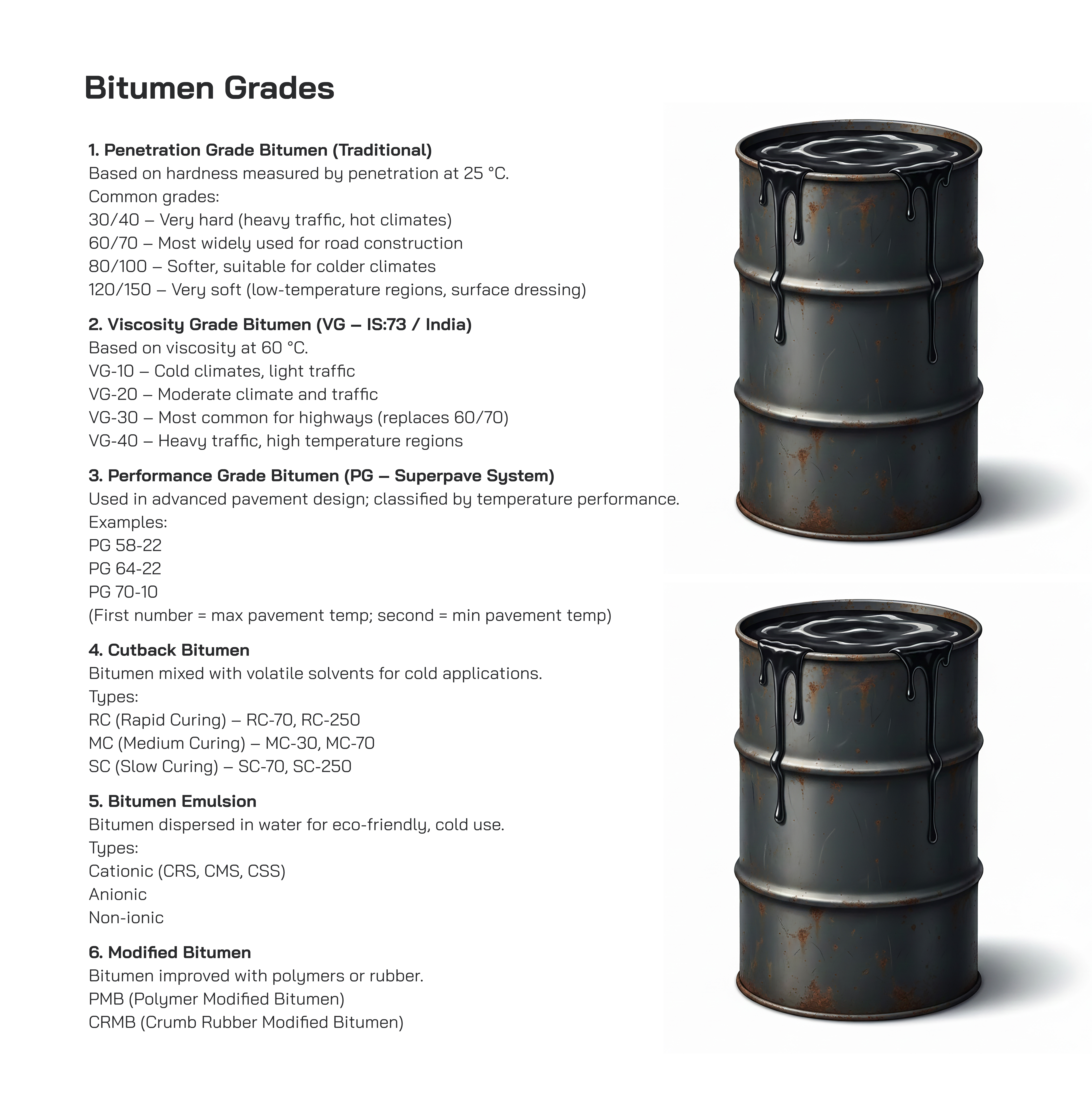
The traditional method of grading bitumen is the penetration grading system. This system classifies bitumen based on its hardness or softness, which is measured by the depth a standard needle penetrates the bitumen sample under controlled conditions at a temperature of 25 degrees Celsius. The penetration value indicates the consistency of bitumen; lower values represent harder bitumen, while higher values indicate softer bitumen. Penetration grade bitumen has been widely used for decades in road construction.
Penetration grade 30/40 is a very hard grade of bitumen. It is mainly used in areas with heavy traffic loads and high ambient temperatures. Due to its hardness, it resists deformation and rutting under heavy vehicles, making it suitable for highways and industrial roads. Penetration grade 60/70 is the most commonly used grade for general road construction. It offers a balanced combination of strength and flexibility, making it ideal for moderate to heavy traffic conditions in tropical and subtropical climates. Penetration grade 80/100 is softer and more flexible, making it suitable for regions with colder climates where bitumen needs to accommodate thermal contraction. Penetration grade 120/150 is very soft and is mainly used in low-temperature regions or for surface dressing works where flexibility is more important than load-bearing capacity.
While penetration grading provides useful information about bitumen consistency, it does not fully represent how bitumen behaves under actual pavement temperatures. To overcome this limitation, viscosity grading was introduced. Viscosity Grade (VG) bitumen classification is based on the viscosity of bitumen measured at 60 degrees Celsius, which closely represents the temperature of bitumen in service conditions. This system is widely adopted in India under IS:73 standards and provides a more realistic assessment of bitumen performance.
70. It offers excellent resistance to rutting and deformation under heavy traffic and high temperatures. VG-40 is a high-viscosity grade used in areas with extremely high temperatures and heavy traffic loads, such as expressways, intersections, and industrial zones.
22. The first number indicates the maximum pavement temperature in degrees Celsius at which the bitumen can perform without excessive deformation. The second number indicates the minimum pavement temperature at which the bitumen can resist cracking.
PG 58-22 is suitable for moderate climates, PG 64-22 is commonly used for highways in warmer regions, and PG 70-10 is designed for very high-temperature conditions with heavy traffic loads. The PG system allows engineers to design pavements with greater reliability, improved resistance to rutting and cracking, and longer service life. It is widely used in developed countries for high-performance road construction.
Cutback bitumen is another important classification used mainly for cold weather or cold application conditions. Cutback bitumen is produced by dissolving bitumen in volatile solvents such as kerosene or naphtha to reduce its viscosity. This makes it easier to apply at lower temperatures without heating. Cutback bitumen is classified based on the rate at which the solvent evaporates.
Rapid Curing (RC) cutback bitumen loses solvent quickly and is used for surface dressing and patching works. Medium Curing (MC) cutback bitumen evaporates more slowly and is suitable for premix applications. Slow Curing (SC) cutback bitumen has the slowest evaporation rate and is used for prime coats and dust control. Due to environmental concerns associated with solvent evaporation, the use of cutback bitumen is gradually being reduced.
Bitumen emulsion is an environmentally friendly alternative to cutback bitumen. It consists of fine droplets of bitumen dispersed in water with the help of emulsifying agents. Because water is used instead of volatile solvents, bitumen emulsions can be applied at ambient temperatures with minimal environmental impact. Bitumen emulsions are widely used for road maintenance, surface dressing, and cold mix applications.
Bitumen emulsions are classified into cationic, anionic, and non-ionic types based on the electrical charge of the bitumen particles. Cationic emulsions are the most commonly used in road construction because they bond well with aggregates. They are further classified into rapid setting, medium setting, and slow setting types depending on their breaking characteristics. Emulsions are especially useful in remote areas, rainy conditions, and low-traffic roads.
Modified bitumen represents the most advanced category of bitumen grades. In this type, bitumen is modified by adding polymers, rubber, or other additives to improve its properties. Polymer Modified Bitumen (PMB) enhances elasticity, temperature resistance, and fatigue life, making it ideal for high-speed highways and heavy traffic conditions. Crumb Rubber Modified Bitumen (CRMB) uses recycled rubber from waste tires, improving flexibility and resistance to cracking while also addressing environmental concerns.
Modified bitumen significantly improves pavement performance by reducing rutting at high temperatures and cracking at low temperatures. It also increases resistance to aging and moisture damage, extending pavement life and reducing maintenance costs. These benefits make modified bitumen increasingly popular in modern road construction projects.
Bitumen grading systems exist to ensure that road pavements perform reliably under diverse climatic conditions, traffic loads, and service environments. While basic classifications such as penetration grade, viscosity grade, and performance grade identify bitumen consistency and temperature suitability, the real-world behavior of bitumen is far more complex. Modern pavement engineering considers not only laboratory test values but also how bitumen responds to stress, aging, moisture, and repeated traffic loading over time. These additional considerations have expanded the understanding and application of bitumen grades beyond traditional definitions.
One of the most important characteristics of bitumen, beyond its grade classification, is temperature susceptibility. Bitumen is a thermoplastic material, meaning it softens at high temperatures and stiffens at low temperatures. In hot climates, excessively soft bitumen can lead to rutting, where wheel paths deform permanently under traffic loads. In cold climates, overly stiff bitumen can crack due to thermal contraction. Bitumen grading systems aim to balance this temperature sensitivity so that pavements remain stable across seasonal variations. Performance Grade (PG) bitumen was developed specifically to address this challenge by directly linking binder performance to pavement temperatures rather than laboratory conditions alone.
Another critical factor in bitumen performance is aging. Bitumen properties change with time due to oxidation and loss of lighter components. Aging occurs during mixing and construction, known as short-term aging, and continues throughout the pavement’s service life, known as long-term aging. As bitumen ages, it becomes harder and more brittle, increasing the risk of cracking. Advanced grading and testing methods evaluate bitumen resistance to aging to ensure long-term pavement durability. Modified bitumen grades are particularly effective in slowing aging effects due to the presence of polymers or rubber additives.
Traffic loading also plays a major role in determining suitable bitumen grades. Roads carrying heavy trucks and high axle loads experience greater stresses than low-volume roads. Under repeated loading, bitumen must resist permanent deformation while maintaining flexibility. High-viscosity grades and modified binders are often selected for highways, expressways, intersections, and urban roads with frequent stopping and starting. These binders improve rutting resistance and fatigue life, reducing the frequency of maintenance and rehabilitation.
Bitumen behavior is also influenced by the type of asphalt mixture in which it is used. Dense-graded mixes, open-graded mixes, and stone matrix asphalt place different demands on the binder. In stone matrix asphalt, for example, bitumen must hold a stone-on-stone skeleton together while resisting drain-down at high temperatures. Modified bitumen grades are commonly used in such applications to ensure stability and durability. Thus, binder selection is closely linked to mixture design, not just climate or traffic.
Moisture damage is another important consideration in bitumen selection. When water penetrates a pavement, it can weaken the bond between bitumen and aggregates, leading to stripping and loss of structural integrity. Certain bitumen grades and additives improve adhesion between binder and aggregate, reducing moisture-related damage. Cationic bitumen emulsions, for example, are preferred because they bond well with aggregates even in damp conditions. Anti-stripping agents and polymer-modified binders further enhance moisture resistance.
Sustainability has become a major focus in modern road construction, influencing how bitumen grades are selected and used. The incorporation of reclaimed asphalt pavement allows old bitumen to be reused, reducing demand for new materials. However, reclaimed bitumen is often aged and stiff, which requires careful selection of fresh binder grades to restore flexibility. Softer or modified binders are commonly used to balance the properties of reclaimed materials. This approach supports environmentally responsible construction while maintaining pavement performance.
Energy efficiency and construction practices also affect bitumen grade choice. Traditional hot mix asphalt requires high temperatures, which consume energy and generate emissions. To address this, warm mix asphalt technologies have been developed, allowing bitumen to be mixed and laid at lower temperatures. Certain bitumen grades and additives are specifically designed to support warm mix applications, improving workability without compromising performance. This advancement demonstrates how bitumen grading continues to evolve alongside construction technology.
Bitumen emulsions and cutback bitumen play a unique role in maintenance and rural road construction. While emulsions are valued for their environmental benefits and ease of application, their performance depends heavily on correct grade selection and curing conditions. Engineers must consider breaking time, setting behavior, and compatibility with aggregates to ensure successful application. The choice between rapid, medium, or slow setting emulsions influences construction speed and pavement quality.
In regions with extreme climatic conditions, specialized bitumen grades are often required. High-altitude areas with large temperature variations demand binders that can handle both heat during the day and cold at night. Similarly, desert regions require bitumen that resists oxidation and hardening under prolonged heat exposure. Performance-based grading systems provide the flexibility needed to address such challenging environments.
Economic factors also influence bitumen grade selection. While advanced and modified binders have higher initial costs, they often reduce life-cycle costs by extending pavement life and lowering maintenance requirements. Engineers increasingly adopt life-cycle cost analysis to justify the use of higher-quality binders for long-term savings and improved road performance.
Beyond conventional descriptions of penetration, viscosity, and performance grading, bitumen is increasingly understood as a highly complex, engineered material whose behavior is governed by its internal structure, interaction with aggregates, and response to real-world stresses. Modern pavement science treats bitumen not simply as a binder but as a viscoelastic material whose properties continuously evolve throughout its service life. This deeper understanding has led to more refined grading philosophies, improved testing methods, and innovative applications aimed at extending pavement life and improving sustainability.
At the microscopic level, bitumen is composed of four major fractions known as saturates, aromatics, resins, and asphaltenes. The balance between these fractions determines the stiffness, elasticity, and temperature susceptibility of the binder. Harder grades generally contain higher proportions of asphaltenes, while softer grades are richer in aromatics and resins. As bitumen ages, chemical reactions such as oxidation alter this balance, increasing asphaltene content and making the binder stiffer and more brittle. This microstructural evolution explains why two bitumen samples with the same initial grade may perform differently after years of service.
Rheology, the study of material flow and deformation, has become central to modern bitumen classification. Traditional grading methods focus on single-point tests, but real pavements experience a wide range of loading times and temperatures. Under slow-moving or stationary traffic, bitumen must resist long-term deformation, while under fast-moving vehicles it must recover quickly from short-term loads. Performance-based grading systems incorporate rheological measurements to assess how bitumen behaves across these conditions. This approach better reflects field performance and reduces the risk of premature pavement distress.
Field performance has shown that climate plays a decisive role in bitumen selection. In hot regions, pavements are prone to rutting and bleeding if the binder is too soft. In cold regions, thermal cracking dominates if the binder is too stiff. Regions with large daily or seasonal temperature variations require binders that can adapt to both extremes. This has driven the adoption of region-specific performance grades and the development of climate zoning maps that guide binder selection. Such climate-adapted grading ensures that pavements are designed for local conditions rather than relying on generalized standards.
Traffic characteristics further complicate binder selection. High-speed highways, urban intersections, bus lanes, and industrial roads each impose different stresses on the pavement. Stop-and-go traffic generates high shear stresses that demand binders with superior elastic recovery. Heavy axle loads accelerate fatigue damage, requiring binders with enhanced resistance to cracking. Modified bitumen grades have proven particularly effective in these situations, as polymer networks within the binder improve elasticity and load distribution under repeated stress.
Testing methods for bitumen have evolved significantly to support these advanced requirements. Modern laboratory tests simulate short-term and long-term aging to predict how binders will perform over time. Other tests evaluate resistance to rutting, fatigue, and low-temperature cracking under controlled conditions. These tests provide a more comprehensive performance profile than traditional grading methods. As testing technology advances, grading systems continue to shift toward performance prediction rather than simple classification.
Construction practices also influence how different bitumen grades perform in the field. Mixing temperature, compaction quality, and construction timing all affect binder behavior. Excessive heating during mixing can accelerate aging, while inadequate compaction can leave voids that allow air and water to penetrate the pavement. Certain grades are designed to improve workability at lower temperatures, supporting energy-efficient construction methods such as warm mix asphalt. These practices reduce fuel consumption, emissions, and construction costs while maintaining pavement quality.
The interaction between bitumen and aggregates is another critical factor often overlooked in basic descriptions. Different aggregates have varying surface textures and chemical properties, which influence adhesion with the binder. Poor adhesion can lead to stripping, where bitumen separates from aggregate in the presence of water. Advanced bitumen grades incorporate additives that enhance bonding and moisture resistance. This is especially important in regions with high rainfall or freeze–thaw cycles, where water damage is a major cause of pavement failure.
Sustainability considerations are reshaping how bitumen grades are developed and applied. The use of reclaimed asphalt pavement introduces aged binder into new mixes, altering overall binder properties. Engineers must carefully select fresh binder grades to restore flexibility and ensure balanced performance. Softer or modified binders are often used to counteract the stiffness of reclaimed materials. This approach supports circular construction practices while maintaining pavement durability.
Environmental performance is also influencing binder innovation. Researchers are exploring bio-based modifiers and additives derived from renewable sources to reduce reliance on petroleum-based materials. These innovations aim to improve elasticity, aging resistance, and environmental compatibility without sacrificing performance. While still emerging, such developments indicate the future direction of bitumen grading toward greener and more sustainable solutions.
Economic analysis increasingly favors performance-oriented binder selection. Although advanced and modified grades may have higher initial costs, they often reduce maintenance frequency and extend pavement service life. Life-cycle cost analysis shows that investing in higher-quality binders can result in significant long-term savings by minimizing repairs, traffic disruptions, and reconstruction. This economic perspective reinforces the importance of selecting bitumen grades based on total performance rather than upfront cost alone.
Bitumen grades also play a crucial role in pavement maintenance and rehabilitation strategies. Surface treatments, overlays, and recycling operations require binders with specific properties to ensure compatibility with existing pavements. Rapid-setting emulsions, rejuvenators, and specialized binders allow engineers to restore pavement performance without full reconstruction. The availability of diverse bitumen grades enables targeted solutions for different types of pavement distress.
Looking ahead, digital technologies and data analytics are expected to further refine bitumen grading and selection. Sensors embedded in pavements can monitor temperature, strain, and moisture, providing real-time data on binder performance. This information can be used to validate grading systems, improve predictive models, and guide future material development. As infrastructure becomes smarter, bitumen grading will increasingly rely on field data and performance feedback.
In conclusion, bitumen grades are more than numerical classifications; they represent engineered solutions tailored to specific pavement conditions. Beyond penetration, viscosity, and performance grading, factors such as aging, traffic loading, moisture resistance, sustainability, mixture compatibility, and construction methods play a critical role in binder selection. Modern road engineering views bitumen as a performance-driven material whose behavior must be understood throughout the pavement life cycle. By selecting appropriate bitumen grades based on comprehensive performance considerations, engineers can build roads that are stronger, more durable, cost-effective, and environmentally responsible, ensuring reliable transportation infrastructure for future generations. Bitumen grading systems play a critical role in selecting the right binder for road construction. Penetration grade, viscosity grade, performance grade, cutback bitumen, bitumen emulsion, and modified bitumen each serve specific purposes depending on climate, traffic, and construction requirements. Proper selection of bitumen grade ensures road durability, safety, and cost-effectiveness. As road engineering continues to advance, the use of performance-based and modified bitumen grades is expected to increase, leading to stronger, longer-lasting, and more sustainable road infrastructure.
In summary, bitumen grades represent far more than simple laboratory classifications. They embody a deep understanding of material science, climate adaptation, traffic behavior, construction practices, and long-term performance. Beyond penetration, viscosity, and performance grading, modern pavement engineering considers microstructure, rheology, aging, sustainability, and life-cycle economics. These advanced perspectives ensure that bitumen continues to evolve as a high-performance engineering material, capable of meeting the growing demands of modern transportation infrastructure while balancing durability, cost, and environmental responsibility.