The refrigeration cycle process is a scientifically designed method used to remove heat from a specific space and maintain that space at a lower temperature than its surroundings. This process forms the foundation of refrigerators, air conditioners, deep freezers, cold storage facilities, and many industrial cooling systems. The refrigeration cycle does not generate cold directly; instead, it continuously transfers heat from one location to another using a circulating refrigerant and a series of mechanical and thermal stages. Understanding this process is essential for grasping how modern cooling technology functions in daily life.
At the center of the refrigeration cycle process is a working fluid known as a refrigerant. The refrigerant circulates through a closed system of components and repeatedly changes its pressure, temperature, and physical state. These controlled changes allow it to absorb heat from the area that needs cooling and release that heat into the surrounding environment. The refrigeration cycle operates continuously as long as power is supplied, ensuring stable and consistent cooling.
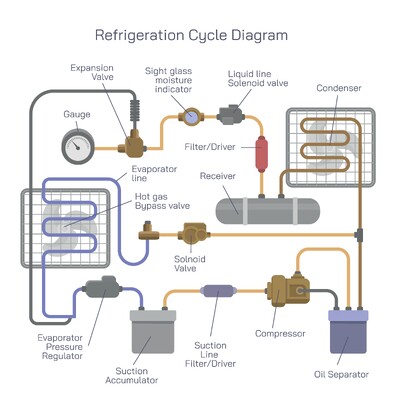
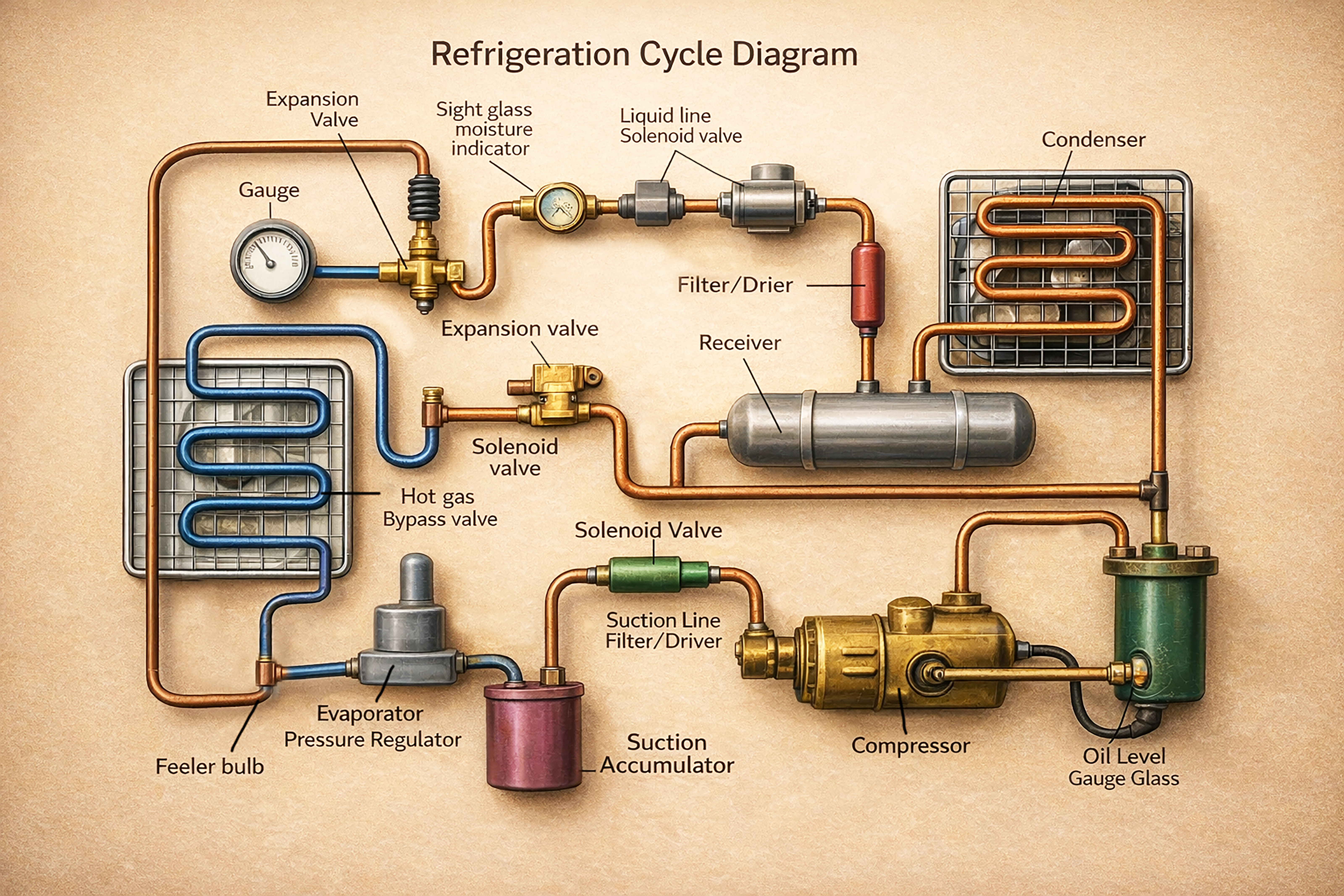
The process begins in the evaporator, which is the component responsible for absorbing heat. Inside the evaporator, the refrigerant enters as a low-pressure, low-temperature liquid. Warm air from the space to be cooled passes over the evaporator surface. Due to the temperature difference, heat energy flows from the warmer air into the colder refrigerant. As the refrigerant absorbs this heat, it undergoes a phase change and transforms from a liquid into a vapor. This heat absorption causes the surrounding air to lose thermal energy, resulting in a cooling effect within the space.
Once the refrigerant has absorbed heat in the evaporator, it moves through the suction line toward the compressor. The compressor is a vital component in the refrigeration cycle process because it maintains refrigerant circulation and prepares the vapor for heat release. When the low-pressure vapor enters the compressor, it is compressed into a smaller volume. This compression significantly increases the pressure and temperature of the refrigerant. Although no heat is removed during this stage, the refrigerant becomes hot enough to release heat effectively in the next stage of the cycle.
From the compressor, the high-pressure, high-temperature refrigerant vapor flows into the condenser. The condenser is usually located outside the cooled space and is designed to release heat into the environment. As air or water flows across the condenser surface, heat is transferred from the refrigerant to the surroundings. During this heat rejection process, the refrigerant changes its physical state from vapor back into liquid while remaining at high pressure. This phase change is essential because it allows the refrigerant to carry heat away from the cooled area efficiently.
After condensation, the refrigerant travels through the liquid line toward the expansion device. Along this path, it may pass through auxiliary components such as filter-driers and sight glasses, which help maintain system cleanliness and allow visual inspection of refrigerant condition. The refrigerant at this stage is a high-pressure liquid that still contains energy but is not yet ready to absorb heat again.
The expansion device plays a crucial role in the refrigeration cycle process. When the refrigerant passes through the expansion valve or capillary tube, it experiences a sudden drop in pressure. This pressure reduction causes a corresponding drop in temperature. As a result, the refrigerant becomes a low-pressure, low-temperature mixture of liquid and vapor. This cooling prepares the refrigerant to absorb heat once again when it re-enters the evaporator.
After expansion, the refrigerant flows back into the evaporator, where the cycle repeats. The refrigerant absorbs heat, changes phase, moves through the compressor, releases heat in the condenser, and undergoes pressure reduction before returning to the evaporator. This continuous loop ensures uninterrupted cooling as long as the system is operating correctly.
The refrigeration cycle process relies heavily on the principles of heat transfer and phase change. Heat naturally flows from warmer regions to cooler regions, and the refrigerant exploits this behavior by maintaining a lower temperature in the evaporator and a higher temperature in the condenser. By controlling pressure levels within the system, the refrigeration cycle ensures that the refrigerant boils and condenses at appropriate temperatures for effective heat exchange.
One of the most important aspects of the refrigeration cycle is that it conserves energy by relocating heat rather than destroying it. Electrical energy supplied to the compressor enables the system to move heat against its natural direction, from a cooler space to a warmer environment. This makes refrigeration systems far more efficient than methods that attempt to produce cold directly.
The refrigeration cycle process is adaptable and scalable. Small domestic refrigerators use the same fundamental process as large industrial chillers, differing mainly in size, capacity, and complexity. In air conditioning systems, the evaporator cools indoor air while the condenser rejects heat outdoors. In food preservation and medical storage, refrigeration cycles maintain low temperatures to prevent spoilage and degradation.
Understanding the refrigeration cycle process is also essential for system maintenance and troubleshooting. Any malfunction in one stage of the cycle affects the entire system’s performance. For example, insufficient refrigerant flow can reduce cooling efficiency, while compressor failure can stop the cycle entirely. Knowledge of the process helps technicians identify issues and restore proper operation.
In educational and engineering contexts, the refrigeration cycle serves as a practical application of thermal science and mechanical principles. It demonstrates how pressure control, phase transitions, and energy transfer can be harnessed to achieve useful outcomes. The process also highlights the importance of system design, material selection, and environmental considerations in modern cooling technology.
In conclusion, the refrigeration cycle process is a continuous and carefully controlled sequence of heat absorption, compression, heat rejection, and expansion. By circulating a refrigerant through the evaporator, compressor, condenser, and expansion device, the system efficiently removes heat from a desired space and releases it elsewhere. This process enables reliable cooling in homes, industries, transportation, and scientific applications, making the refrigeration cycle one of the most important technological achievements in modern engineering and daily life.