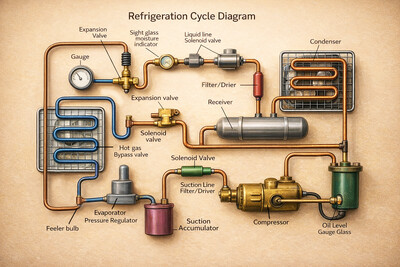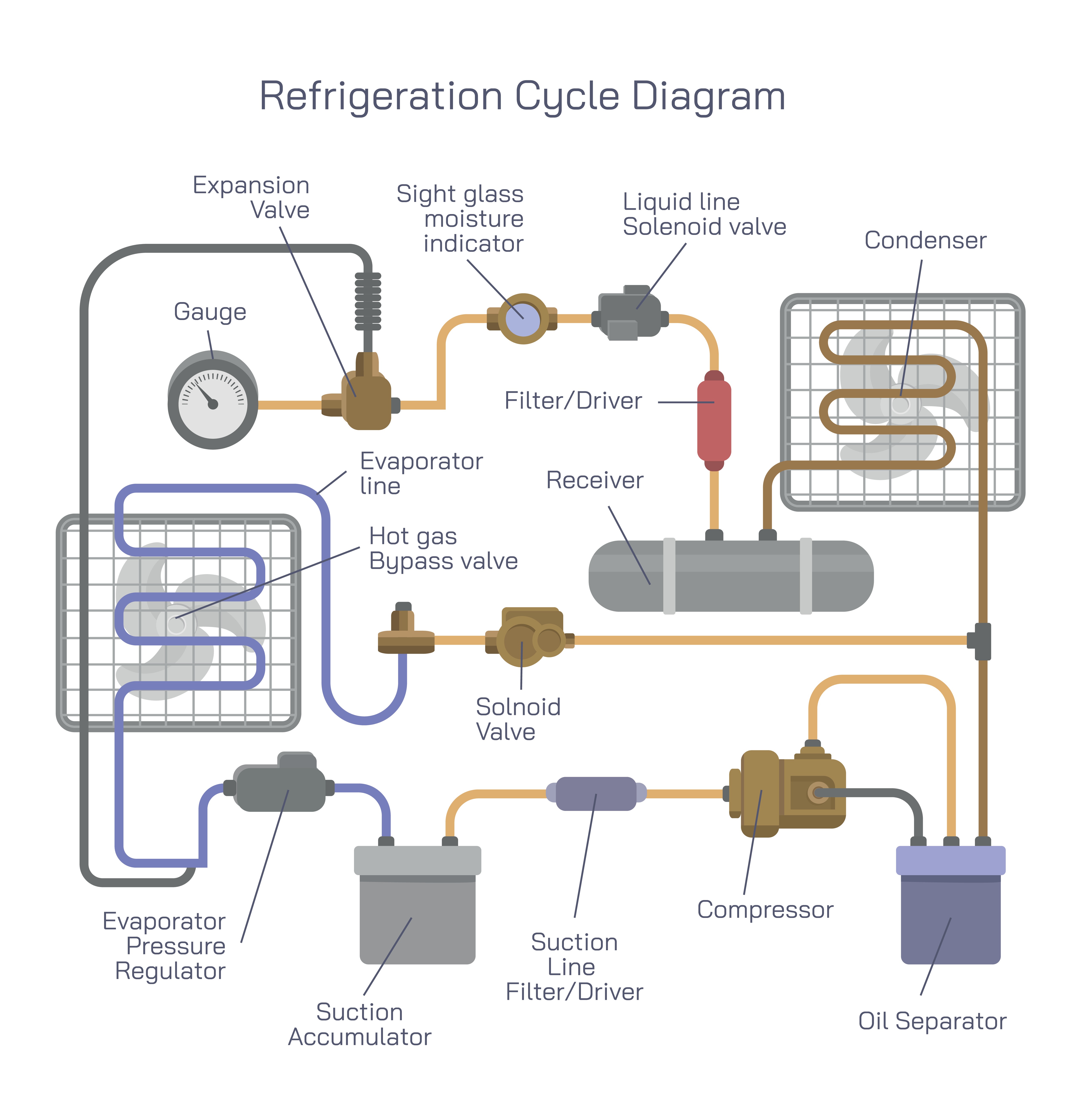
The refrigeration cycle is a fundamental process used to remove heat from a confined space and maintain it at a lower temperature than its surroundings. It forms the working basis of refrigerators, air conditioners, cold storage units, water coolers, and many industrial cooling systems. The refrigeration cycle diagram visually represents how different components of a cooling system interact to absorb heat from one area and reject it into another, thereby producing a continuous cooling effect. Understanding this diagram is essential for learning how artificial cooling is achieved in everyday life.
At the heart of the refrigeration cycle is a circulating substance known as a refrigerant. The refrigerant flows continuously through a closed loop of components, changing its physical state and pressure as it moves. These controlled changes allow the refrigerant to absorb heat from the area to be cooled and release that heat outside. The main components involved in this cycle are the compressor, condenser, expansion device, and evaporator, along with several auxiliary parts shown in the diagram that improve safety, efficiency, and control.
The cycle begins at the evaporator, which is the component responsible for absorbing heat from the surrounding space. Inside the evaporator, the refrigerant exists at low pressure and low temperature. As warm air from the space passes over the evaporator coils, heat is transferred from the air to the refrigerant. This heat causes the refrigerant to change its state from liquid to vapor. As a result, the air loses heat and becomes cooler, which is the desired cooling effect.
The low-pressure refrigerant vapor then moves from the evaporator to the compressor through the suction line. The compressor plays a critical role in the refrigeration cycle by compressing the refrigerant vapor. When the vapor is compressed, its pressure and temperature rise significantly. This process does not remove heat but prepares the refrigerant for heat rejection in the next stage. The compressor is often referred to as the heart of the refrigeration system because it maintains continuous refrigerant circulation.
From the compressor, the high-pressure, high-temperature refrigerant vapor flows into the condenser. The condenser is usually located outside the cooled space and is designed to release heat to the surrounding environment. As ambient air or water flows over the condenser coils, heat is transferred from the refrigerant to the surroundings. During this process, the refrigerant changes its state from vapor back into liquid while remaining at high pressure. This phase change is crucial because it allows the refrigerant to carry heat away from the cooled space.
After leaving the condenser, the refrigerant enters the liquid line and passes through components such as the filter-drier and sight glass, as shown in the diagram. The filter-drier removes moisture and impurities from the refrigerant, protecting the system from corrosion and blockages. The sight glass allows technicians to visually inspect the condition and flow of the refrigerant, ensuring proper system operation.
Next, the refrigerant reaches the expansion device, which may be an expansion valve or a capillary tube. The expansion device controls the flow of refrigerant into the evaporator and creates a sudden drop in pressure. As the pressure decreases, the temperature of the refrigerant also drops. This low-temperature refrigerant is now ready to absorb heat once again in the evaporator. The expansion device plays a vital role in maintaining proper cooling and system balance.
After passing through the expansion valve, the low-pressure refrigerant enters the evaporator, where the cycle repeats. The refrigerant absorbs heat, changes phase, and continues circulating through the system. This continuous loop ensures uninterrupted cooling as long as the system is operating.
The refrigeration cycle diagram also includes several supporting components that enhance performance and safety. The receiver stores excess liquid refrigerant and ensures a steady supply to the expansion device. The accumulator prevents liquid refrigerant from entering the compressor, which could cause damage. Oil separators remove lubricating oil from the refrigerant flow and return it to the compressor, ensuring smooth mechanical operation. Solenoid valves control refrigerant flow during start-stop operations, while pressure regulators maintain safe operating conditions.
One of the most important aspects of the refrigeration cycle is heat transfer. The system does not create cold directly; instead, it removes heat from one place and transfers it to another. The evaporator absorbs heat from the cooled space, and the condenser releases that heat into the environment. This controlled heat movement is what makes refrigeration possible.
The refrigeration cycle is widely used because it is efficient, reliable, and adaptable. Domestic refrigerators use the same basic cycle as large industrial chillers, differing mainly in size, capacity, and complexity. In air conditioning systems, the evaporator cools indoor air while the condenser releases heat outdoors. In cold storage facilities, refrigeration systems maintain low temperatures to preserve food, medicines, and biological materials.
Understanding the refrigeration cycle diagram helps students and technicians visualize how each component contributes to the cooling process. It also aids in troubleshooting, maintenance, and system design. Any malfunction in one component affects the entire cycle, emphasizing the importance of proper coordination among all parts.
In educational contexts, the refrigeration cycle is a key example of applied thermal science and mechanical engineering. It demonstrates how controlled pressure changes, phase changes, and heat transfer principles can be used to achieve practical outcomes. The diagram simplifies complex processes and makes them easier to understand, even for beginners.
In conclusion, the refrigeration cycle diagram illustrates a continuous cooling process based on refrigerant circulation through the evaporator, compressor, condenser, and expansion device. Each component performs a specific function that allows heat to be absorbed from a desired space and rejected elsewhere. By repeating this cycle continuously, refrigeration systems provide effective cooling for homes, industries, and commercial applications. The refrigeration cycle remains one of the most important and widely used cooling technologies in modern life.