Buys Ballot’s Law — Understanding the Relationship Between Wind and Atmospheric Pressure
The Foundational Concept Behind Buys Ballot’s Law
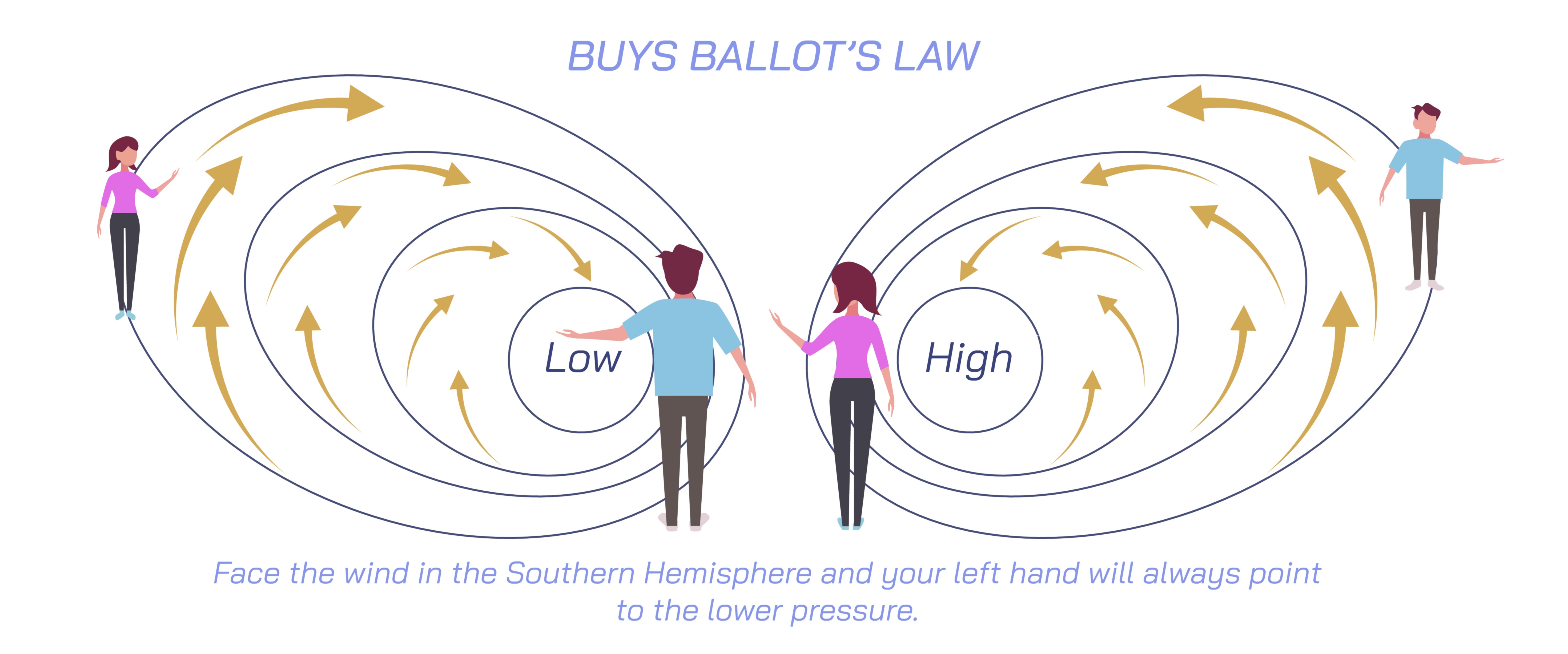
Buys Ballot’s Law describes a simple yet profound relationship between wind direction and atmospheric pressure, forming one of the core principles of meteorology. It states that in the Northern Hemisphere, if a person stands with their back to the wind, the lower pressure region lies to their left, while the higher pressure region lies to their right. In the Southern Hemisphere, this orientation is reversed, with lower pressure to the right and higher pressure to the left. This rule arises from the way air moves across Earth’s rotating surface and provides a practical method for identifying pressure systems without the need for instruments. Long before satellites, computer models, or Doppler radar existed, this principle helped sailors, meteorologists, and explorers understand the structure of weather systems simply by observing the wind. Today, Buys Ballot’s Law remains an essential part of atmospheric science because it reveals the elegant balance between pressure gradients, wind flow, and Earth’s rotation.
How Differences in Atmospheric Pressure Create Wind
Wind exists because the atmosphere is constantly trying to balance areas with different air pressures. When a region of the atmosphere becomes warm, moist, or less dense, its pressure drops. Nearby regions with colder or denser air maintain higher pressure. The atmosphere naturally seeks equilibrium, so air flows from the high-pressure region toward the low-pressure area. This movement of air forms wind, which becomes one of the most dynamic components of weather. But this flow is rarely a simple straight-line motion. As air begins to move, it is influenced by Earth’s rotation, friction with the surface, the curvature of continents, and the structure of pressure systems. Buys Ballot’s Law captures this combined effect by describing how winds orient themselves in relation to pressure systems, helping observers understand the broader pattern of atmospheric circulation.
The Influence of Earth’s Rotation on Wind Direction
A key reason Buys Ballot’s Law works is because of the Coriolis effect—a deflection of moving air caused by Earth’s rotation. As air travels across the surface, it is subtly pushed to one side. In the Northern Hemisphere, moving air veers to the right of its path, while in the Southern Hemisphere, it veers to the left. This deflection prevents winds from blowing directly from high-pressure to low-pressure areas. Instead, winds shift into a path that runs roughly parallel to the lines of atmospheric pressure. The result is a flow that curves around pressure centers rather than flowing straight across them. Buys Ballot’s Law encapsulates this deflection with a simple observation: by standing with the wind at your back, you can identify where the low-pressure system lies, because the wind is already aligned according to the atmospheric balance between pressure forces and Earth’s rotation.
Why Winds Circulate Around High and Low Pressure Systems
Wind behaves differently around high- and low-pressure systems because the forces acting on air vary depending on the direction of the pressure gradient. In a low-pressure system, air flows inward from surrounding regions but is deflected by the Coriolis effect, causing it to spiral around the center. In the Northern Hemisphere, this creates a counterclockwise rotation, while the Southern Hemisphere exhibits clockwise rotation. High-pressure systems behave in the opposite way. Air moves outward from the center of high pressure, but the Coriolis effect again creates a spiraling motion—clockwise in the Northern Hemisphere and counterclockwise in the Southern Hemisphere. Buys Ballot’s Law provides a simple way to visualize these circulations. In front of a low-pressure area, the wind orientation places the low-pressure region to your left in the Northern Hemisphere, revealing the direction in which the system is rotating and helping to predict incoming weather conditions.
Practical Importance for Weather Prediction and Observation
Before the rise of modern weather forecasting, Buys Ballot’s Law served as a crucial tool for mariners and travelers who needed to understand shifting weather patterns quickly. By evaluating wind direction without relying on instruments, they could estimate the position of approaching storms or high-pressure fair weather systems. Even today, the law is valuable for meteorologists, pilots, sailors, and emergency responders because it provides a rapid, intuitive sense of atmospheric dynamics. Understanding which direction a pressure system lies helps determine whether a region is likely to encounter rain, storms, clearing skies, or strong winds. Low-pressure systems usually signal unsettled conditions, while high-pressure systems bring stability and clearer weather. The law becomes especially useful when observing developing fronts or tracking the edges of cyclones and anticyclones.
Examples of Buys Ballot’s Law in Real-World Meteorological Phenomena
Buys Ballot’s Law is strongly reflected in the structure of major weather systems such as tropical cyclones, midlatitude storms, and expansive high-pressure ridges. In cyclones, the spiraling inward winds demonstrate a clear orientation relative to low pressure, making it possible to estimate the storm’s position by observing wind direction alone. In large high-pressure areas, winds spread outward while curving, forming broad, steady flows that often bring calm skies. This same principle applies to jet streams and regional wind belts, where pressure gradients extend across thousands of kilometers. Even local winds—from sea breezes to mountain airflow—can exhibit patterns that align with Buys Ballot’s Law. These natural examples illustrate the law’s universality and show how atmospheric motion is governed by consistent physical forces across all scales.
The Broader Significance of Pressure and Wind Alignment
Buys Ballot’s Law does more than describe a relationship between pressure and wind; it reveals the deeper structure of atmospheric balance. Wind exists not just as a movement of air but as a response to the invisible tug-of-war between pressure gradients, rotational forces, and surface friction. This balance shapes everything from local breezes to global circulation systems. Understanding how wind behaves relative to pressure helps scientists predict storms, identify weather fronts, and interpret large-scale climate patterns. In this sense, the law is both a practical tool and a window into the precise harmony of forces governing Earth’s atmosphere.
Why Buys Ballot’s Law Remains a Cornerstone of Meteorology
Despite its simplicity, Buys Ballot’s Law captures a foundational truth about how air moves around pressure systems. It highlights the predictable alignment between wind direction and atmospheric structure, offering a straightforward method for analyzing weather patterns without complex data or instruments. Its value lies in its universality, its clarity, and its deep connection to the physics of Earth’s rotation. Whether used by sailors centuries ago or by modern meteorologists interpreting surface observations, the law continues to guide understanding and decision-making. It stands as an elegant example of how a simple rule can reveal the hidden organization of one of nature’s most dynamic systems.