Land oil rigs, also known as onshore oil rigs, are large industrial structures designed to drill wells into the earth’s surface to access underground oil and natural gas reservoirs. These rigs form the backbone of onshore petroleum exploration and production and have been used for more than a century to meet global energy demands. Despite advancements in offshore and deepwater technologies, land oil rigs remain critically important due to their lower operational costs, easier accessibility, and wide applicability across diverse geological regions.
The primary function of a land oil rig is to create a deep, controlled borehole through layers of soil, rock, and sediment until hydrocarbon-bearing formations are reached. Once the well is drilled, the same site may be used for oil or gas production for many years. Land rigs are typically installed in oilfields located on continents, deserts, plains, forests, and even mountainous regions, depending on where underground reservoirs are identified.
Before drilling begins, extensive geological and geophysical surveys are conducted to determine the presence of hydrocarbons beneath the surface. These surveys analyze rock formations, structural traps, and pressure conditions to identify promising drilling locations. Once a site is selected, land preparation begins. The area is leveled, access roads are constructed, and supporting infrastructure such as water supply, power systems, and safety zones are established. Only after this preparation is complete is the rig transported and assembled on site.
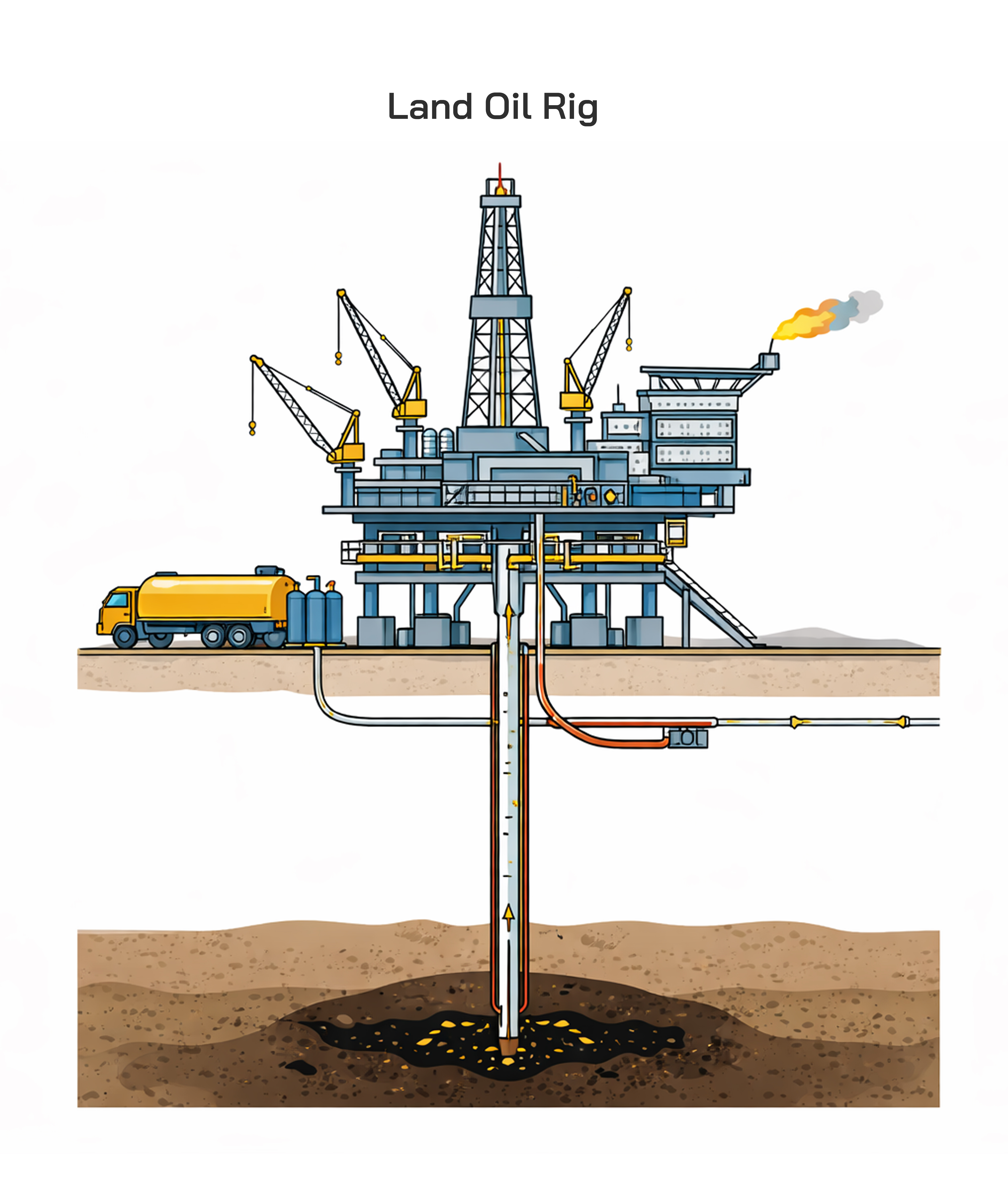
A typical land oil rig consists of several major structural and mechanical systems working together. The most visible part is the derrick, a tall steel framework that supports the hoisting system. The derrick allows drill pipes, casing, and heavy equipment to be raised and lowered into the well. Its height is essential for handling long sections of drill pipe efficiently during drilling operations.
The drilling process begins with the drill bit, which is attached to the bottom of a string of drill pipes. The bit is designed to cut through rock using rotation, weight, and pressure. Power is supplied by engines or generators that drive the rotary system, which turns the drill string. Modern land rigs often use top drive systems mounted at the top of the derrick to rotate the drill pipe, providing greater control and efficiency compared to older rotary table systems.
As the drill bit penetrates deeper into the earth, drilling fluid, commonly known as drilling mud, is continuously circulated through the system. This fluid is pumped down the drill pipe, exits through nozzles in the drill bit, and flows back to the surface through the space between the drill pipe and the borehole walls. Drilling mud serves several critical functions. It cools and lubricates the drill bit, carries rock cuttings to the surface, stabilizes the borehole, and helps control underground pressure. Proper mud circulation is essential for safe and effective drilling.
Pressure control is one of the most important aspects of land oil rig operation. Underground formations may contain high-pressure fluids that can rush into the wellbore if not properly managed. To prevent uncontrolled releases, known as blowouts, rigs are equipped with blowout preventers. These are heavy-duty safety devices installed at the wellhead that can seal the well in emergencies. Blowout preventers are a critical component in protecting workers, equipment, and the environment.
As drilling progresses, steel casing is installed inside the borehole at various depths. Casing provides structural support to the well, prevents collapse, and isolates different underground formations. After casing is placed, cement is pumped into the space between the casing and the borehole walls. This cementing process secures the casing in place and prevents fluid migration between layers. Proper casing and cementing are essential for long-term well integrity and environmental protection.
Once the target reservoir is reached and drilling is completed, the rig may transition into the production phase or be replaced by production equipment. In many cases, land rigs drill the well and then move on to another location, while smaller production systems such as pumping units are installed to extract oil or gas. These pumping systems lift hydrocarbons to the surface using mechanical motion or natural reservoir pressure, depending on the characteristics of the well.
Land oil rigs vary in size and complexity depending on drilling depth and geological conditions. Shallow drilling rigs are relatively compact and used for wells that do not extend deep into the earth. Deep drilling rigs, on the other hand, are massive structures capable of reaching several kilometers below the surface. These rigs are equipped with advanced control systems, monitoring equipment, and automation technologies to improve accuracy, safety, and efficiency.
One of the major advantages of land oil rigs is their adaptability. They can be transported, assembled, and dismantled more easily than offshore rigs, allowing operators to move between drilling sites efficiently. This mobility reduces costs and makes land drilling economically viable even for smaller oil fields. Additionally, onshore drilling allows easier access for maintenance, inspection, and emergency response.
Environmental and safety considerations are central to modern land oil rig operations. Regulations require strict control of emissions, waste disposal, and land restoration after drilling activities are completed. Many rigs now use closed-loop drilling fluid systems and advanced monitoring technologies to minimize environmental impact. After a well’s productive life ends, it is properly sealed and the land is rehabilitated to restore it as closely as possible to its original condition.
From an economic perspective, land oil rigs continue to play a crucial role in global energy supply. A significant portion of the world’s oil and natural gas production comes from onshore fields. These rigs support industries ranging from transportation and manufacturing to electricity generation and chemical production. Despite the growth of renewable energy, land-based oil extraction remains an important component of the global energy mix.
Beyond their basic structure and drilling function, land oil rigs are part of a much larger operational ecosystem that integrates engineering, logistics, environmental management, workforce coordination, and long-term field development strategies. A single onshore rig rarely operates in isolation; instead, it functions as one component within an entire oilfield system that may include multiple wells, shared processing facilities, pipelines, storage units, and monitoring stations. This integrated approach allows operators to maximize resource recovery while controlling costs and improving safety.
One important aspect not often highlighted is the role of land oil rigs in appraisal and field development drilling. After an initial discovery well confirms the presence of hydrocarbons, additional wells are drilled to understand the size, shape, and productivity of the reservoir. These appraisal wells help engineers model reservoir behavior, estimate recoverable reserves, and plan optimal well placement. Land rigs are frequently redeployed across the same field for this purpose, drilling wells at different angles and depths to gather geological and pressure data that guide long-term production strategy.
Directional and horizontal drilling have significantly expanded the capabilities of land oil rigs. Modern onshore rigs are no longer limited to drilling straight vertical wells. Using advanced downhole tools and real-time monitoring, rigs can drill wells that curve gradually or extend horizontally through the reservoir. This technique allows access to a larger area of the oil-bearing formation from a single surface location, reducing land disturbance and increasing production efficiency. Horizontal drilling is particularly valuable in tight reservoirs, shale formations, and layered sedimentary structures where oil and gas are distributed over wide areas.
Automation and digitalization have transformed how land oil rigs are operated. Many modern rigs are equipped with computerized control systems that monitor drilling parameters such as torque, weight on bit, penetration rate, and fluid pressure in real time. These systems help operators detect abnormal conditions early, reduce human error, and optimize drilling performance. Data collected during drilling is transmitted to remote operations centers, where engineers analyze trends and make informed decisions without being physically present at the rig site.
The human element remains essential despite increasing automation. Land oil rig crews consist of skilled professionals including drillers, tool pushers, engineers, geologists, safety officers, and maintenance technicians. Each role contributes to smooth and safe operations. Training and experience are critical, as onshore drilling environments can vary widely depending on geology, climate, and location. Extreme heat, cold, dust, or remote conditions require careful planning and specialized safety measures to protect personnel.
Logistics and supply chain management are another crucial dimension of land oil rig operations. Drilling requires a continuous supply of materials such as drill pipe, casing, cement, chemicals, fuel, and spare parts. Coordinating deliveries to remote or rugged locations demands detailed planning and reliable transportation networks. Any disruption in supply can delay drilling, increase costs, and affect project timelines. Efficient logistics are therefore as important as the mechanical performance of the rig itself.
Land oil rigs also play a key role in well intervention and workover operations. After a well has been producing for some time, production rates may decline due to pressure loss, blockage, or reservoir changes. Smaller land rigs or specialized workover rigs are used to re-enter existing wells to clean, repair, or modify downhole equipment. These interventions can restore or enhance production without drilling a completely new well, extending the economic life of onshore fields.
From a reservoir management perspective, land oil rigs support enhanced oil recovery techniques. In mature fields, additional wells may be drilled to inject water, gas, or other substances into the reservoir to maintain pressure and push remaining oil toward production wells. These injection wells are drilled and maintained using land rigs, making them essential tools in maximizing recovery from existing resources and reducing the need for new exploration.
Environmental monitoring around land oil rigs extends beyond drilling activities. Operators continuously assess soil quality, groundwater conditions, air emissions, and noise levels to ensure compliance with regulations. Long-term monitoring helps detect any unintended impacts early and allows corrective action before serious damage occurs. In many regions, land rig operations are subject to strict environmental audits and community oversight, reinforcing responsible resource development.
Decommissioning and site restoration are the final stages of the land oil rig lifecycle. When a well or field is no longer economically viable, the rig is removed, and the well is permanently sealed using multiple cement barriers. Surface equipment is dismantled, and the land is restored to meet regulatory and landowner requirements. In agricultural or residential areas, this may involve soil replacement, replanting vegetation, and long-term environmental monitoring. This end-of-life process ensures that land oil rig operations do not leave lasting negative impacts.
Economically, land oil rigs contribute to regional development by creating jobs, supporting local businesses, and generating government revenue through taxes and royalties. In many countries, onshore oil production plays a vital role in energy security and economic stability. Even as the global energy sector evolves, land oil rigs continue to adapt by improving efficiency, reducing emissions, and integrating cleaner technologies where possible.
Looking toward the future, land oil rigs are expected to coexist with renewable energy systems rather than disappear entirely. Advances in drilling efficiency, emissions control, and digital monitoring are helping reduce the environmental footprint of onshore operations. Some land drilling sites are already integrating renewable power sources such as solar or hybrid energy systems to support auxiliary equipment, demonstrating how traditional oil extraction can evolve within a changing energy landscape.
Land oil rigs also differ significantly in their design philosophy depending on the geological setting in which they operate. In sedimentary basins with relatively uniform rock layers, rigs are optimized for high drilling speeds and extended horizontal sections, whereas in structurally complex regions with faults or hard rock, rigs are reinforced for higher torque, slower penetration rates, and enhanced directional control. This adaptability allows onshore drilling to take place in a wide variety of terrains, from flat plains to rugged plateaus, without fundamentally changing the core rig concept.
Another important dimension of land oil rig operations is well planning and simulation before drilling ever begins. Engineers use advanced computer models to simulate drilling trajectories, pressure behavior, and rock responses. These simulations help determine optimal drilling parameters, casing points, and mud properties. By anticipating potential challenges such as stuck pipe, lost circulation, or abnormal pressures, operators can reduce downtime and avoid costly accidents. This predictive planning has become a cornerstone of modern onshore drilling efficiency.
Noise and vibration management are increasingly important aspects of land oil rig deployment, particularly in areas close to communities. Modern rigs incorporate sound-dampening enclosures, vibration isolation systems, and quieter power generation units to minimize disturbance. In some regions, drilling schedules are adjusted to limit nighttime operations. These measures help balance energy production with social responsibility and community acceptance.
Land oil rigs are also closely tied to advances in drilling bit technology. The evolution from simple roller cone bits to sophisticated polycrystalline diamond compact bits has dramatically improved drilling performance. These modern bits can cut through hard formations more efficiently and last longer, reducing the frequency of bit changes and associated downtime. Bit selection is now a highly specialized process, tailored to specific rock types and drilling objectives.
Water management represents another critical operational challenge. Onshore drilling requires significant volumes of water for drilling fluids, cementing, and sometimes hydraulic stimulation. In water-scarce regions, operators invest in recycling systems that treat and reuse drilling fluids, reducing freshwater consumption. Efficient water handling not only lowers environmental impact but also reduces operational costs and logistical complexity.
The interaction between land oil rigs and local infrastructure is an often-overlooked factor. Roads, power supply, communication networks, and emergency services all influence how efficiently a rig can operate. In remote areas, operators may need to construct temporary infrastructure or deploy mobile power and communication systems. These logistical efforts add to project complexity but also contribute to regional development by improving access and connectivity.
Land oil rigs also play a role in energy transition strategies through their involvement in non-traditional drilling activities. Some onshore rigs are now used to drill geothermal wells, carbon capture and storage injection wells, or subsurface monitoring wells. These applications leverage the same drilling expertise developed in oil and gas while supporting lower-carbon or transitional energy technologies. This diversification demonstrates how land drilling capabilities can be repurposed beyond conventional hydrocarbon extraction.
Maintenance and reliability engineering are central to land oil rig performance. Preventive maintenance programs track wear on critical components such as hoisting systems, rotary drives, pumps, and structural elements. Sensors and condition-monitoring tools detect early signs of fatigue or failure, allowing repairs to be scheduled before breakdowns occur. This proactive approach improves safety, reduces unplanned downtime, and extends equipment lifespan.
Regulatory compliance shapes nearly every aspect of land oil rig operations. Governments impose strict requirements on well design, emissions, waste handling, and worker safety. Compliance involves extensive documentation, inspections, and reporting. While regulatory frameworks vary by region, they collectively push operators toward safer, cleaner, and more transparent practices. For rig operators, navigating these regulations is as important as managing technical performance.
Climate and weather conditions also influence land oil rig design and operation. In cold regions, rigs are winterized with insulated systems, heated enclosures, and cold-resistant materials to prevent freezing and mechanical failure. In hot or arid environments, cooling systems, dust control measures, and heat-resistant components are prioritized. These adaptations ensure reliable operation across extreme climates.
From a financial perspective, land oil rigs are central to capital allocation decisions in the energy sector. Drilling costs, success rates, and expected production profiles influence investment strategies. Because onshore drilling generally involves lower capital risk than offshore projects, land rigs often serve as the first step in resource development, especially for independent operators or emerging producers.
Technological standardization has also shaped land oil rig deployment. Modular rig designs allow components to be transported and assembled efficiently, reducing setup time between wells. Standardized systems simplify training, maintenance, and spare parts management. This modular approach has increased drilling speed and reduced the overall footprint of onshore operations.
Cultural and social factors play a role in how land oil rigs are perceived and accepted. In regions where oil production has been established for generations, rigs are often viewed as symbols of economic opportunity. In newer areas, community engagement, transparency, and benefit-sharing are critical for gaining social license to operate. Operators increasingly invest in local employment, training, and infrastructure to build long-term relationships with surrounding communities.
Land oil rigs also contribute valuable subsurface data beyond immediate production goals. Information gathered during drilling enhances understanding of regional geology, groundwater systems, and subsurface stresses. This data can support future resource development, environmental studies, and even seismic risk assessment, extending the value of drilling activities beyond a single well.
In the long term, the evolution of land oil rigs reflects the broader evolution of the energy industry itself. While their fundamental purpose remains accessing subsurface resources, the methods, technologies, and responsibilities associated with land drilling continue to expand. Greater emphasis on efficiency, safety, environmental stewardship, and technological integration ensures that land oil rigs remain adaptable tools in a complex and changing global energy landscape.
Taken together, these additional dimensions reveal that land oil rigs are not merely mechanical structures but highly integrated systems shaped by engineering, economics, environment, regulation, and society. Their continued development and adaptation highlight their enduring importance in meeting energy needs while responding to modern expectations for responsibility and innovation.
In summary, land oil rigs are far more than simple drilling structures. They are dynamic, technologically advanced systems embedded within complex economic, environmental, and operational frameworks. Their ability to adapt to new drilling methods, integrate digital technologies, support reservoir management, and meet stricter environmental standards ensures their continued relevance. While global energy priorities are shifting, land oil rigs remain a critical tool for responsibly accessing underground resources and supporting modern society’s energy needs.