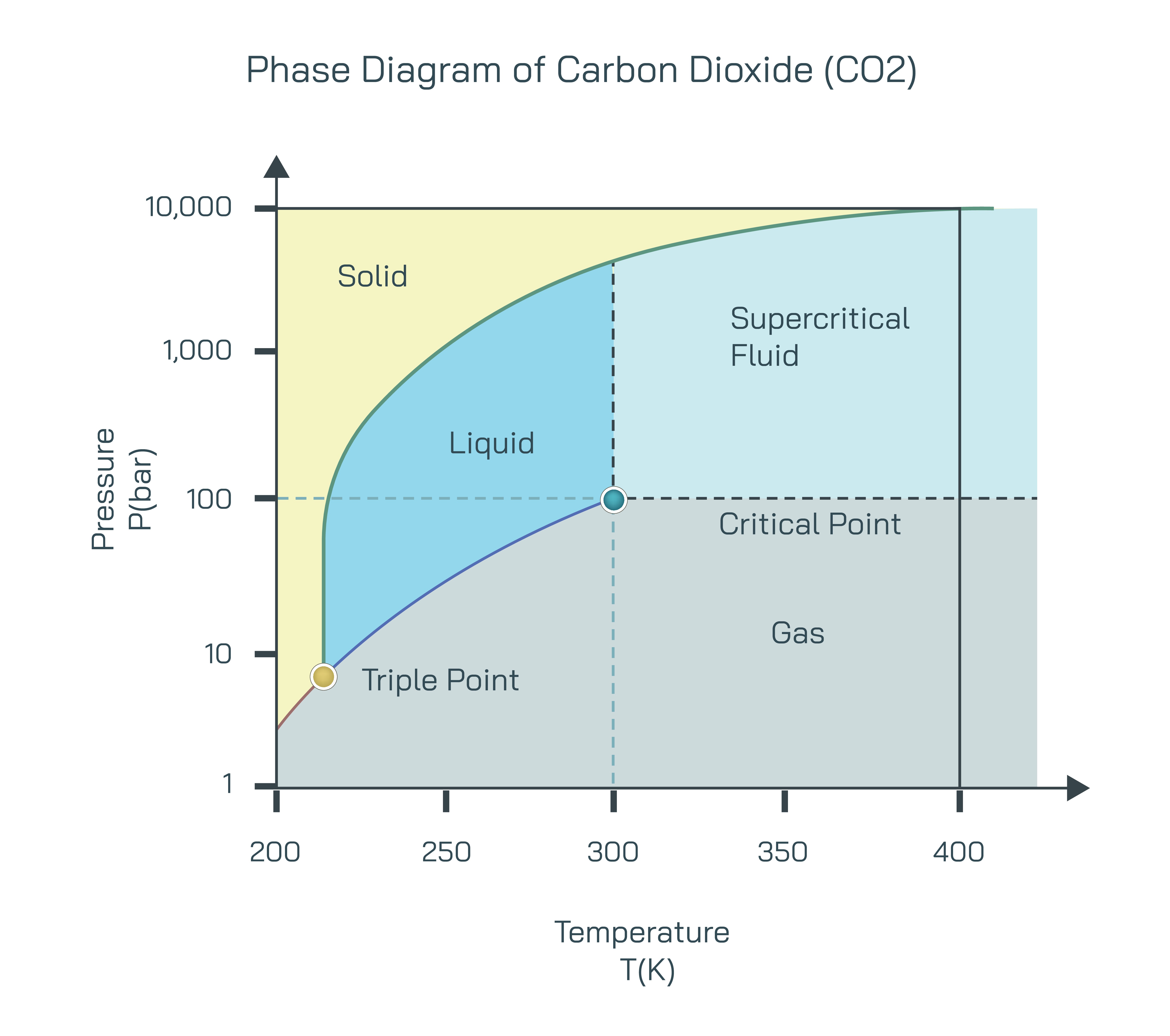
The phase diagram of carbon dioxide illustrates the relationship between temperature and pressure that determines whether carbon dioxide exists as a solid, liquid, or gas. This diagram is a fundamental concept in physical chemistry and thermodynamics because it visually represents how changes in environmental conditions influence the physical state of a substance. Carbon dioxide exhibits unique phase behavior compared to many common substances, making its phase diagram especially important for scientific understanding, industrial applications, and educational purposes.
Overview of Carbon Dioxide Phase Diagram
A phase diagram plots pressure on the vertical axis and temperature on the horizontal axis. The diagram is divided into distinct regions representing the solid, liquid, and gaseous states of carbon dioxide. The boundaries separating these regions are known as phase equilibrium lines, where two phases coexist in balance. Each region corresponds to conditions under which carbon dioxide remains stable in a particular state.
Unlike water, carbon dioxide does not exist as a liquid under normal atmospheric pressure. At standard pressure, solid carbon dioxide transitions directly into gas, a phenomenon known as sublimation. This behavior is clearly depicted in the phase diagram and explains why dry ice does not melt into a liquid under everyday conditions.
Solid Phase of Carbon Dioxide
In the solid region of the phase diagram, carbon dioxide exists as dry ice. This phase occurs at low temperatures and relatively higher pressures. Dry ice is commonly used in cooling applications because it sublimates without leaving a liquid residue. The solid phase boundary separates the solid region from the gas region and represents the sublimation curve. Along this curve, solid and gas phases coexist in equilibrium.
Gaseous Phase of Carbon Dioxide
The gaseous region occupies the area of higher temperatures and lower pressures. Under these conditions, carbon dioxide behaves as a gas and follows gas laws approximately. This is the most familiar form of carbon dioxide, present in the atmosphere and widely used in industrial processes such as carbonation, fire suppression, and controlled atmospheres for food preservation.
Liquid Phase of Carbon Dioxide
Liquid carbon dioxide exists only under specific conditions of high pressure and moderate temperature. In the phase diagram, this region appears between the solid and gaseous regions. Because atmospheric pressure is too low to stabilize liquid carbon dioxide, it must be compressed to exist in liquid form. Liquid carbon dioxide is widely used in industrial extraction processes, refrigeration systems, and as a solvent in supercritical applications.
Triple Point of Carbon Dioxide
One of the most significant features of the carbon dioxide phase diagram is the triple point. The triple point is the unique combination of temperature and pressure at which solid, liquid, and gas phases coexist in equilibrium. For carbon dioxide, this point occurs at a relatively low temperature and elevated pressure. Below this pressure, the liquid phase cannot exist at all. The triple point explains why dry ice sublimates directly into gas under normal conditions, bypassing the liquid state entirely.
Critical Point and Supercritical Carbon Dioxide
Another essential feature is the critical point, which marks the end of the liquid-gas boundary. Beyond this point, carbon dioxide becomes a supercritical fluid, exhibiting properties of both liquids and gases. Supercritical carbon dioxide has high diffusivity like a gas and high solvating power like a liquid. This unique state is extensively used in industrial and scientific applications, including decaffeination of coffee, essential oil extraction, and environmentally friendly cleaning processes.
Phase Boundaries and Transitions
The phase diagram includes three main boundary lines. The sublimation line separates solid and gas phases, the fusion line separates solid and liquid phases, and the vaporization line separates liquid and gas phases. Movement across these boundaries results in phase transitions such as sublimation, melting, boiling, condensation, or freezing. The position and slope of these lines reflect the molecular interactions and thermodynamic properties of carbon dioxide.
Importance of the CO₂ Phase Diagram
Understanding the phase diagram of carbon dioxide is crucial in chemistry, physics, and engineering. It helps explain the behavior of dry ice, the storage and transport of compressed carbon dioxide, and the conditions required for liquid and supercritical states. In environmental science, the phase behavior of carbon dioxide is important for understanding natural processes and technological methods aimed at carbon capture and utilization.
Conclusion
The phase diagram of carbon dioxide provides a clear and comprehensive picture of how temperature and pressure govern the physical state of CO₂. Its distinctive features, including the absence of a liquid phase at atmospheric pressure, the presence of a well-defined triple point, and the formation of a supercritical fluid beyond the critical point, make it a vital topic in scientific education. By studying this diagram, learners gain deeper insight into phase transitions, thermodynamic principles, and the practical applications of carbon dioxide across various fields of science and industry.