Archimedes’ Principle — Understanding the Buoyant Force Law
The Core Idea Behind the Buoyant Force
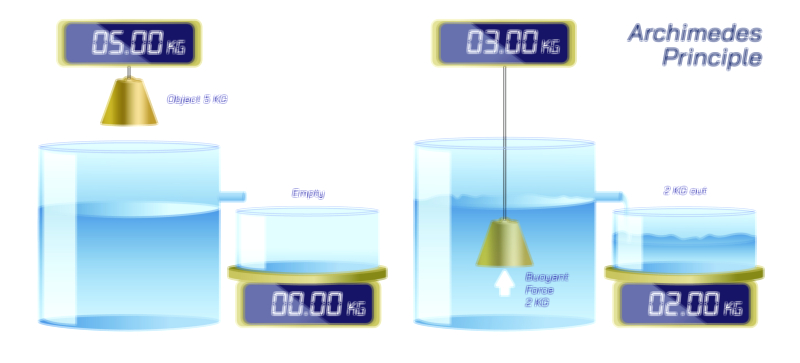
Archimedes’ Principle describes one of the most intuitive and universal behaviors in the natural world: the way fluids push upward on objects placed within them. This upward push, called the buoyant force, is the reason objects can float, sink gradually, or feel lighter in water than they do in air. The principle states that when an object is immersed in a fluid, the fluid exerts an upward force that directly opposes the object’s weight. This effect is not limited to water but applies to all fluids, including liquids and gases. Whether someone feels lighter while swimming, a cloud rises in the sky, or a ship stays afloat despite its massive size, the same fundamental law governs all of these interactions. Archimedes’ discovery provides an elegant explanation for this force by linking it with the behavior of the fluid that gets pushed aside or displaced by the object, creating an upward support that continues as long as the object remains in the fluid.
How the Upward Force Develops Inside a Fluid
Fluids exert pressure in every direction, and this pressure increases with depth. When an object is submerged, the fluid at the bottom of the object pushes upward more strongly than the fluid at the top pushes downward. This difference creates a natural upward lift, even though it may not always be strong enough to make the object float. Anyone who has lifted a stone underwater or moved their arms through a swimming pool has felt the drag and lift that come from fluid pressure acting on surfaces. This upward support emerges automatically from the structure of the fluid, requiring no external mechanism or added energy. It is a silent, consistent force that acts on every side of the object but reveals itself most strongly as the upward buoyant force opposing gravity. The deeper the object moves, the greater the pressure on its lower surfaces, and therefore the more pronounced the buoyant response becomes.
Floating, Sinking, and Neutral Balance
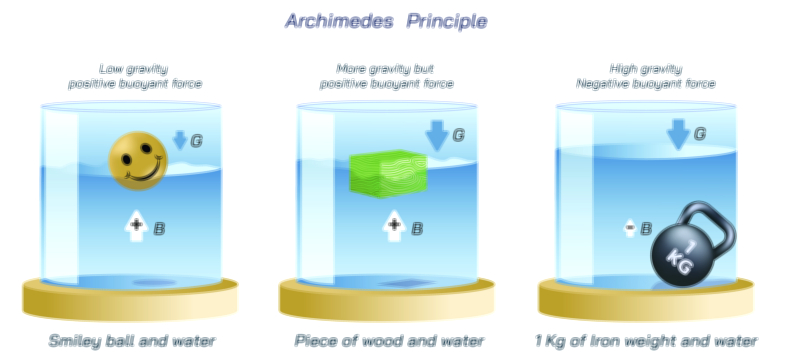
The buoyant force determines how an object behaves in a fluid by competing directly with the object’s weight. When the upward support equals the downward pull of gravity, the object becomes neutrally supported and will remain suspended, neither rising nor sinking. When the buoyant force is stronger than the object’s weight, the object rises until it reaches a point where both forces balance. When the object’s weight is greater than the buoyant force, it sinks, yet even while sinking it still experiences noticeable upward support that makes movement easier than it would be in open air. This interplay explains familiar experiences such as the sensation of weightlessness while floating, the gentle settling of items that are only slightly heavier than water, and the rapid sinking of dense materials such as metals. It also underpins how divers maintain position underwater through controlled breathing and weighting techniques, and how submarines adjust internal water levels to rise or descend in the ocean.
Practical Importance in Engineering and Design
Archimedes’ Principle is critical in designing anything intended to function in a fluid environment. Ships, whether large cargo vessels or small fishing boats, rely entirely on predictable fluid displacement to remain afloat. Engineers calculate how much fluid a hull must move aside in order to support the vessel’s weight, guiding the shape, depth, and overall mass of the structure. Submarines use carefully adjustable compartments to take in or release water, changing their buoyant force to move upward or downward through the ocean. Hot air balloons depend on the same principle but in the atmosphere, rising because the warm air inside them is lighter than the cooler air outside, creating an upward buoyant push. Even everyday objects, such as life jackets, are designed with materials that guarantee strong upward support. Across industries, from naval architecture to aerospace engineering, the consistent behavior described by Archimedes’ Principle ensures that machines, devices, and structures interact safely with fluids.
Buoyancy in Nature and Biological Systems
Nature makes extensive use of buoyant force in subtle yet remarkable ways. Fish regulate their depth through internal organs that adjust the volume of air inside their bodies, changing their buoyancy so they can rise or descend with minimal effort. Ice floats on water because it expands when frozen, making it less dense and allowing the buoyant force to support it. Birds soar through the air by riding currents that act like buoyant flows in a gas. Even the human body relies on buoyancy in numerous ways, from the ease of swimming to the gentle lift that benefits physical therapy in water. These examples demonstrate how the buoyant force is not merely a law of physics but a universal dynamic shaping life, movement, and behavior across countless species and environments.
Why Archimedes’ Principle Remains Universal and Timeless
The enduring power of Archimedes’ Principle lies in its clarity and universal reach. It explains phenomena that occur in bathtubs, oceans, skies, and laboratory experiments, connecting the motion of objects with the subtle response of fluids. The principle serves as a foundation for deeper studies in fluid mechanics, engineering, and natural sciences, but its essence remains simple enough to observe directly by placing an object in water and watching it respond. It reminds us that the physical world operates through balanced forces and predictable interactions, creating order out of what appears to be random movement. By understanding buoyant force, we unlock a deeper appreciation for floating structures, rising currents, and the intricate ways fluids support and shape life.