Non-Newtonian Fluids — Types, Properties, and Examples
Non-Newtonian fluids are liquids whose viscosity changes under applied stress or shear rate, unlike Newtonian fluids, which maintain constant viscosity regardless of force. This unique property makes non-Newtonian fluids behave differently under different conditions, appearing either thicker or thinner depending on the type of force applied. These fluids are widely studied in fluid dynamics, material science, and engineering, and have practical applications in food, cosmetics, industrial processes, and scientific experiments.
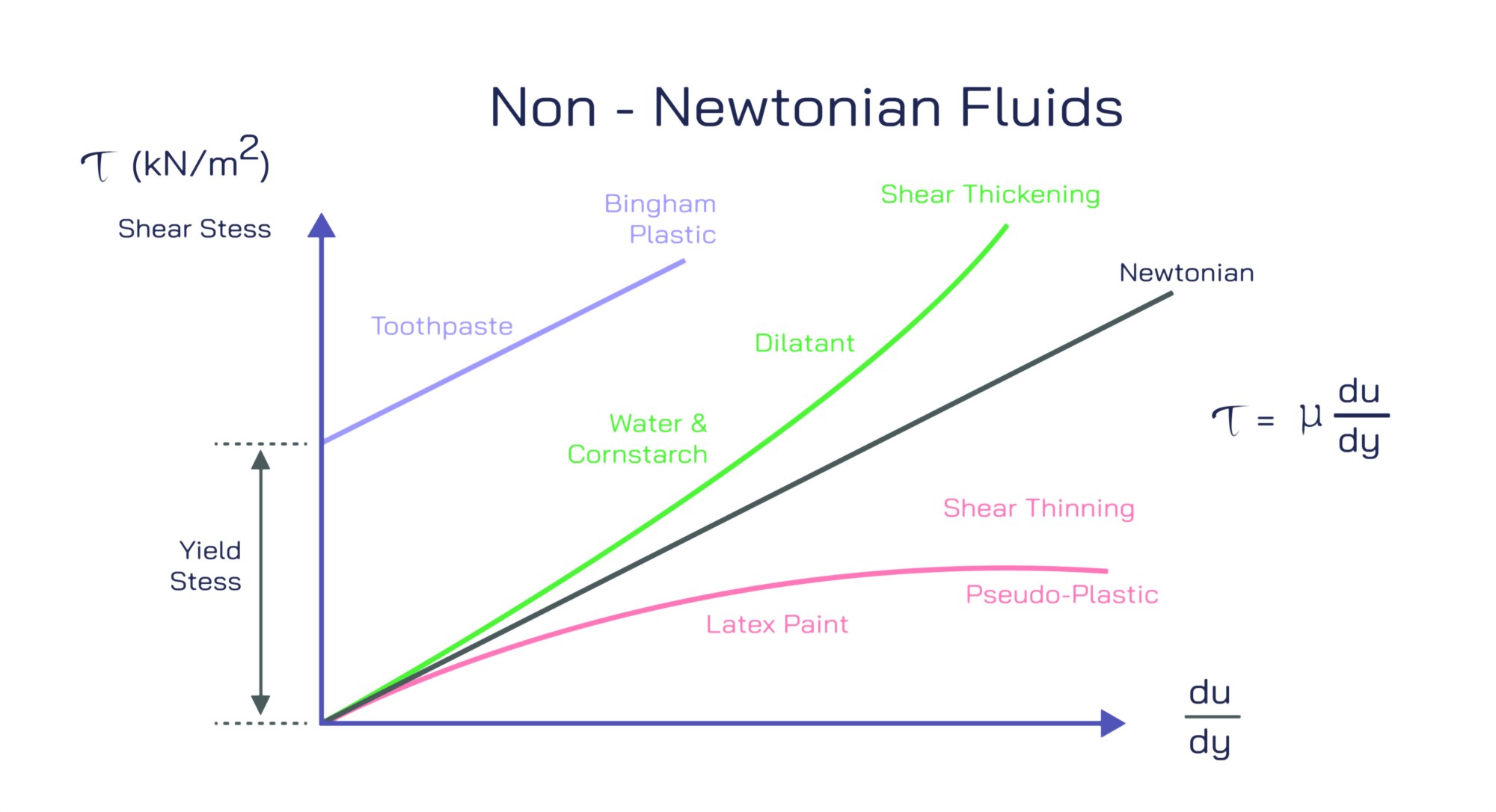
Non-Newtonian fluids are classified based on their response to stress or shear rate. Shear-thinning fluids, also known as pseudoplastic fluids, decrease in viscosity when subjected to force. Examples include ketchup, paint, blood, and certain polymer solutions. This property allows easy pouring or spreading under pressure but prevents them from flowing freely at rest. Shear-thickening fluids, also called dilatant fluids, increase in viscosity when stressed. A classic example is a cornstarch and water mixture, which behaves like a solid when impacted suddenly but flows like a liquid under gentle movement.
Other types of non-Newtonian fluids include thixotropic fluids, which gradually become less viscous over time when stirred, such as gels and some paints, and rheopectic fluids, which increase in viscosity over time under constant stress, a less common behavior observed in some lubricants and clay suspensions. Many non-Newtonian fluids also exhibit viscoelasticity, showing both viscous and elastic characteristics under different forces, making them crucial in industrial and biomedical applications.
Non-Newtonian fluids are important in both everyday life and technological applications. In the food industry, they help control texture, stability, and flow of sauces, creams, and pastes. In engineering, understanding their behavior is essential for lubricants, paints, polymers, and drilling fluids. These fluids also provide excellent models for studying complex fluid dynamics, stress responses, and adaptive material design. Their unusual behavior is often demonstrated in science experiments and educational settings, such as walking on a cornstarch slurry or observing shear-thinning in ketchup.
In conclusion, non-Newtonian fluids are liquids with variable viscosity that responds uniquely to applied stress. Shear-thinning, shear-thickening, thixotropic, and rheopectic fluids illustrate the wide diversity of behaviors, affecting both everyday materials and industrial applications. Studying these fluids provides insight into complex fluid mechanics, material design, and practical applications in food, cosmetics, and engineering, highlighting their fascinating and versatile nature in science and technology.