Torricelli’s Hydrostatic Law — Fluid Flow and Pressure Principle Explained
Torricelli’s hydrostatic law describes one of the most fundamental relationships in fluid mechanics: the way a liquid stored at a certain height develops pressure and uses that pressure to generate motion when allowed to flow. Although most people associate Torricelli’s name with the equation for discharge velocity from a tank, the deeper principle he discovered connects the internal pressure inside a static fluid to the dynamic speed the fluid acquires when leaving an opening. Torricelli observed that liquid stored above a given depth holds gravitational potential energy, and this energy translates into kinetic energy when the liquid is allowed to escape. The remarkable insight of the law is that the fluid streams outward with the same velocity that a solid body would gain after falling freely from a height equal to the vertical distance between the fluid surface and the outlet. In other words, a column of water behaves as a storage reservoir not only of mass but of potential energy, and once a path is opened, the water begins to accelerate as if it were falling under gravity even while the bulk of the fluid above remains apparently still. Torricelli’s hydrostatic law thus reveals that there is no contradiction between a fluid at rest and a fluid capable of sudden motion; the stillness conceals stored energy that becomes motion the instant a path is created.
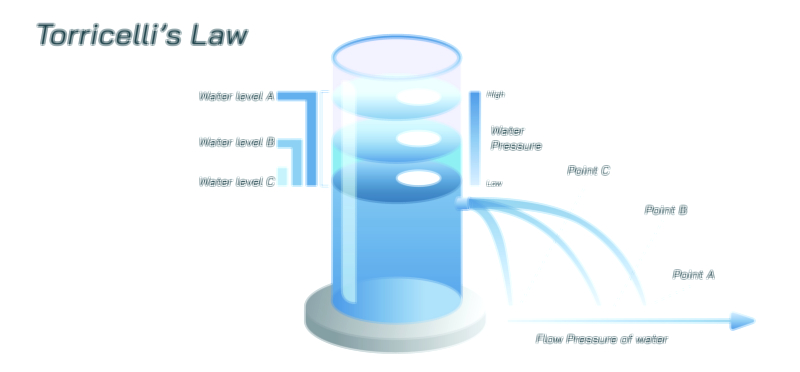
To understand the principle conceptually, picture a container filled with water and a small opening located near its bottom. The water above the opening pushes downward due to its weight, and this produces hydrostatic pressure that increases with depth. The deeper the opening lies beneath the surface, the greater the pressure acting at that point. Inside the closed tank there is no fluid motion because the downward gravitational force is balanced by an equal upward supporting force from the fluid and container surfaces. However, when the opening is exposed to the air, that balance is interrupted. The pressure associated with the water column above the opening now has a way to act outward, and the liquid begins to flow. Torricelli recognized that this was not an arbitrary acceleration but a transformation of gravitational potential energy into kinetic energy. The water accelerates on its way out of the opening until the available potential energy dictated by the height of the column has been converted to outward motion. Once that conversion reaches equilibrium, the liquid emerges at a nearly constant speed. The law makes clear that the velocity of the issuing jet depends not on the width or shape of the container, nor on the total amount of water stored inside, but solely on the vertical height of the liquid surface above the outlet. Even if the reservoir is extremely wide or extremely narrow, the velocity remains identical as long as the height above the opening is the same, because the governing factor is the pressure associated with gravitational energy per unit volume.
A key implication of Torricelli’s hydrostatic principle is that fluid pressure at a given depth is equivalent to the mechanical work that would be done if the fluid were allowed to fall through that same height. It is natural to assume that water accelerates only when it flows downward or when its mass moves collectively, yet Torricelli showed that the acceleration happens even when the water surface stays motionless. This is because fluid molecules transmit pressure through their interactions; the molecules at the top apply weight to those beneath them, and this transmission continues downward until the pressure at the opening reflects the full depth of the water column. The flow then behaves as if a segment of water above the opening had fallen and gained the final velocity now observed in the jet exiting the container. What makes this so striking is that the water inside the reservoir does not visibly accelerate the way a falling object does; instead, the motion is focused at the exit, where the accumulated energy becomes directional velocity. Thus, Torricelli’s law shows that pressure is not a passive force but a disguised form of stored energy waiting for a path to release itself.
As the liquid continues to drain, the height of the water surface decreases and the pressure at the outlet declines. The speed of the outflow diminishes accordingly, not because the passage becomes clogged or the fluid loses energy from friction, but because the reservoir now stores less gravitational potential energy than before. When the surface eventually drops to the level of the outlet, the potential energy vanishes and the flow stops. This slow reduction in velocity observed during draining is visible in common experience: water shoots out rapidly at first and weakens gradually as the level falls. Torricelli’s hydrostatic law therefore captures not only the intensity of flow but also its temporal progression, connecting the decline in velocity directly to the decline in vertical height rather than to the volume of water remaining in the container.
The principle becomes even clearer when applied beyond simple tanks. Water towers rely on this law to provide household and municipal water pressure; the higher the water is stored, the faster and more forcefully it can circulate through pipes without mechanical pumping. Hydroelectric dams also operate on this principle. Water stored high behind the dam holds enormous potential energy, and when it is released, the velocity generated by this stored height is directed through turbines to produce mechanical rotation and ultimately electricity. Irrigation channels, fountains, and gravity-fed plumbing all take advantage of the fact that gravitational energy converts directly into motion at a point of release. Even in nature, springs and geysers exhibit Torricelli-like behavior when underground water under pressure finds a pathway to the surface. The velocity of discharge is determined not by the total quantity of stored water underground, but by the elevation of the water table compared with the spring or vent opening.
Torricelli’s hydrostatic law not only explains the velocity of fluids but also forms an essential bridge between static and dynamic fluid theory. Hydrostatics deals with fluids at rest, while hydrodynamics deals with fluids in motion. Torricelli’s law sits at their intersection because it shows that static pressure — arising solely from the weight of a fluid — becomes motion when a path is provided. The fact that motion follows from pressure links Torricelli’s discovery directly to later developments in Bernoulli’s principle, which describes in broader terms how pressure, height, and velocity are interrelated in moving fluids. The same conservation of mechanical energy that governs Torricelli’s law resurfaces in Bernoulli’s work, which shows that as velocity increases in a flowing fluid, pressure decreases, and vice versa. Thus, Torricelli’s principle was not merely a calculation of water jet speed, but a physical insight that reshaped the understanding of energy in fluid motion.
Although real systems are often influenced by friction, turbulence, and viscosity, these do not alter the fundamental mechanism behind Torricelli’s law. They only reduce the efficiency of energy conversion. In a perfectly ideal system, all available gravitational potential energy becomes kinetic energy of the stream. In real systems, some of that energy is lost to turbulence at the exit, internal friction within the fluid, or drag from the pipe or orifice surface. Yet the height of the water surface remains the dominant factor determining the speed because gravity remains the driving force behind pressure. Engineers account for frictional losses in practical designs, but the theoretical core always rests on Torricelli’s insight: fluid motion originates from the conversion of gravitational energy that has accumulated silently while the fluid was at rest.
Ultimately, Torricelli’s hydrostatic law reveals that fluids possess a hidden dynamic nature even in complete stillness. Their capacity to transmit pressure and convert potential energy into motion demonstrates how gravity governs not only falling solids but also the unseen internal conditions of liquids. A tank of quiet water is not simply a passive body; it is a stored reservoir of mechanical energy, waiting to express itself in the form of flow whenever a path to the outside world becomes available. Whether we see water draining through a small opening, powering a turbine, supplying pressure to a city, or leaping skyward through a fountain, the phenomenon traces back to the principle Torricelli uncovered: the velocity of a flowing liquid is the visible expression of the gravitational energy stored within its height. Through this understanding, Torricelli’s hydrostatic law stands as a timeless example of how physical laws transform stillness into motion and convert the hidden force of gravity into the graceful movement of fluids throughout nature and human invention.