Meniscus Formation and Curved Liquid Surface Physics
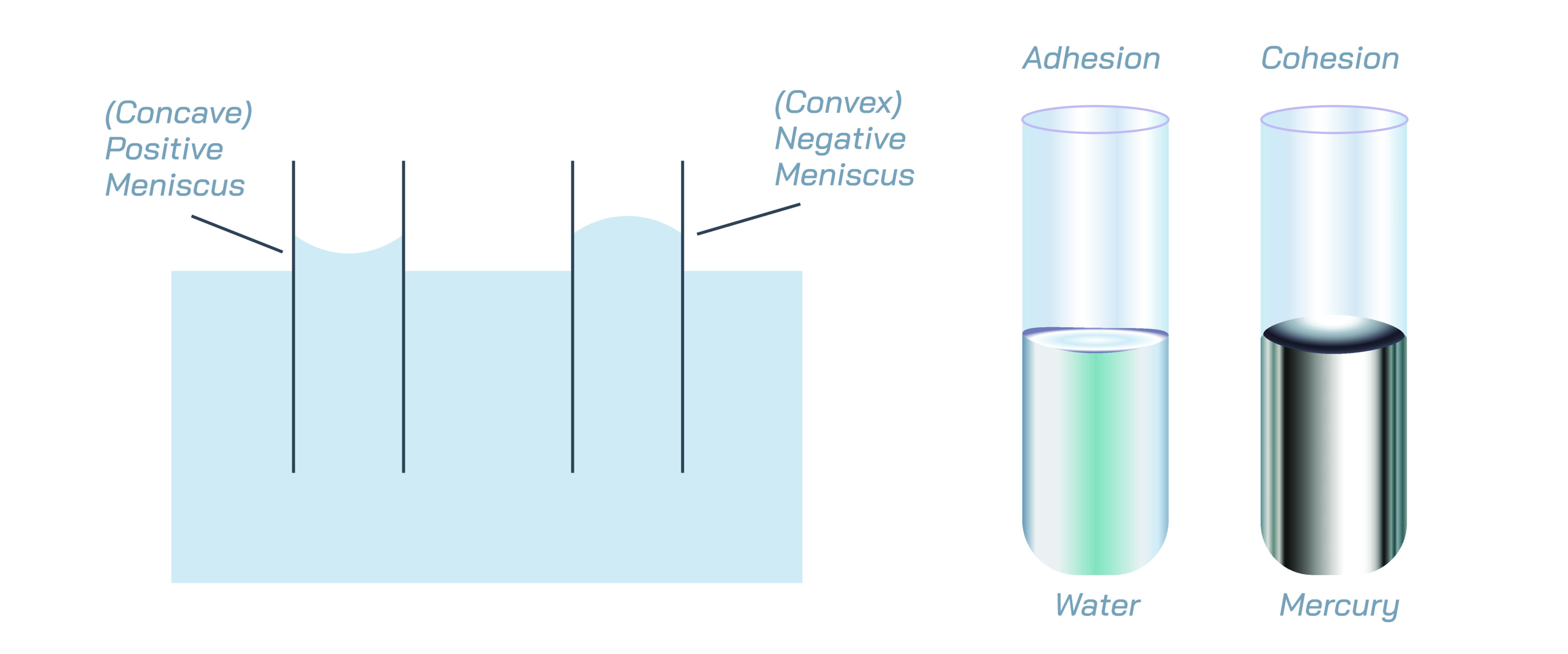
The phenomenon of meniscus formation—the curved shape that appears at the surface of a liquid near the walls of a container—is one of the most visually subtle yet scientifically rich behaviors in the study of fluid physics. What appears at first glance to be a simple curve where liquid meets solid is actually the result of a complex interplay of molecular forces, surface energy, cohesive behavior within the liquid, adhesive interactions between liquid and solid, and gravitational effects acting on that surface. In its essence, a meniscus is the visible boundary where the liquid self-adjusts to minimize energy under the influence of intermolecular forces, and the curvature of that boundary carries deep implications for liquid measurement, biological processes, capillary action, environmental fluid flow, and countless industrial applications. The shape of the meniscus—whether it curves upward to form a concave shape or downward to form a convex shape—depends on the balance between adhesion, the attraction between liquid molecules and the container surface, and cohesion, the attraction that liquid molecules exert on each other. When the adhesive forces are stronger than the cohesive ones, as in water wetting clean glass, the liquid rises along the walls, forming a concave meniscus. When the reverse is true, as with mercury in a glass container, cohesive forces dominate, pulling the surface inward and creating a convex meniscus. This simple variation in curvature becomes an immediate visual indicator of molecular interactions, revealing whether a liquid prefers to spread along a surface or to contract away from it.
This curved surface becomes much more than a visual curiosity when its relationship with capillary action is considered. Capillary action occurs when the interplay of adhesive and cohesive forces allows a liquid to rise or fall against gravity in a narrow tube. In cases where a concave meniscus forms, such as water inside a thin capillary, the attraction of water molecules to the tube walls causes the liquid to climb upward. Meanwhile, molecules within the liquid remain bound together by cohesive forces, pulling the rest of the column up with them. This results in a measurable rise in height that increases as the tube becomes thinner, illustrating how the ratio of surface area to cross-sectional volume amplifies the effect. In contrast, liquids that form convex menisci, such as mercury, are repelled by the walls of a capillary tube and are drawn downward instead of upward. The relevance of these behaviors is far-reaching: plants rely on capillary rise to move water from roots to leaves, porous materials absorb and transport fluids across their structure by the same mechanism, and modern microfluidic technologies—in which entire chemical laboratories operate on chips with channels thinner than human hair—depend on the controlled manipulation of capillary forces to drive liquid motion without pumps. The meniscus, by shaping the pressure distribution along a liquid’s boundary, becomes an active participant in directing fluid flow at both microscopic and macroscopic scales.
The physics governing the meniscus is therefore deeply intertwined with the concept of surface tension, the property of liquid surfaces that causes them to behave like stretched elastic membranes. Surface tension arises because molecules within a liquid are attracted equally in all directions by their neighbors, but molecules at the boundary experience asymmetric forces, since no neighbors exist above them. This imbalance creates a surface layer that resists deformation and seeks to minimize surface area. When a container interacts with this surface layer, the liquid adjusts its curvature to balance the energy cost of increasing surface area against the energy gained or lost from adhesion to the container. For water in a glass tube, adhesion reduces energy when the liquid climbs the walls, so the system favors a concave curve. For mercury, adhesion is weak and cohesion is dominant, so the system minimizes energy by contracting inward and reducing contact with the surface, forming a convex shape. Gravity counteracts these effects by trying to level the liquid surface, and the resulting dynamic balance creates the final curvature we observe. The sharper the curvature at the meniscus, the stronger the effect of molecular forces relative to gravitational flattening. In very small systems, such as droplets on hydrophilic or hydrophobic surfaces, the meniscus may dominate entirely and gravity becomes nearly irrelevant, while at large scales such as lakes, oceans, and swimming pools, gravity overwhelms surface forces and the water surface appears flat despite retaining curvature at the boundary where water touches walls or edges.
The practical consequences of meniscus curvature extend deeply into the realm of precision measurement and scientific experimentation. Laboratory glassware such as graduated cylinders, burettes, and volumetric flasks must be read at the meniscus to ensure accurate measurements, and whether the lowest point of a concave meniscus or the highest point of a convex meniscus should be used depends on the characteristics of the liquid. In chemical titration, even a fraction of a milliliter can change the interpretation of results, so scientists are trained to align eye level with the correct point of the meniscus and to avoid parallax error that occurs when the observer looks from an angle. The simple, everyday act of reading liquid level in a measuring container therefore becomes an act of applied fluid physics where molecular attraction determines the curvature that determines the reading that determines the outcome of an experiment. Meniscus misinterpretation has historically been responsible for systematic errors in chemical, pharmaceutical, and biological laboratories and still demands careful attention in professional practice.
The meniscus also plays a crucial role in biological systems beyond capillary rise alone. The surface of tears spreading across the eye forms a meniscus where the tear film meets the eyelid, and the dynamics of this curvature determine lubrication, clarity of vision, and comfort. Saliva, blood plasma, synovial fluid in joints, and mucus in the respiratory tract all exhibit meniscus-driven behavior that influences how these fluids wet biological surfaces, form protective layers, and move through narrow passages. In the mechanical environment of the lungs, the menisci formed within alveoli contribute to the surface tension that helps maintain structural stability during breathing; pulmonary surfactants regulate this surface tension so that alveoli do not collapse under the pressure of their own curved surfaces. The scientific understanding of meniscus behavior is therefore deeply embedded in medical and physiological science, informing clinical treatment of respiratory distress, ocular disorders, and lubrication challenges in biomechanics.
Even at larger societal scales, meniscus physics affects the design of technologies we encounter daily. Inkjet printers rely on the meniscus shape at the tip of micro-nozzles to control droplet formation, while writing instruments such as fountain pens manage liquid flow using capillary-driven curvature along feed channels. Fuel systems in engines handle liquid meniscus effects during movement and vibration, ensuring consistent delivery. In consumer products such as liquid detergents and household cleaners, bottle shape is engineered to promote a favorable meniscus for smooth dispensing. In computer hardware, particularly cooling systems for high-performance processors, heat pipes depend on liquid films that form menisci along wick structures, carrying vapor and condensate efficiently between evaporator and condenser zones. Across all of these systems, designers carefully adjust surface chemistry, material texture, and channel geometry to manipulate liquid curvature and direct motion using forces that nature provides for free.
Perhaps one of the most striking examples of large-scale meniscus engineering is found in civil and environmental engineering, where the curvature of water at the edge of soil particles affects groundwater transport, irrigation patterns, filtration efficiency, and pollutant movement through porous earth. The ability of soils to retain moisture depends partly on how the menisci between grains generate capillary suction, which can hold water against gravity and prevent fast runoff. In building foundations, these same capillary forces may draw water upward into structural materials, creating moisture damage unless managed through design. Though the fundamental physics is the same as in a glass cylinder, the consequences scale from micrometers to buildings and landscapes.
Underlying all of these examples is the realization that a meniscus is not passive—it is the visible reflection of molecular-scale decisions embedded in matter. Liquid molecules continuously negotiate between attractions that bind them together and interactions that pull them toward or away from solid surfaces. The result is a curved boundary that is both a record of those negotiations and an active participant in energy distribution, pressure gradients, measurement precision, and fluid motion. Something as outwardly simple as the shape of liquid around the rim of a cup is in fact a dynamic expression of energy minimization, molecular preference, and the tug-of-war between cohesion, adhesion, gravity, and surface tension.
In a world shaped by fluids—from blood circulating within the human body to fuel flowing through engines, from rainwater moving through soils to ink deposited on pages—the meniscus stands as a quiet but ever-present signal of how nature balances forces. It teaches that even small details carry immense physical meaning, that microscopic interactions become macroscopic phenomena, and that the world we see is built from the relationships of molecules we cannot see. By studying the curvature of a liquid surface, we gain insight not only into the physics of fluids but into the deeper ways in which matter organizes itself to conserve energy, remain stable, and sustain life and technology simultaneously.