Parallelogram Law — Vector Addition, Principle, and Applications
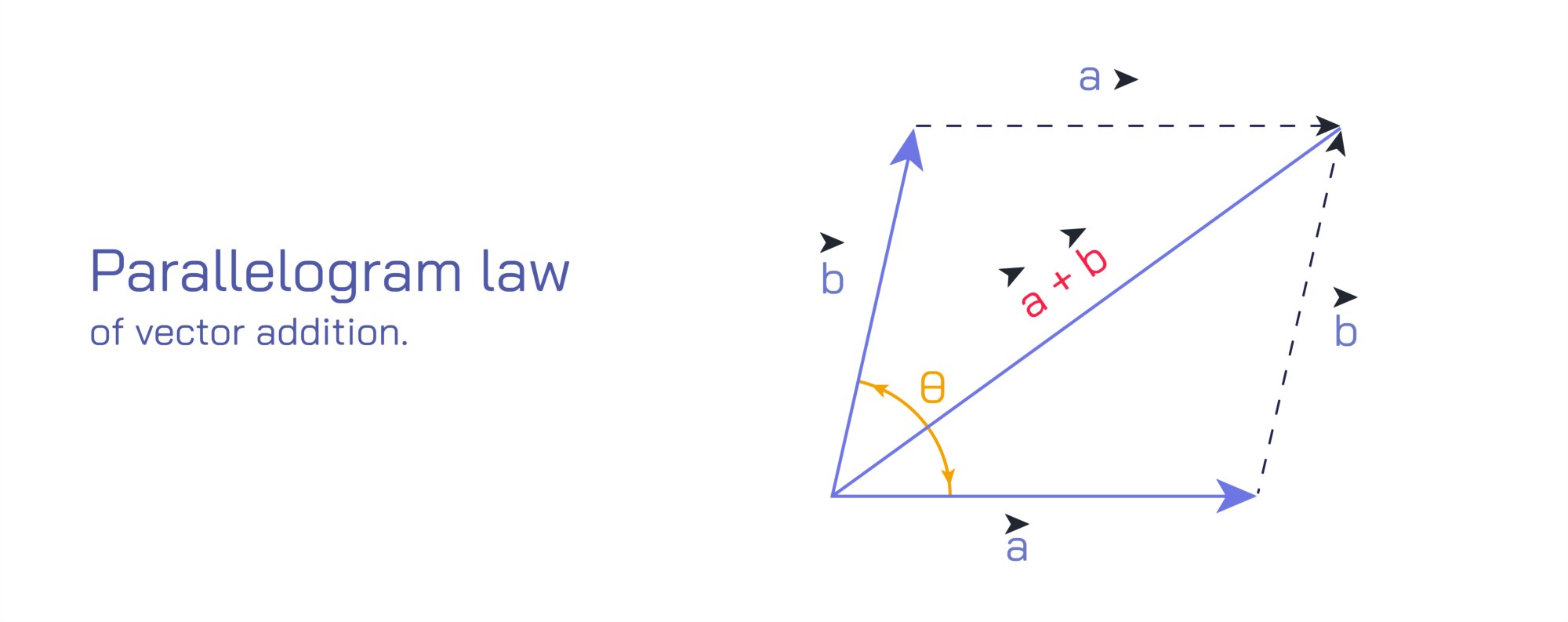
The parallelogram law is a fundamental principle in physics and mathematics used to determine the resultant of two vectors acting at a single point. According to this law, if two vectors are represented by the adjacent sides of a parallelogram drawn from a common point, the diagonal passing through that point represents the resultant vector in both magnitude and direction. This provides a clear geometric visualization of vector addition and is widely used in mechanics, engineering, and physics to simplify complex problems.
To apply the parallelogram law, vectors are drawn from a common origin, forming the sides of a parallelogram. By completing the parallelogram and drawing the diagonal from the same origin, the diagonal represents the combined effect of the two vectors. This method allows for an intuitive understanding of how forces, displacements, or velocities combine in real-world situations, providing a practical way to predict motion or equilibrium conditions.
The parallelogram law is especially important in physics for analyzing forces acting on objects. When two forces act at a point, this law helps determine the net force’s magnitude and direction, which is crucial for understanding equilibrium, motion, and mechanical stability. Engineers use this principle in designing structures, machinery, and systems where accurate vector resolution ensures safety and efficiency. It is also applied in navigation, robotics, and other technical fields where precise calculation of combined vectors is required.
Beyond practical applications, the parallelogram law is essential in education for teaching the concept of vector addition and resolution. It helps students visualize how vectors interact, providing a foundation for more advanced topics in physics and engineering. Understanding this law enables better problem-solving skills and a clearer grasp of how forces and movements operate in real life.
In conclusion, the parallelogram law provides a geometric and practical method to determine the resultant of two vectors acting at a point. By representing vectors as the sides of a parallelogram and using the diagonal as the resultant, it offers a simple yet powerful approach to analyze forces, velocities, and displacements. Its applications in physics, engineering, and education make it an essential concept for understanding vector mechanics, solving problems, and designing functional systems.