Leaf Venation Types — Patterns, Functions, and Examples
Leaf venation refers to the arrangement of veins in a leaf, which forms a network responsible for transporting water, nutrients, and food throughout the plant. Venation not only provides mechanical support but also aids in efficient transport of sap and photosynthetic products. Leaf venation patterns vary among plant species and are used for identification, classification, and understanding plant adaptation to different environments.
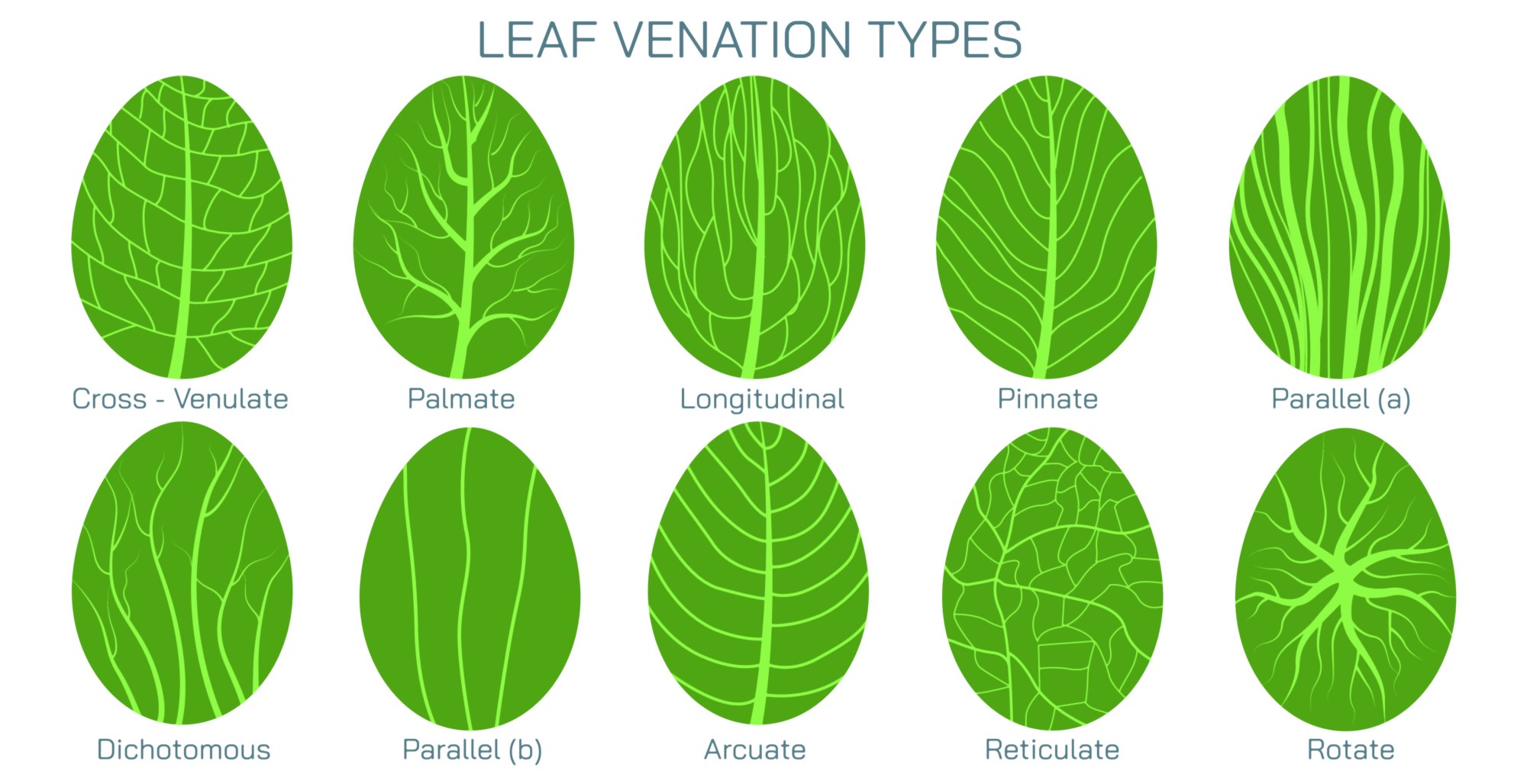
One common type is parallel venation, where veins run parallel to each other from the base to the tip of the leaf. This type is typically found in monocot plants such as grasses, wheat, and corn. Parallel venation ensures uniform distribution of water and nutrients across elongated leaves, which are often narrow and long. The veins are usually connected by small transverse veins, forming a ladder-like structure that supports the leaf mechanically and physiologically.
Another prevalent pattern is reticulate venation, which forms a net-like network of interconnected veins. Reticulate venation is characteristic of dicot plants, including roses, mango, and sunflower. This type of venation can be further classified into pinnate, where secondary veins branch from a central midrib, and palmate, where several primary veins arise from a single point near the leaf base. Reticulate venation provides flexibility, efficient transport of nutrients, and mechanical strength, allowing broad leaves to withstand environmental stresses such as wind or rain.
A less common pattern is dichotomous venation, where veins repeatedly fork into two branches without forming a central midrib. This type is seen in plants like Ginkgo biloba and some ferns. Dichotomous venation allows uniform distribution of resources in leaves with simple or fan-shaped structures and represents an ancient venation pattern in plant evolution.
Leaf venation also plays a crucial role in photosynthesis by supporting the leaf lamina and ensuring optimal distribution of water and minerals to photosynthetic cells. It enhances mechanical strength, prevents wilting, and supports transpiration. Observing and understanding leaf venation provides insights into plant classification, evolutionary relationships, and adaptation strategies. Venation patterns are widely used in botany for species identification, ecological studies, and agricultural practices.
In conclusion, leaf venation types — parallel, reticulate (pinnate and palmate), and dichotomous — demonstrate the diversity and functionality of vein patterns in plants. These patterns facilitate nutrient transport, mechanical support, and photosynthetic efficiency, while also serving as key identifiers in plant classification. Studying leaf venation enriches our understanding of plant anatomy, evolution, and adaptation, highlighting the intricate design and efficiency of plant vascular systems.