Radioactive Decay Vector Illustration for Science and Physics Education – A Detailed Conceptual Exploration of Atomic Instability, Nuclear Transformations, and the Natural Process of Energy Release Inside Matter
A radioactive decay vector illustration created for science and physics education serves as a visual gateway into one of the most fundamental and fascinating processes in the universe: the spontaneous transformation of unstable atomic nuclei. While the term “radioactive decay” may at first evoke images of radiation hazards or nuclear energy, its meaning in scientific education is much broader and deeper. It is a natural phenomenon that has shaped the history of the Earth, powered the heat in its core, created the elements we know today, and made possible the technologies and medical tools that influence daily life. A visual representation of radioactive decay captures this invisible transformation and translates it into a symbolic diagram that students, researchers, and learners can understand intuitively through shape, motion, and structure.
The core of radioactive decay lies in instability within an atomic nucleus. Certain isotopes possess too many or too few neutrons relative to protons, and this imbalance creates internal tension in the nuclear structure. Unlike chemical reactions involving electron clouds around atoms, radioactive decay occurs at the core of the atom, where forces a trillion times stronger than chemical interactions operate. In these unstable nuclei, nature continuously seeks a configuration that is lower in energy and more stable. To reach that stability, the nucleus releases energy and matter in the form of radiation. A vector illustration can depict this through graphical transitions — the nucleus shedding a particle, releasing energy, or undergoing an internal rearrangement — transforming from a less stable state to a more stable one.
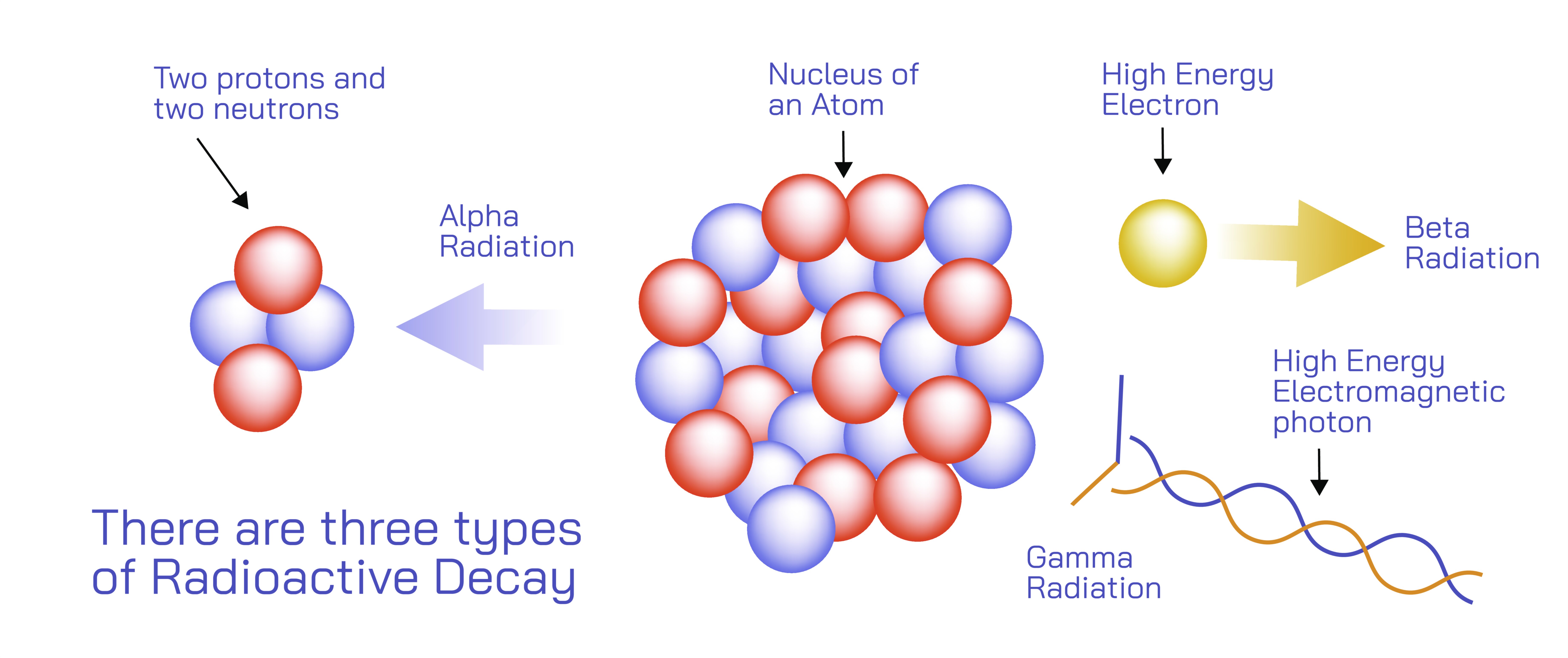
A comprehensive educational illustration does not view radioactive decay as a singular event but rather a family of different transformation modes, each with its own visual signature and physical meaning. Alpha decay can be depicted with a heavy nucleus emitting a compact particle composed of two protons and two neutrons — an alpha particle — symbolically represented as a small tightly bound cluster leaving the core. Beta decay can appear in the vector layout as a neutron splitting into a proton and an electron, pushing out the electron as beta radiation while the nucleus shifts identity on the periodic table. Gamma decay, by contrast, is the visual release of pure energy — often expressed through bright waves or gamma-ray symbolism — with no change in the number of protons or neutrons, only in the energy state of the nucleus. Neutrino emission, internal conversion, and electron capture add even more layers of conceptual transformation to these diagrams, each reinforcing the idea that atoms are not static spheres but dynamic and evolving structures.
In physics education, time is one of the most misunderstood but important aspects of radioactive decay. Students often seek predictability in atomic transformation, but radioactive decay is not deterministic on an individual atom level; it is statistical. A single unstable atom may decay within a split second or last for millions of years, and this uncertainty is not due to limitation of measurement — it is a built-in characteristic of quantum physics. The educational role of a vector diagram here is not to show the exact moment but to highlight the probability pattern: half-life. A half-life chart layered into the illustration shows how half of a large population of identical unstable atoms decay over a specific time interval, and how this decay continues through gradual exponential reduction. Half-life diagrams explain why radioactive dating works, how nuclear fuel cycles operate, and why some isotopes pose long-term risk whereas others fade rapidly.
The transformation of one nucleus into another gives radioactive decay a philosophical dimension in science education: matter changes identity. An illustration that shows the parent isotope transforming into a daughter isotope with a shift in mass number and atomic number reinforces the idea that elements are not immutable. A uranium nucleus becoming thorium, a carbon-14 atom becoming nitrogen-14, or a cobalt isotope transforming into a stable element — these transitions have created the chemical diversity of the natural world. Vector graphics that map these transformations across decay chains, such as the uranium series, demonstrate how long sequences of decays ultimately produce a stable nucleus, revealing the idea that stability is a destination that matter continuously seeks.
The energy released during radioactive decay is another crucial element that illustrations help translate into intuition. Nuclear energy is orders of magnitude larger than chemical energy because it comes from the strong nuclear force — a fundamental force that binds protons and neutrons. When a vector diagram includes energy waves radiating from the nucleus or particles traveling outward, the viewer begins to understand how nuclear decay powerfully heats planetary interiors, drives radioisotope thermoelectric generators in space probes, enables diagnostic imaging in medicine, and shapes both lifesaving and potentially harmful radiation. Radiation arrows and shielding diagrams visually reinforce the idea that nuclear energy is real and transported through particles and waves, not magic or abstract numbers.
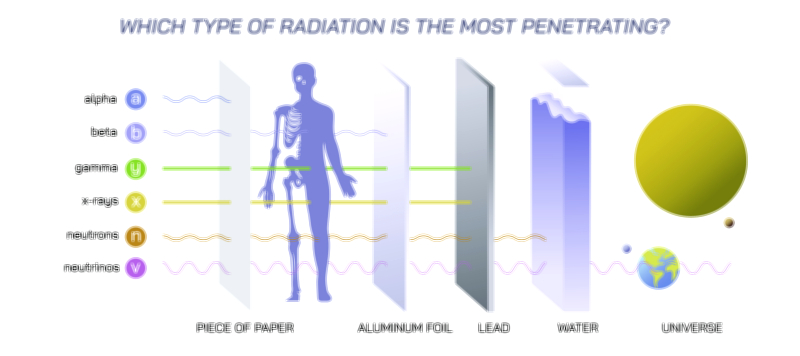
In educational environments, students also need to grasp safety. A vector illustration that shows protective barriers, controlled laboratory environments, and shielding reinforces respect without fear. When diagrams show that radiation interacts with matter by ionizing atoms and damaging biological molecules, learners see why miners, medical workers, nuclear researchers, and industrial technicians follow controlled safety protocols. Illustrations of decay types can emphasize that alpha particles cannot penetrate skin, beta radiation requires shielding, and gamma rays need dense material for protection. This nuanced understanding empowers rather than frightens — students learn that nuclear science is neither inherently dangerous nor automatically safe; it is powerful and must be handled with knowledge and respect.
Radioactive decay vector illustrations become essential not only in theoretical science classes but across multidisciplinary learning. In geology, they explain radiometric dating and the age of rocks. In archaeology, they underline how carbon-14 reveals the timeline of human civilization. In astrophysics, they show how radioactive isotopes in supernovae create elements heavier than iron. In chemistry, they reveal why isotopes behave differently even though they share chemical properties. In medicine, they show how targeted decay inside the human body can kill cancer cells while sparing surrounding tissue. A single vector illustration, when designed thoughtfully, becomes an intersection of physics, history, biology, space science, and engineering.
Because such an illustration is rendered in vector form, it gains scientific precision and clarity across learning platforms. It scales cleanly on textbooks, digital whiteboards, interactive learning apps, posters, university slides, and lab modules. It allows educators to isolate particles, label transitions, color-code decay types, and animate sequences to show step-by-step nuclear transformations. A vector glimpse into the nucleus becomes an invitation to curiosity — students who once imagined atoms as still icons begin to see them as dynamic systems shaped by forces and probabilities.
At its core, radioactive decay tells a story of the universe stabilizing itself one nucleus at a time. It is nature’s quiet conversation between energy and matter, balance and imbalance, time and transformation. A radioactive decay vector illustration for science and physics education captures that story visually and turns an abstract, invisible process into a narrative learners can understand without advanced mathematics or laboratory access. It offers a doorway to a deeper realization:
Atoms change.
Matter evolves.
The universe is not static — it is ongoing creation through transformation.
When students see that message reflected in the shapes, arrows, particles, and glowing energy waves of a well-designed vector illustration, they do not simply memorize radioactive decay — they understand it. And that understanding becomes the foundation for deeper exploration into nuclear physics, quantum mechanics, and the scientific forces that shape the world around us.