Theory of Relativity – Einstein’s Framework of Space-Time, Motion, Gravity, and the Transformation of Physics Through Special and General Relativity
1915. Together, these theories revealed that physical reality does not behave according to common intuition and that the universe expresses itself mathematically, geometrically, and dynamically in ways far deeper than classical physics suggested.
Special Relativity and the Redefinition of Space, Time, and Motion
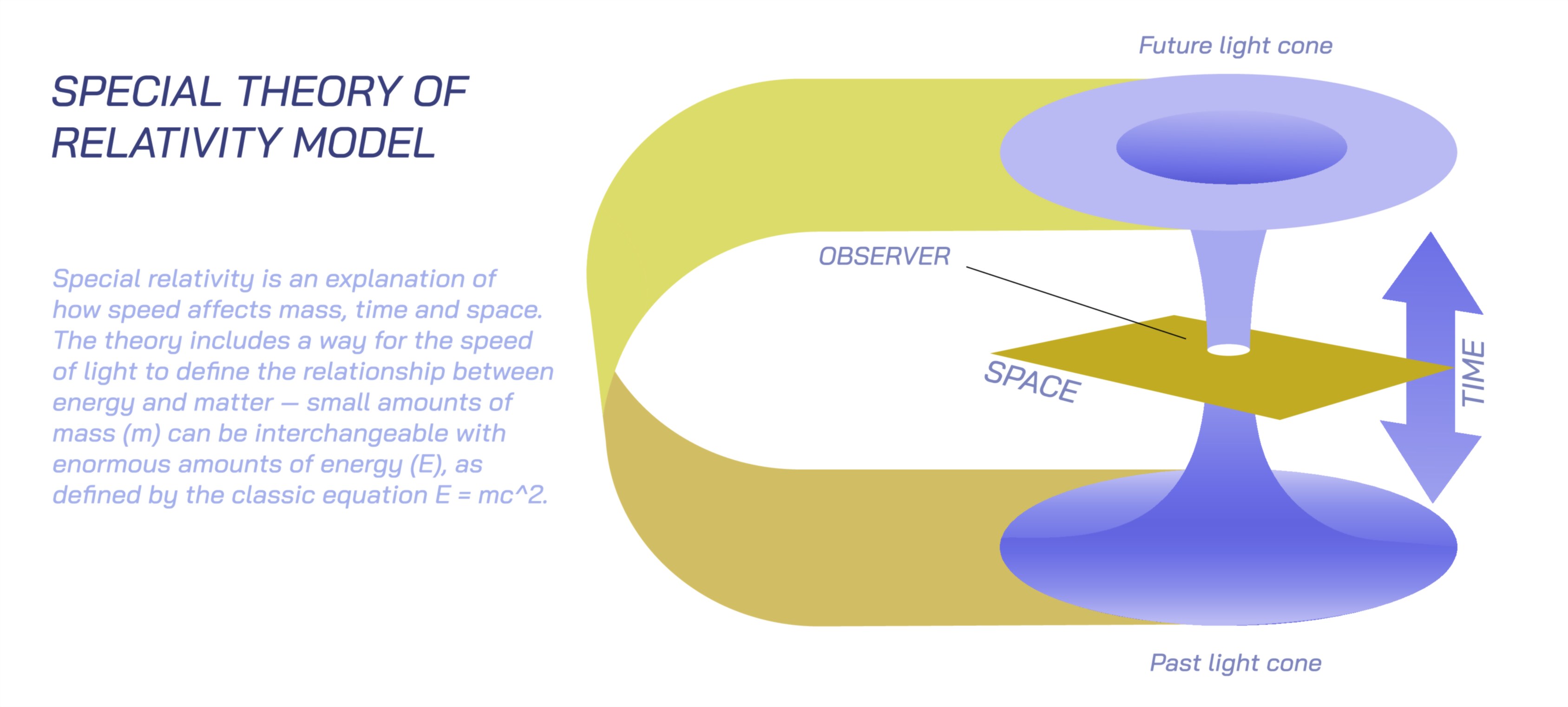
Special Relativity begins with two principles that seem simple but lead to extraordinary consequences. The first states that the laws of physics are the same for all observers in uniform motion relative to one another. The second states that the speed of light in a vacuum is constant for every observer, regardless of the motion of the light source or the observer. Because these two principles cannot both make sense within the Newtonian worldview, the structure of physics had to change. Einstein demonstrated that time does not flow identically for all observers and that clocks tick at different rates depending on motion. When an object moves at speeds close to the speed of light, time slows down relative to an observer at rest, a phenomenon known as time dilation. The length of objects moving at high velocities shortens along the direction of motion, a phenomenon known as length contraction. Even the order of events becomes dependent on perspective, meaning two events that appear simultaneous for one observer may not be simultaneous for another moving at a high velocity. Special Relativity showed that space and time are not separate entities but interconnected aspects of a single continuum—space-time. In daily life, we do not observe these effects because we move far below the speed of light, but particle accelerators, nuclear reactions, high-speed spacecraft, and satellite systems all operate in domains where relativistic effects are not only real but essential for accurate predictions.
One of the most profound results of Special Relativity is the recognition that mass and energy are interchangeable, connected through a relationship that shows mass is a concentrated form of energy. This unification means that the total quantity of matter and energy in a closed system remains conserved as a single combined property, not as separate quantities. The consequence of this idea extends from nuclear energy to the creation and annihilation of particles in high-energy physics. It also sets strict limits on motion: accelerating an object with mass to the speed of light would require infinite energy, which is why no massive body can ever reach or exceed that cosmic speed limit. Light itself does not need mass to travel at such speed because it exists purely as energy, making it the fundamental messenger of information across the universe.
General Relativity and the Curvature of Space-Time as the Source of Gravity
Special Relativity revolutionized the understanding of motion, but it did not yet address gravity. General Relativity completed that transformation by replacing the Newtonian view of gravity as a force with a geometric interpretation in which space-time bends in response to mass and energy. In this theory, every object with mass creates a curvature in the space-time fabric around it, and other objects follow the curved pathways created by this distortion. A planet orbiting a star, therefore, is not being pulled by a distant force but is moving along the natural shape of space-time created by the star’s mass. The larger the mass, the greater the curvature, and the stronger the gravitational influence. This model explains why light bends as it passes near massive objects: it travels in a straight line through space-time, but the space-time itself is curved by mass. General Relativity also predicts gravitational time dilation, in which clocks run more slowly near massive objects. This effect is not theoretical speculation; satellites orbiting Earth tick faster than clocks on the surface and must be corrected constantly using relativity so that GPS positioning remains accurate.
General Relativity also opened up new predictions about extreme cosmic phenomena. It foretold the existence of black holes, regions where the curvature of space-time becomes so severe that nothing, not even light, can escape. It predicted gravitational waves, ripples that propagate through the space-time fabric when massive objects accelerate, especially during collisions of neutron stars or black holes. These predictions remained mathematically convincing long before experimental technology existed to verify them. In 2015, gravitational waves were directly detected for the first time, confirming that space-time can vibrate and transmit energy across the cosmos. The same equations underpin the modern understanding of the expansion of the universe, which describes space itself stretching over time. General Relativity is central to cosmology, astrophysics, and models of the Big Bang because it links the behavior of galaxies, the evolution of the universe, and the distribution of matter with the geometry of space-time.
Relativity as a Foundation for Modern Scientific and Technological Advancements
Although Relativity is often associated with deep space and extreme physics, it quietly supports numerous technologies that shape everyday life. Satellite navigation systems function only because their internal timing accounts for both Special and General Relativity. High-energy physics relies on relativistic corrections when studying particle collisions. Astronomical observations that measure galaxy motion, gravitational lensing, or cosmic background radiation all require relativistic models to interpret the universe correctly. Even the design of telecommunications networks and scientific instruments involves relativity whenever precision timing is required over long distances or in orbit. This connection between abstract theoretical principles and practical technology makes Relativity a powerful example of how fundamental research can ultimately transform civilization.
The Theory of Relativity also exerts a profound philosophical influence because it challenges the notion that experience defines reality. Human intuition suggests that time is universal and constant, that motion is relative only to the object observed, and that space is an unchanging arena. Relativity proves that everyday intuition is merely a local experience shaped by the slow-moving, low-gravity world that humans inhabit. At higher speeds, deeper gravity wells, and greater cosmic scales, the universe reveals itself to be fundamentally different. Time can stretch and slow, distances can change depending on velocity, and the geometry of space itself becomes dynamic rather than rigid. This broadens the idea of scientific understanding beyond familiar experience and shows that reality must be described by physical laws rather than personal perception.
Einstein’s Theory of Relativity remains one of humanity’s greatest intellectual achievements because it redefined not only the mechanics of motion and gravity but the very nature of existence. It teaches that the universe is not constructed from independent fragments of matter and energy but from a unified space-time framework that responds to mass, motion, and geometry. It reminds learners that even the most deeply held scientific assumptions can be improved or replaced by better explanations when observational evidence and mathematical reasoning demand it. Relativity continues to shape how scientists explore black holes, build spacecraft, map galaxies, measure gravitational waves, and interpret the structure and origin of the cosmos. It stands as a testament to the power of scientific imagination, mathematical reasoning, and a willingness to question the familiar in pursuit of deeper understanding of the universe.