Theory of Relativity – Understanding Space-Time, Motion, Gravity, Energy, and the Transformation of Physics through Einstein’s Revolutionary Ideas
The Theory of Relativity is one of the most transformative achievements in the history of physics because it reshaped how scientists understand space, time, motion, gravity, and the structure of the universe itself. Before Einstein, space and time were viewed as fixed, absolute, and independent frameworks within which events occurred. Classical Newtonian mechanics described gravity as a force that acted instantaneously across distance, and time was believed to pass identically for all observers regardless of their motion. Einstein challenged these assumptions by demonstrating that the universe behaves very differently when objects move at high speeds or exist in strong gravitational fields. His work, developed in two major stages—Special Relativity in 1905 and General Relativity in 1915—showed that space and time are interconnected, relative rather than absolute, and inseparable from matter and energy. The theory rewrote the foundations of modern physics and provided the conceptual basis for technologies and discoveries that shape everyday life, from GPS satellites to cosmology and black hole science.
Special Relativity and the Changing Nature of Space and Time
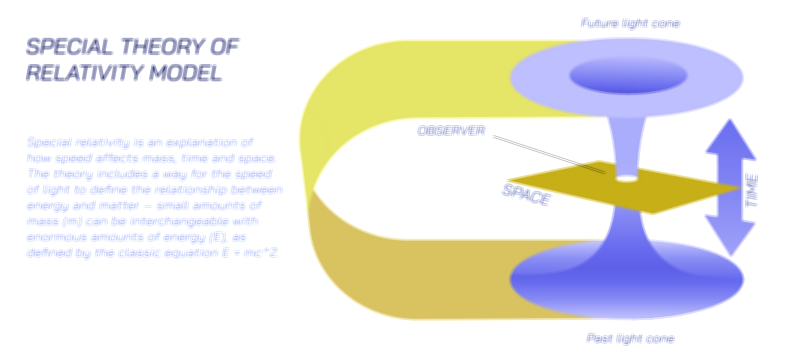
Special Relativity began with a simple yet revolutionary idea: the laws of physics are the same for all observers who are moving at constant speed, and the speed of light in a vacuum is the same for all observers regardless of their motion. From these principles, Einstein demonstrated that time does not pass identically for all observers and that the measurement of distances and durations depends on the relative motion between objects. When an object moves with very high speed—approaching the speed of light—time slows down for that object relative to an observer at rest, a phenomenon known as time dilation. Likewise, lengths in the direction of motion shorten from the perspective of a stationary observer, a phenomenon called length contraction. Even simultaneity loses its absoluteness: two events that appear simultaneous to one observer may not be simultaneous to another who is moving relative to the first. These effects are not illusions but real transformations in space and time. They are normally invisible in everyday life because human speeds are tiny compared to the speed of light, but they become extremely important in high-speed contexts such as particle accelerators, satellite motion, and astrophysics.
The most famous conceptual breakthrough associated with Special Relativity is the inseparable connection between mass and energy. Einstein showed that mass itself is a form of energy and that an object’s energy increases as its velocity increases. This led to the realization that accelerating an object to the speed of light would require infinite energy, which is why no object with mass can ever reach or exceed the speed of light. The conservation of mass and energy became unified into a single principle, revealing that matter can be converted to energy and energy to matter under the right conditions. Although widely recognized today because of nuclear reactions and particle physics, this idea marked a profound shift in the understanding of physical reality.
General Relativity and the Curvature of Space-Time
If Special Relativity altered the understanding of motion and time, General Relativity transformed the understanding of gravity itself. Instead of describing gravity as a force acting between masses, Einstein demonstrated that gravity emerges from the curvature of space-time caused by matter and energy. Space and time, rather than being passive backgrounds, form a dynamic four-dimensional fabric that bends around massive objects. A planet orbiting a star does not need to be pulled by an invisible force; instead, it follows a path determined by the curvature of space-time created by the star. The more massive an object is, the deeper and more pronounced the curvature becomes, and other objects move along these curved trajectories. In this view, motion under gravity is simply motion through the geometry of space-time.
General Relativity replaced the Newtonian idea of instantaneous gravitational action with a model in which gravitational influence travels through space at a finite speed—the speed of light. It also provided explanations for phenomena that classical physics could not adequately describe, such as the precise orbit of Mercury, the bending of light during solar eclipses, gravitational time dilation near massive bodies, and the behavior of objects in extremely dense astrophysical environments. In strong gravitational fields, time passes more slowly than in weak fields, meaning that clocks tick differently depending on gravitational position. This time dilation is not just theoretical: satellites orbiting Earth require constant time corrections based on relativity in order for GPS technology to function accurately. Every map application and navigation system on Earth works because Einstein’s models of space-time are mathematically woven into the satellite timing algorithms.
Relativity and the Structure of the Universe
The Theory of Relativity opened new doors for understanding the universe on the largest scales. Because space-time can expand, contract, and curve, cosmology became a scientific discipline grounded in precise physical laws. Relativity predicts the existence of black holes, objects where gravity becomes so strong that not even light can escape. It describes gravitational waves, ripples that move through the fabric of space-time when massive bodies accelerate, such as merging neutron stars or colliding black holes. Although gravitational waves were predicted a century ago, they were not detected experimentally until 2015, when highly sensitive observatories measured tiny distortions in space caused by distant cosmic events. These discoveries confirmed that the behavior of the universe matches the principles Einstein envisioned even at the most extreme limits.
Relativity also contributed to the understanding that the universe is expanding. Observational astronomy later confirmed that galaxies are moving away from each other and that space-time itself is stretching. These insights led to modern models of the Big Bang, the evolution of cosmic structure, and the origins of time and space themselves. Relativity is therefore not only a model of motion but a blueprint for the universe as a whole.
Educational Impact and Why the Theory of Relativity Matters
The Theory of Relativity is not just an advanced scientific topic; it shapes how learners understand the nature of reality. It teaches that intuition is not always reliable when extended beyond everyday human experience and that the universe behaves differently at high speeds, large masses, and extreme distances. Relativity demonstrates that scientific truth evolves when new observations challenge old assumptions and that simple foundational principles can lead to sweeping conclusions about nature. It also illustrates how mathematics and imagination work together, because relativity began not in laboratories but in Einstein’s thought experiments about light, motion, and clocks.
The theory continues to influence technology, philosophy, engineering, astronomy, navigation, telecommunications, and quantum science. Every time a radio signal bounces from Earth to a satellite, every time astronomers interpret images of distant galaxies, and every time researchers analyze gravitational interactions, relativity forms part of the scientific framework behind those systems. It is a reminder that physics is not only about the objects we can hold in our hands but also about phenomena that stretch across galaxies and shape the universe on cosmic scales.
Ultimately, the Theory of Relativity deepens appreciation for the elegance and complexity of the universe. It replaces the idea of space and time as rigid containers with a picture of reality as a living, connected geometry shaped by motion and matter. It reinforces the idea that even the most ordinary measurements—length, time, mass, and motion—depend on perspective. For students, relativity is not simply a lesson in equations; it is a lesson in how scientific thinking expands human perception, transforming our sense of what the universe is and revealing that reality is richer and more dynamic than everyday experience alone could ever show.