𝐒𝐨𝐝𝐢𝐮𝐦 𝐂𝐲𝐚𝐧𝐢𝐝𝐞 — 𝐌𝐨𝐥𝐞𝐜𝐮𝐥𝐚𝐫 𝐒𝐭𝐫𝐮𝐜𝐭𝐮𝐫𝐞, 𝐂𝐡𝐞𝐦𝐢𝐜𝐚𝐥 𝐁𝐨𝐧𝐝𝐢𝐧𝐠, 𝐑𝐞𝐚𝐜𝐭𝐢𝐯𝐢𝐭𝐲 𝐁𝐞𝐡𝐚𝐯𝐢𝐨𝐮𝐫 𝐚𝐧𝐝 𝐃𝐞𝐞𝐩 𝐄𝐝𝐮𝐜𝐚𝐭𝐢𝐨𝐧𝐚𝐥 𝐂𝐡𝐞𝐦𝐢𝐬𝐭𝐫𝐲 𝐒𝐮𝐦𝐦𝐚𝐫𝐲.
Sodium cyanide, written chemically as NaCN, is an inorganic salt that appears as a white crystalline solid, yet its internal structure and chemical behaviour reveal a sophisticated relationship between ionic bonding, covalent bonding, acid–base chemistry and coordination chemistry. The compound is well known industrially for its role in gold and silver extraction, electroplating and organic synthesis; however, its importance in chemistry education stems from the way it demonstrates how molecular structure governs reactivity. Even though sodium cyanide is widely recognized for its toxicity, understanding it scientifically requires focusing on the microscopic principles that give rise to its macroscopic properties, rather than its hazards alone. A deeper look into NaCN shows the intimate connection between the structure of the cyanide ion, electron distribution along a carbon–nitrogen triple bond, and the high nucleophilicity and strong metal-binding ability of this anion.
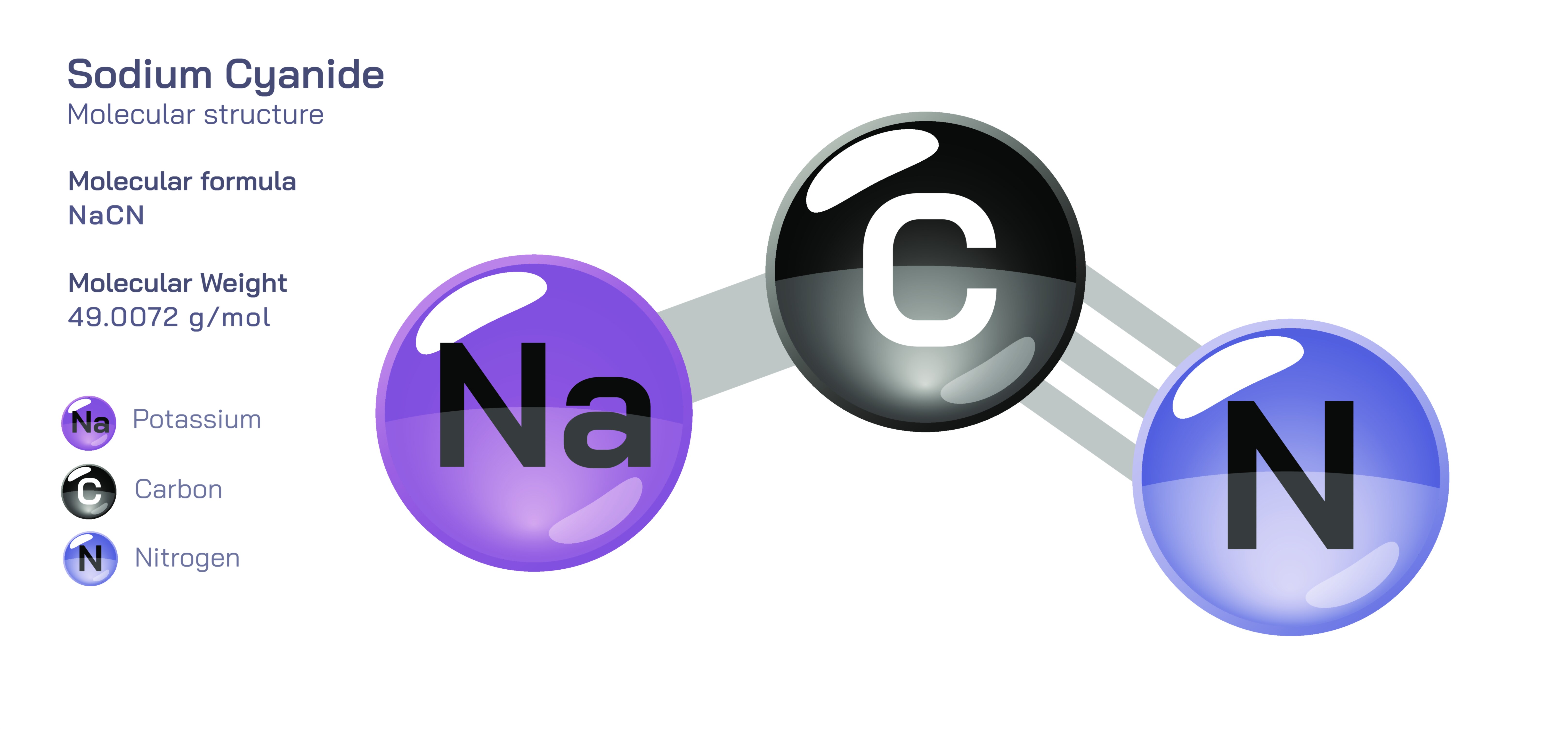
The central structural feature of sodium cyanide is the cyanide ion, CN⁻. This ion consists of a carbon atom triple-bonded to a nitrogen atom, forming one of the strongest covalent bonds known in inorganic chemistry. The triple bond consists of one sigma bond and two pi bonds, resulting in a very short and rigid linkage that holds the carbon and nitrogen atoms extremely close together. Because nitrogen is more electronegative than carbon, electron density is not evenly shared; instead, the extra electron associated with the negative charge is localized more heavily on the carbon side of the ion. This distribution makes the carbon atom the reactive site for bonding, rendering the cyanide ion a powerful nucleophile capable of attacking electron-deficient centres, particularly electrophilic carbon atoms in organic molecules and metal ions that accept electron pairs. In this way, sodium cyanide provides a clear example of how electron distribution within a covalent bond defines the behaviour of a molecule in chemical reactions.
The sodium ion in sodium cyanide plays a stabilizing role. When sodium loses its single valence electron, it becomes the cation Na⁺, and it bonds ionically with CN⁻ in the crystalline solid. In its solid state, sodium cyanide does not exist as discrete NaCN molecules but rather as an extended ionic lattice with alternating Na⁺ and CN⁻ ions arranged in a repeating three-dimensional pattern. The electrostatic attraction between the positively charged sodium ions and negatively charged cyanide ions establishes this lattice, giving sodium cyanide a definite crystalline form and relatively high melting point. However, the ionic lattice is readily broken by water: hydration energy released when water molecules surround both Na⁺ and CN⁻ ions overcomes the lattice energy that holds them together. As a result, NaCN dissolves quickly and completely in water to release free cyanide ions—an essential factor in both its industrial usefulness and its physiological toxicity.
In aqueous solution, the cyanide ion behaves according to acid–base equilibrium principles. CN⁻ strongly attracts protons and readily forms hydrogen cyanide (HCN), which is a weak acid in water. This behaviour illustrates how anions derived from weak acids act as strong bases. If sodium cyanide is dissolved in neutral water, the solution becomes basic because the cyanide ion removes protons from water to produce hydroxide ions (OH⁻). This reversible exchange between CN⁻ and HCN demonstrates that cyanide is a conjugate base capable of dynamic proton transfer. The position of this equilibrium is of great educational interest because it clearly shows how the strength of an acid determines the reactivity of its conjugate base.
Beyond simple acid–base behaviour, the cyanide ion plays a vital role in coordination chemistry. Carbon, with its localized negative charge and available electron pair, binds strongly to metal ions, forming metal–cyanide coordination complexes. This occurs particularly with transition metals such as gold, silver, copper, nickel and iron. The formation of soluble gold–cyanide complexes underlies the industrial extraction of gold from ore—a process called cyanidation. In this extraction, gold in the ore reacts with cyanide, oxygen and water to form the soluble dicyanoaurate complex. This reaction illustrates electron donation from the cyanide ligand to a metal centre, showing how cyanide operates as a strong field ligand that stabilizes certain oxidation states of metals. The metal-binding strength of cyanide is also central to its toxicity in biological systems: cyanide interferes with iron-containing enzymes by forming extremely stable complexes that block essential metabolic pathways. The scientific message is that toxicity arises not from the salt itself but from the intrinsic chemical affinity of the cyanide ion for metal ions critical to biological function.
The reactivity of sodium cyanide in organic chemistry stems from the nucleophilicity of the carbon atom in CN⁻. The cyanide ion attacks electron-deficient carbon atoms, making sodium cyanide a powerful reagent for forming carbon–carbon bonds. This nucleophilic substitution behaviour is central in the synthesis of organic nitriles, where cyanide displaces leaving groups such as halides in alkyl halides. The resulting nitriles can then be transformed into amines, carboxylic acids or other organic compounds, demonstrating how sodium cyanide provides a pathway for molecular construction. Chemistry education frequently relies on NaCN for teaching nucleophilic substitution because it clearly illustrates how electron-rich ions seek electron-deficient atoms and how covalent linkages grow from these exchanges.
Although sodium cyanide is often associated with toxicity, the cause lies in its molecular structure rather than in any exotic property. Hydrogen cyanide formed from protonation of CN⁻ is a volatile gas that diffuses rapidly and interacts with metalloproteins. In aqueous environments containing metal ions essential to life—especially iron in mitochondrial enzymes—cyanide forms extremely stable complexes that block oxygen utilization and cellular respiration. The danger of cyanide therefore reflects its powerful affinity for metal ions rather than any corrosive or acidic character. This example offers a profound educational lesson: harmful or beneficial effects of a chemical depend on structure and biological interaction, not on formula alone.
Thermally, sodium cyanide behaves differently from many inorganic salts. It does not decompose into its elemental components upon heating under inert conditions because the C≡N triple bond is extremely strong. Instead, thermal breakdown requires oxygen, producing sodium carbonate, carbon dioxide and nitrogen-containing gases. This oxidation behaviour demonstrates that cyanide chemistry is governed by electron transfer and that decomposition patterns reflect attempts to stabilize electron distribution.
Despite its hazardous nature, sodium cyanide serves multiple constructive roles when handled scientifically. In metallurgy, it enables the extraction and purification of gold and silver. In electroplating, it ensures uniform metal deposition due to the stability of metal–cyanide complexes. In chemical synthesis, it enables the formation of complex organic structures. These uses are tied not to the sodium ion, but to the structural and electronic character of the cyanide ion, underscoring again that the functionality of a compound arises from its electron arrangement rather than its elemental labels.
From a broad educational standpoint, sodium cyanide is a rich model compound that teaches numerous fundamental chemical concepts: ionic lattice formation, covalent triple bonding, electron density distribution, resonance stabilization in small anions, proton transfer equilibria, nucleophilic attack in organic chemistry, ligand–metal coordination, and electron-transfer reactions. Each macroscopic property—whether dissolution, alkalinity, complex formation or toxicity—can be directly traced to the microscopic structural features of the cyanide ion and the stabilizing presence of sodium ions.
Ultimately, sodium cyanide illustrates that chemistry is governed by the position and movement of electrons. A single extra electron localized on carbon within a triple-bonded anion defines the nucleophilicity, metal-binding ability, basicity and physiological impact of cyanide. Sodium ions serve as passive counterions that stabilize and transport the reactive species without altering its behaviour. Through NaCN, students see that understanding structure means understanding function, and that the smallest details of molecular bonding can determine the largest consequences in technology, industry and biological systems.