Four Wheeler Parking Lot — Organized Vehicle Parking Area Design
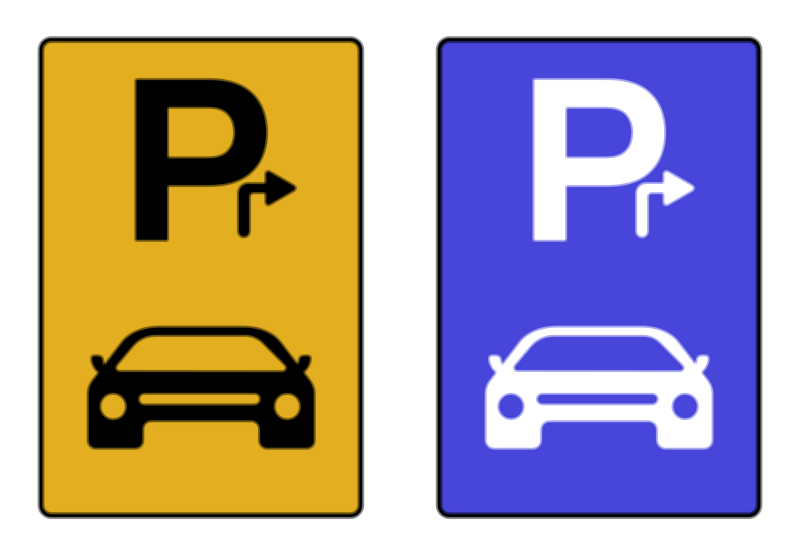
A Four Wheeler Parking Lot sign may appear to be a simple piece of visual communication at first glance, often represented in a vector illustration by a clean “P” symbol paired with the silhouette of a car or framed within a designated parking zone graphic, yet beneath that minimalist artwork lies an intricate system of urban logic, mobility engineering, safety planning, and human-centered design. The sign is not simply informing drivers where they are allowed to stop; it is guiding an entire category of vehicles toward a space that has been specifically evaluated to handle their footprint, turning characteristics, and loading patterns without interfering with the natural flow of city life. Cars, jeeps, vans, SUVs, and other four-wheeled vehicles carry more size, mass, momentum, and space demand than two-wheelers, bicycles, or pedestrians, and the places where they are allowed to remain stationary determine whether an environment functions smoothly or becomes a congested and unsafe landscape. The vector illustration becomes the starting point for a much broader network of benefits: it preserves walkability, protects accessibility, supports commercial operations, safeguards emergency pathways, reduces driver confusion, and maintains the visual openness and functional clarity of building entrances and public spaces. Although the graphical icon consists of only a few lines and carefully proportioned shapes, its message has deep implications for how people use shared space, how vehicles are managed, and how safety and comfort coexist within urban environments.
The reason spaces require such signage has a great deal to do with where cars tend to stop when their drivers must decide for themselves. Without designated parking areas, drivers naturally gravitate toward locations that offer personal convenience, such as building entrances, shop fronts, school gates, hospital porches, sidewalks, narrow internal roads, and drop-off points. While these sites feel convenient for those behind the wheel, they are the exact spots where obstruction is most damaging for everyone else. A car parked at a building entrance becomes an obstacle not only to people arriving on foot but also to delivery personnel, luggage-carrying visitors, wheelchair users, parents with children, and individuals trying to exit the building quickly. On narrow streets, a single illegally parked car forces all passing traffic into the opposite lane, removing the predictability that prevents accidents. In front of commercial areas, a car absorbing storefront space diminishes visibility and blocks the point of entry to a business. At hospitals and emergency facilities, the wrong vehicle parked at the wrong time can obstruct a stretcher, oxygen supply, ambulance approach, or wheelchair ramp. The Four Wheeler Parking Lot sign reorganizes this behavior at its root by offering drivers a clear and sanctioned location where parking is safe, practical, and socially considerate. When drivers follow the sign, entrances remain open for people rather than machines, sidewalks remain walking paths rather than spillover storage, children crossing the road gain visibility rather than losing it, and emergency services retain the frictionless access they depend on.
More than just preventing obstructions, the sign also enhances the emotional and psychological experience of entering a building or shared space. Arrival is the first sensory moment a person has with a location, and it strongly influences how they interpret the environment. A clean entrance void of randomly parked cars signals order, respect, and safety. People immediately feel more comfortable approaching schools, hospitals, residences, workplaces, or commercial buildings when the entrance space is clear and visually logical. On the contrary, vehicles bunched around the gateway create subconscious tension, confusion, and risk because the surroundings feel contested rather than welcoming. The Four Wheeler Parking Lot sign sustains the intended architecture of arrival by ensuring that the primary frontage of the building performs as a transition space between exterior and interior life without being turned into a holding zone for unattended vehicles. The power of the sign lies not in restricting drivers but in preserving the psychological and spatial dignity of arrival, ensuring that buildings greet people, not block them.
Commercial activity further underscores the significance of designated car parking signage. Retail markets, shopping complexes, high streets, malls, and restaurant districts depend heavily on walkability. Customers do not enjoy weaving between parked vehicles to reach business entrances, and businesses depend on clear sightlines to make their storefronts visually accessible from a distance. A car obstructing a shop’s frontage inadvertently reduces earning potential by dimming exposure to passing customers. Service corridors, loading docks, and back-end logistics paths also require open access for cargo movement, and even a single car parked outside these zones can interrupt operations, delay deliveries, and increase labor effort. A Four Wheeler Parking Lot sign alleviates these knock-on costs by encouraging drivers to position their vehicles in locations where commercial flow remains uninterrupted. When businesses operate without such interference, customers enter comfortably, workers move more efficiently, and the entire economic ecosystem benefits from uninterrupted circulation and clear spatial logic.
Accessibility is another foundational dimension supported by this sign. Modern architecture and urban policy have evolved to prioritize inclusive access for individuals of all capabilities. Wheelchair ramps, tactile floor indicators for the visually impaired, wide entrance clearances, curb cuts, and smooth pedestrian surfaces exist to ensure that everyone, regardless of physical condition, can move without assistance. When a car parks across these features, even briefly, independence is stripped away from the people who rely on them most. A person in a wheelchair cannot squeeze past a vehicle parked on the ramp designed to support their uninterrupted access. A visually impaired person following tactile paving loses their orientation when that path is blocked. A senior citizen with mobility limitations cannot comfortably negotiate a turning path around a parked vehicle. Parents with strollers or individuals carrying heavy goods should not be forced to step into traffic because the accessible pathway has been transformed into a parking stall. The Four Wheeler Parking Lot sign supports the social ethic that accessibility should not be fragile; it should be protected by directing vehicles away from spaces that were designed for human movement, not mechanical storage.
Emergency readiness is another area in which the sign offers profound, though often invisible, value. Many people do not think about emergency responders until the moment they are needed, but built environments must think about them continuously. Fire lanes, hydrant-access areas, ambulance docking points, building rescue entries, and evacuation corridors are not allowed to be obstructed because the consequences of such blockage are irreversible. A fire truck forced to park farther from a building because a private car occupies the designated emergency space wastes time that could cost lives. Paramedics attempting to unload a stretcher need direct access to hospital entrances; cars parked carelessly in the approach path delay urgent medical steps. During crisis evacuations, parked vehicles near exits create bottlenecks that compromise safe and quick movement for large crowds. The Four Wheeler Parking Lot sign prevents parking decisions that might unintentionally interfere with crisis response by guiding cars toward safe holding zones instead of leaving drivers to choose their own spots based on convenience rather than emergency vulnerability. In this way, the sign is not only a tool for everyday order; it is a silent component of public safety infrastructure.
Traffic management principles also reinforce the necessity of these designated parking areas. One of the core tenets of transportation engineering is predictability. Roads remain safe when all users—cars, bikes, pedestrians, and heavy vehicles—can anticipate each other’s behavior. Searching for unmarked parking introduces unpredictable and abrupt movements, such as sudden slowing, lane switching, illegal U-turns, or sharp curb maneuvers. These patterns create conflicts among cars and increase collision risk. When drivers know exactly where authorized parking is located, they approach the space deliberately rather than opportunistically, reducing hesitation and erratic behavior. The sign therefore improves driver confidence, lowers the likelihood of reckless improvisation, and enhances the efficiency of traffic flow by replacing uncertainty with structured behavior.
In the evolving world of smart mobility, this sign acquires a technological role as well. Navigation apps highlight designated parking areas so drivers can proceed directly to them instead of circling congested zones looking for space. Ride-sharing platforms, delivery fleets, logistics companies, and subscription-based parking systems rely on these designated spaces to maintain operational efficiency. Parking management software uses map-coded parking lots to manage occupancy status and guide vehicles intelligently. Computer-vision enforcement tools detect the symbol to monitor compliance automatically. Autonomous and semi-autonomous vehicles depend on the established semantics of parking signage to determine where they are permitted to park or drop passengers. The clarity of vector illustration ensures that both the human eye and machine vision can identify the sign reliably, turning it into a universal icon of parking legality across both physical and digital mobility networks.
On a social level, the Four Wheeler Parking Lot sign represents the balancing point between private convenience and collective well-being. Parking a car in a convenient but undesignated location may save the driver a minute but transfers inconvenience, risk, and discomfort to others. A parked vehicle can block someone’s safe path, delay emergency workers, endanger a child stepping into traffic, obscure visibility for drivers approaching a turn, or reduce the comfort and usability of public spaces. When a driver follows the Four Wheeler Parking Lot sign rather than improvising a parking spot, they demonstrate courtesy not just to authority but to their community. Every parked vehicle that occupies the designated lot instead of blocking a walkway or entrance contributes to safety, dignity, and smooth functioning for countless strangers who pass through that environment every day.
Ultimately, the Four Wheeler Parking Lot — Organized Vehicle Parking Area Design sign captures the entire philosophy of civilized mobility within a simple vector icon. It directs cars toward locations designed for them, preserving spaces designed for people. It protects entrances, storefronts, sidewalks, accessibility zones, fire lanes, and pedestrian movement routes by absorbing automotive presence into a controlled area. It supports commercial vibrancy, safe navigation, predictable traffic behavior, emergency infrastructure, and universal access. The sign proves that efficient cities are not built by restricting mobility but by managing it intelligently, ensuring that every form of movement has a place where it can operate without harming others. Though the illustration itself may be only a stylized car within a permission symbol, it is, in practice, a stabilizing thread that weaves together safety, comfort, cooperation, and order across the complex shared spaces of urban life.