Nitrous Acid — Structure, Properties, and Chemical Reactions
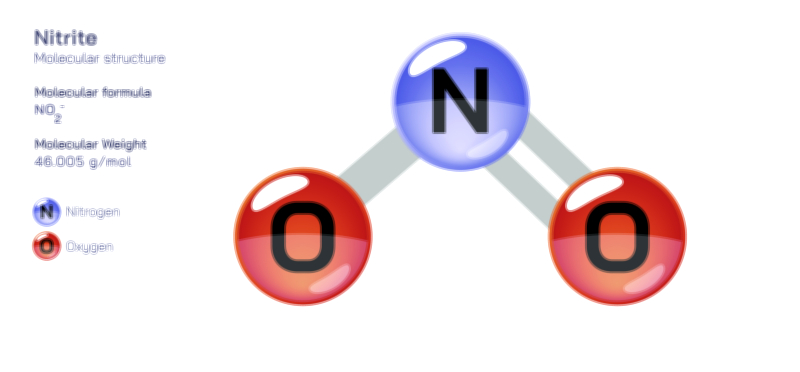
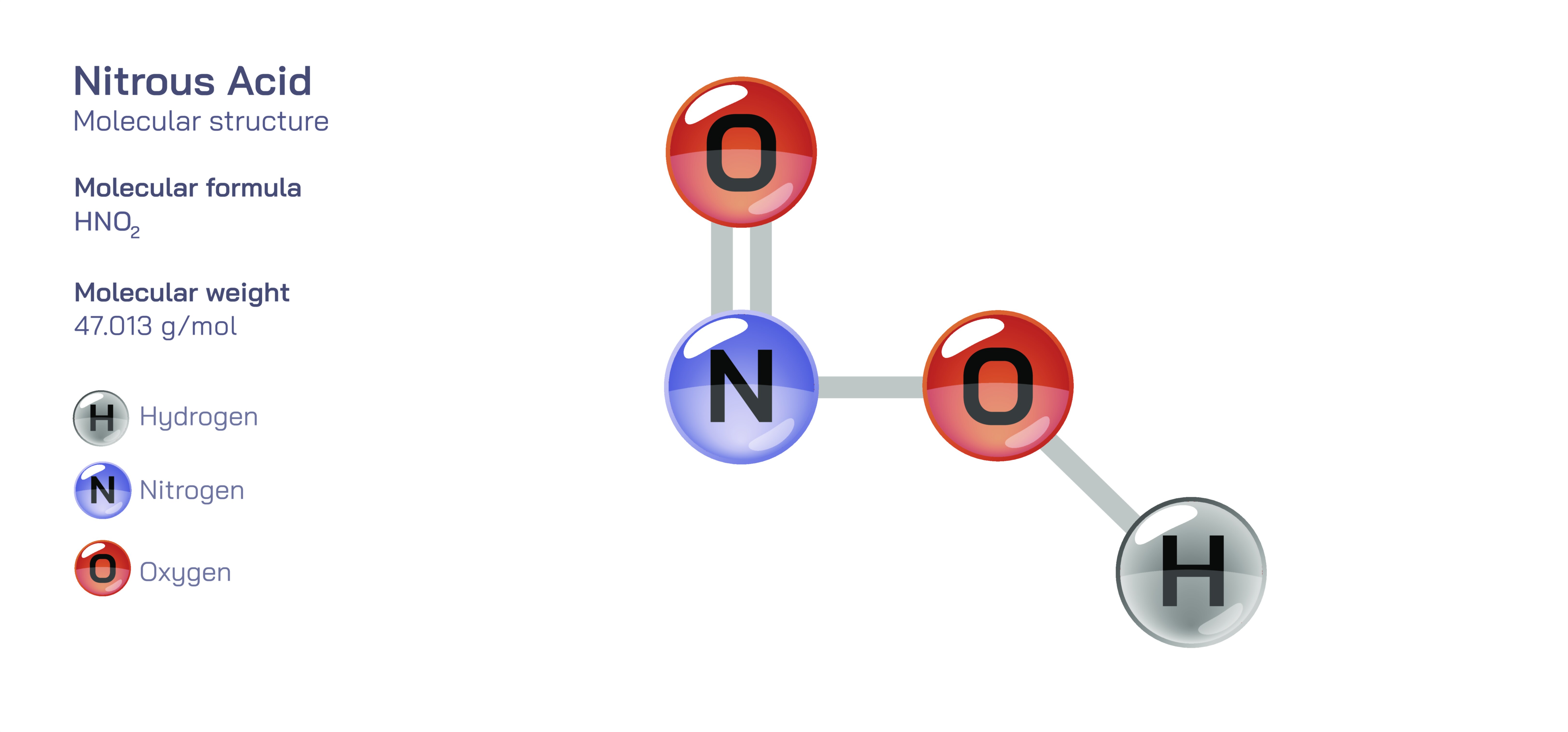
Nitrous acid occupies a unique position in inorganic chemistry because its molecular identity exists not as a stable bottled compound but as a transient, reactive species that appears briefly in aqueous solution before transforming into more stable nitrogen-oxygen molecules. The chemical formula HNO₂ summarizes a structure composed of one hydrogen, one nitrogen, and two oxygen atoms, yet the true behavior of nitrous acid cannot be understood without examining how those atoms are arranged. In a vector illustration of the molecule, the nitrogen atom appears at the center bonded to two oxygen atoms, one through a double bond and one through a single bond that also carries the acidic hydrogen. The geometry is bent rather than linear because the electron pairs do not distribute symmetrically around nitrogen, and multiple resonance structures must be drawn to represent the delocalized electron density across the oxygen–nitrogen framework. This resonance explains both the compound’s weak acidity and its ability to participate readily in reduction and oxidation processes. Visually, the structural diagram highlights the O–H bond responsible for proton release and the reactive nitrogen–oxygen assembly that gives nitrous acid unusual versatility in redox chemistry, making a seemingly modest molecule the source of reactions fundamental to environmental processes, industrial synthesis, and laboratory transformations.
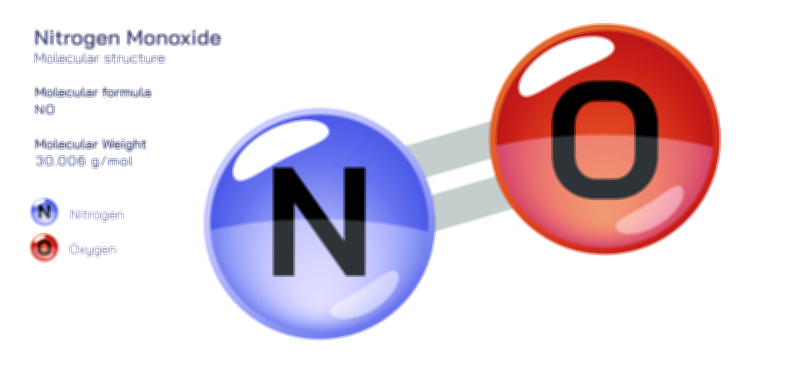
The physical and chemical properties of nitrous acid are anchored in the fact that it is inherently unstable. Pure nitrous acid cannot be isolated or stored; it exists only in solution and even then only under conditions that maintain equilibrium between nitrous acid molecules, nitrite ions, and hydronium ions. In cold, dilute, and mildly acidic water, nitrous acid persists momentarily, but as conditions change it quickly decomposes or reacts with surrounding substances. Temperature and concentration dramatically shift its fate: moderate warming or increased acid strength trigger its disproportionation into nitric oxide (NO) and nitric acid (HNO₃), revealing the molecule’s tendency to rearrange itself into two different oxidation states of nitrogen. The reactivity that drives this decomposition also allows nitrous acid to behave as both a weak oxidizing agent and a weak reducing agent depending on the chemical environment. It can oxidize iodide to iodine, yet it can also be oxidized by strong acids or oxidizing agents to form nitrate. These opposing tendencies are not contradictions but reflections of the molecule’s position between more reduced and more oxidized nitrogen species in the nitrogen cycle. A structural diagram showing the delocalized electron density communicates why nitrous acid does not remain static: it is chemically configured to shift electrons readily, and this flexibility drives both its instability and its functional importance.
Nitrous acid plays a defining role in diazotization reactions, one of the most influential transformations in synthetic and industrial chemistry. When nitrous acid reacts with primary aromatic amines under acidic conditions, it forms diazonium salts that serve as crucial intermediates in the synthesis of azo dyes, pharmaceuticals, polymers, and surface-modifying agents. These diazonium compounds undergo coupling reactions that yield vibrantly colored azo molecules used to produce pigments and coatings in textiles, plastics, printing inks, and food colorants. The process depends on generating nitrous acid in situ by mixing sodium nitrite with a proton source; the moment the acid forms, it produces nitrosyl ions capable of converting the amine into a diazonium species. The vector illustration of nitrous acid captures the availability of nitrogen and oxygen atoms in resonance that enable the transient nitrosyl electrophile, but it is the rearrangement of that structure during the reaction that produces an entire industrial class of compounds. Without nitrous acid, the global dye and pigment industry, which affects everything from clothing aesthetics to product labeling and printing technology, would not exist in its present form.
Nitrous acid also exhibits biologically and environmentally significant reactivity through its ability to form nitrosamines when it encounters secondary amines under acidic conditions. These nitrosamines have drawn considerable scientific interest because some of them exhibit carcinogenic properties in laboratory studies, especially under high-temperature processing or prolonged storage in certain foods. This connection does not make nitrous acid inherently toxic but demonstrates that its reactive nitrogen center can generate powerful products depending on context. Food processing science therefore uses strict regulations and additive strategies to limit chemical environments in which nitrosamines may form. Again, the molecule behaves according to structural chemistry rather than intention: the nitrogen–oxygen framework reacts in predictable ways, and human management determines whether that chemistry produces beneficial or harmful outcomes.
In atmospheric and environmental systems, nitrous acid emerges as a reactive intermediate rather than a full-time resident compound. At Earth’s surface and within the lower atmosphere, nitrous acid is produced when nitrogen dioxide reacts with water on particle surfaces, soil, or atmospheric moisture. When sunlight strikes HONO, it photodissociates to produce nitric oxide and hydroxyl radicals. Hydroxyl radicals are sometimes called the atmospheric “detergent” because they initiate oxidation pathways that break down countless airborne organic compounds and pollutants. Through this role, nitrous acid becomes one of the main sources of hydroxyl radicals in early daylight hours, determining how rapidly pollutants convert into secondary atmospheric products. The molecule therefore exerts an influence far larger than its fleeting presence suggests: its structure predisposes it to release fragments that regulate the chemistry of urban air quality, climate-relevant aerosols, and ozone formation.
In analytical and water chemistry, nitrous acid also has notable importance because it participates in nitrite equilibria that can be measured to evaluate environmental health. Nitrite levels in water systems arise partly because nitrous acid exists in reversible equilibrium with nitrite ions depending on pH. The ion and the acid are not separate topics but two faces of the same chemical system. When pH drops, nitrite ions convert into nitrous acid, and this acid can undergo chemical transformations that influence biological and ecological conditions. Elevated nitrite and nitrous acid concentrations in aquatic environments are associated with agricultural runoff, wastewater discharge, and microbiological imbalance, signaling concerns for aquatic organisms because nitrite interferes with oxygen transport in fish. The reactivity of nitrous acid therefore contributes to environmental monitoring tools that help assess pollution, water safety, and wastewater treatment performance.
In metallurgy and synthetic inorganic chemistry, nitrous acid functions as a selective reducing or oxidizing reagent useful for converting metal ions between oxidation states. It reduces iodate to iodide and ferric ions to ferrous ions, yet it oxidizes stannous ions to stannic ions. These seemingly dual behaviors originate directly from the position of nitrous acid in redox potential tables. Its structure contains both a nitrogen atom capable of electron donation and resonance-stabilized oxygen atoms capable of capturing electrons under different conditions. Nitrous acid does not decide which direction to react; the surrounding redox environment determines whether it serves as electron donor or acceptor. This capacity makes it an effective mild reagent for analytical chemistry, where controlled partial redox changes are often necessary to identify, quantify, or separate metal ions.
The decomposition of nitrous acid into nitric oxide and nitric acid also has industrial and safety implications. The products of this decomposition are strongly linked to further environmental or industrial reactions, and the balance between them determines downstream chemistry. In cases where nitric oxide is the primary product, subsequent reactions in air may feed into photochemical smog formation. When nitric acid predominates, acidification pathways become relevant. The structural illustration of the molecule may show only resonance and bent geometry, but those features determine which decomposition direction is favored by heat, light, catalysts, or the presence of other acids.
The story of nitrous acid illustrates a central lesson in chemistry: a molecule need not be stable to be important. Its very instability allows it to act as a crossroads through which multiple reaction pathways flow. In water, it balances between nitrite and nitrate. In atmospheric chemistry, it mediates the generation of hydroxyl radicals and participates in photochemical cycles. In industrial synthesis, it produces diazonium salts that lead to widely used dyes and pigments. In redox chemistry, it can shift electron balance toward oxidation or reduction depending on conditions. The molecular diagram of HNO₂ — with nitrogen at the center, two oxygen atoms in resonance, and a hydrogen attached to one oxygen — visually conveys the architecture that makes these transformations possible. The geometry and electron distribution determine acidity, decomposition, and reactivity, and those features scale upward to affect technology, environmental systems, food science, and industrial manufacturing. Nitrous acid may exist only briefly wherever it forms, but in those moments it orchestrates chemical change that shapes both natural processes and human innovation.