Nitric Acid — Chemical Structure, Uses, and Reactions
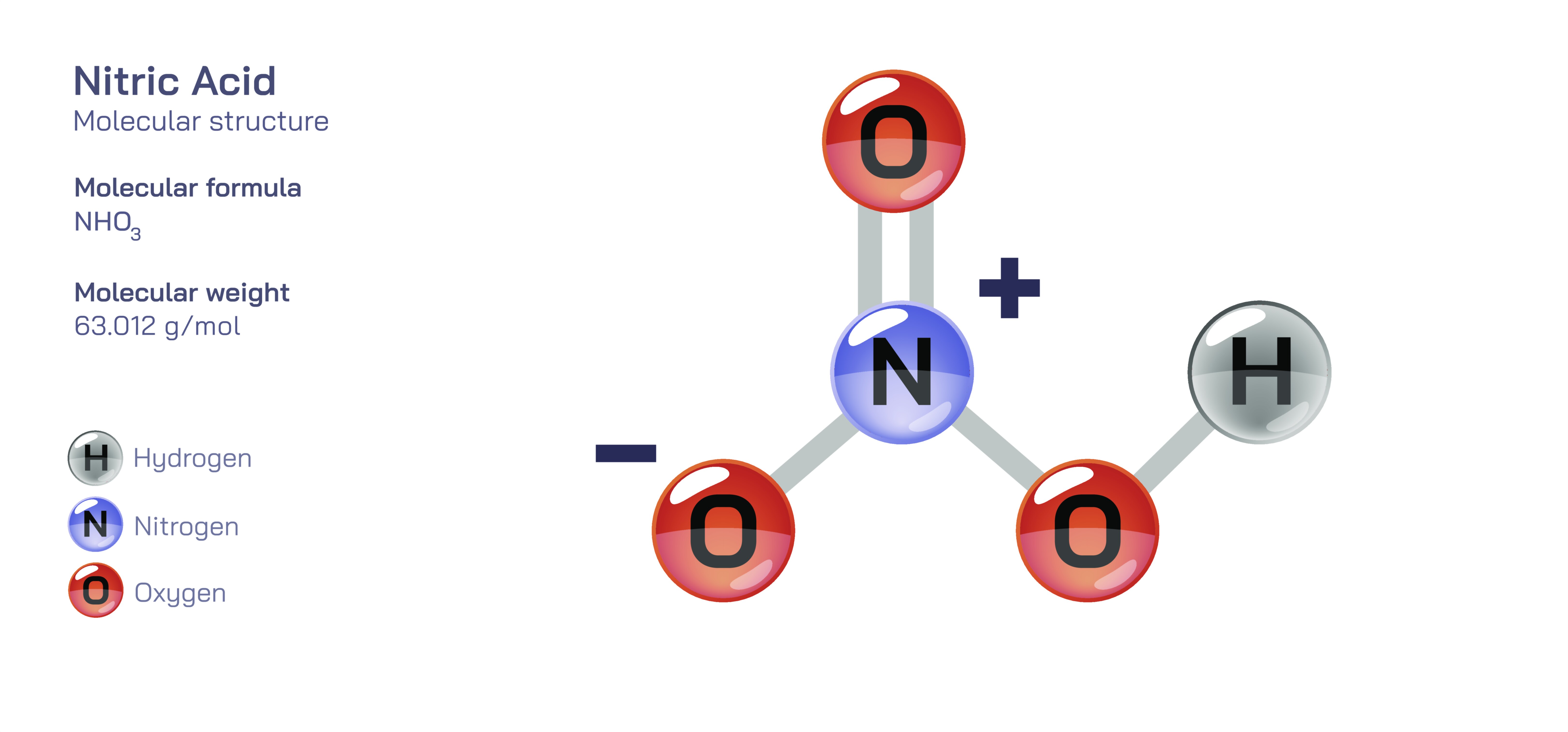
Nitric acid is one of the most influential inorganic acids in modern chemistry, and its molecular structure, industrial functions, and highly reactive behavior make it a cornerstone of both laboratory science and large-scale manufacturing. Structurally, nitric acid consists of a central nitrogen atom bonded to three oxygen atoms, one through a double bond and two through single bonds, with one of the singly bonded oxygens carrying a hydrogen atom. What makes the molecule chemically powerful is not just this arrangement but the resonance distribution of charge across the nitrogen-oxygen framework, which gives nitric acid both strong acidity and exceptional oxidizing ability. In aqueous environments, nitric acid readily ionizes to release hydrogen ions and nitrate ions, and this dissociation process is what allows it to participate in reactions ranging from proton donation to powerful oxidation of metals, non-metals, organic molecules, and transition-state intermediates in catalytic pathways. Visual representations of the compound in vector illustrations typically show the three-oxygen group surrounding the nitrogen in a trigonal planar orientation, with double-headed arrows indicating resonance and a highlighted acidic hydroxyl group to emphasize the part of the structure that dissociates. While such a diagram appears simple at first glance, it conveys the basis for nitric acid’s strong Brønsted acidity, high reactivity, and essential place in industrial chemistry.
Nitric acid plays a central role in agriculture through its use in fertilizer production, where it reacts with ammonia to form ammonium nitrate, one of the world’s most widely used nitrogen fertilizers. This application reflects one of the most significant chemical transformations in modern civilization: converting atmospheric nitrogen into bioavailable fertilizer, enabling global food production to scale beyond natural biological limits. Industrial nitric acid production through the Ostwald process ties directly to the Haber–Bosch synthesis of ammonia, linking energy, agriculture, and chemistry into an interconnected system that sustains billions of people. Beyond ammonium nitrate, nitric acid is used to synthesize calcium ammonium nitrate, urea ammonium nitrate, and other nitrogen-rich agricultural formulations that enhance soil nitrogen levels and stimulate plant growth. These fertilizers release nitrate ions into the soil, which plants absorb through their root systems and convert into amino acids, proteins, nucleic acids, and chlorophyll. Thus, a single molecule capable of donating protons and participating in oxidative transformations ultimately influences global food security and agricultural productivity. This use of nitric acid, when properly managed, supports crop yields and agricultural sustainability, although misuse or excessive application of nitrate-based fertilizers can contribute to environmental challenges such as eutrophication, reinforcing the importance of balancing chemical innovation with ecological responsibility.
Another major industrial application arises in the production of explosives, where nitric acid serves as the nitrating agent that introduces nitro groups into organic compounds. Molecules such as glycerol, toluene, cellulose, and pentaerythritol undergo nitration reactions to form compounds like nitroglycerin, trinitrotoluene (TNT), nitrocellulose, and PETN. These materials harness the chemical energy stored in nitrogen–oxygen bonds and release it explosively when triggered by heat or shock. The nitration process depends directly on the structure and reactivity of nitric acid, and the presence of a strongly electrophilic nitronium ion generated in concentrated acid mixtures makes the reaction possible. While this field of chemistry historically enabled military development, it also drives peaceful technologies such as airbag propellants, rock blasting for mining and infrastructure, pyrotechnics, and demolition work. Each of these applications relies on the predictable reactivity of nitric acid in transferring nitro groups to organic frameworks. Even though the explosive materials derived from nitration are dramatically different from nitric acid in appearance and behavior, their existence traces back to the reactive oxygen–nitrogen system of this single inorganic acid.
Nitric acid is equally important in metallurgy and surface engineering because of its ability to dissolve reactive metals while forming protective oxide layers on others. Metals such as copper, silver, and iron react vigorously with nitric acid to produce metal nitrates, nitrogen oxides, and heat, reflecting the acid’s oxidizing character. At the same time, metals such as chromium and aluminum resist dissolution due to the formation of passivation layers that protect the underlying metal. This selective behavior makes nitric acid central to etching processes, electrorefining, alloy preparation, and ore processing. In jewelry manufacturing and metal purity testing, nitric acid demands attention because of its ability to distinguish between noble and non-noble metals by observing whether the material dissolves. In the aerospace and automotive industries, nitric acid solutions help clean and activate metal surfaces prior to coating or welding, preparing the metal for advanced bonding and corrosion-resistant systems. In stainless-steel fabrication, nitric acid participates in passivation treatments that remove free iron from the surface and promote chromium oxide formation, increasing resistance to rust. These metallurgical applications demonstrate how nitric acid’s structural traits — acidity, oxidation power, and nitrate formation — translate into physical changes in metals that determine their durability and performance.
In the laboratory, nitric acid has long served as a fundamental reagent for qualitative and quantitative analysis of materials. One of its most important uses lies in preparing samples for elemental analysis, where it dissolves metals, decomposes organic matrices, and releases ions into solution so that techniques such as ICP-OES, ICP-MS, and AAS can measure elemental composition with precision. In addition, the formation of brightly colored nitrate complexes makes nitric acid useful in analytical chemistry for identifying transition metals and determining oxidation states. It also functions in the preparation of aqua regia, the mixture of nitric and hydrochloric acid capable of dissolving gold and platinum by generating chlorinated complexes and nitric oxide species that disrupt the metals’ inert stability. In academic and industrial research, nitric acid enables controlled oxidation reactions, nitration, decomposition of organic residues, and pH adjustments that contribute to synthetic chemistry, material science, and nanotechnology. Even when chemists no longer see nitric acid in the final material, the structure of the compound silently influences the science by providing a controlled source of protons, nitrate ions, and oxidizing potential.
Environmental chemistry also depends on nitric acid because of its central role in the natural nitrogen cycle and atmospheric reactions. Nitrogen oxides emitted from combustion can react in the upper atmosphere to form nitric acid, which falls back to Earth in the form of acid rain. This process affects soil chemistry, aquatic ecosystems, infrastructure, and vegetation and has sparked major global responses to limit NOₓ emissions from industry and transportation. Although environmental nitric acid originates from atmospheric chemistry rather than industrial production, the molecule’s effects on ecosystems remind us that biochemical necessity, industrial productivity, and environmental stewardship are deeply interconnected. The same reactive qualities that make nitric acid invaluable in synthesis and agriculture can become disruptive when unmanaged.
Nitric acid also participates in countless other industrial streams, including dye and pigment manufacturing, pharmaceutical synthesis, polymer modification, semiconductor processing, and wastewater treatment. In the pharmaceutical field, nitration reactions may produce intermediates that become drug molecules or imaging agents, while in polymer chemistry, nitric acid can modify cellulose and starch, altering the mechanical properties of fibers and films. In semiconductor fabrication, ultrapure nitric acid helps clean wafer surfaces and remove trace metallic contaminants to ensure defect-free microstructures. In the environmental sector, nitric acid assists in converting ammonia in wastewater into nitrate for further treatment, controlling nitrogen species that would otherwise become environmental pollutants. These applications show the adaptability of nitric acid across fields that require strict control of chemical reactivity.
Every reaction involving nitric acid — whether dissolving metal, forming fertilizer, generating explosives, purifying samples, or cleaning semiconductor wafers — relates to the same microscopic features that define its structure. The nitrogen–oxygen bonding framework, the resonance-stabilized distribution of charge, and the presence of a dissociable hydroxyl group create a compound capable of both releasing protons and accepting or donating electrons during oxidation-reduction chemistry. This duality between acidity and oxidative power makes nitric acid one of the rare reagents capable of transforming organic, inorganic, and metallic substances with equal impact. What we see in a vector illustration — a nitrogen atom bonded to three oxygen atoms and connected to hydrogen — is the symbolic representation of a chemical identity that affects energy, agriculture, manufacturing, exploration, environmental cycles, and scientific discovery. Nitric acid remains more than a staple of chemistry textbooks; it is a material that touches nearly every technological and industrial system in the modern world.