Newton’s Laws of Motion and the Relationship Between Force and Motion
Newton’s laws of motion form the foundational structure of classical mechanics, describing how objects behave under the influence of forces and how motion emerges, changes, or remains constant depending on the physical circumstances surrounding a body. These laws, first articulated by Sir Isaac Newton in the seventeenth century, provided the missing link between the observed movement of everyday objects and the mathematical description of motion that could be applied to everything from a falling apple to the orbit of planets. More importantly, these laws introduced a precise and universal relationship between forces and motion, revealing that movement is not simply a natural tendency of objects but the result of interactions and physical influences that can be defined, predicted, and measured. The modern understanding of engineering, physics, mechanics, transportation, structural stability, aerodynamics, and countless technological innovations owes its roots to these three foundational statements that together reveal the underlying logic of motion in the physical world. Newton did not merely describe how objects move; he explained why they move, how motion changes when forces act, and what happens when no forces interfere. This shift from philosophical speculation to mathematical law shifted the world into a new scientific era, transforming nature into something predictable rather than mysterious.
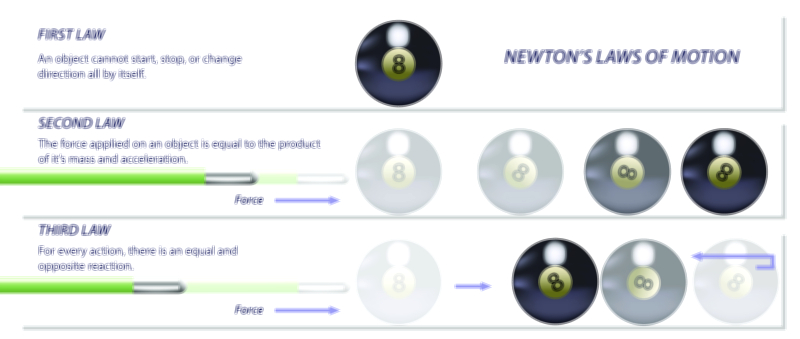
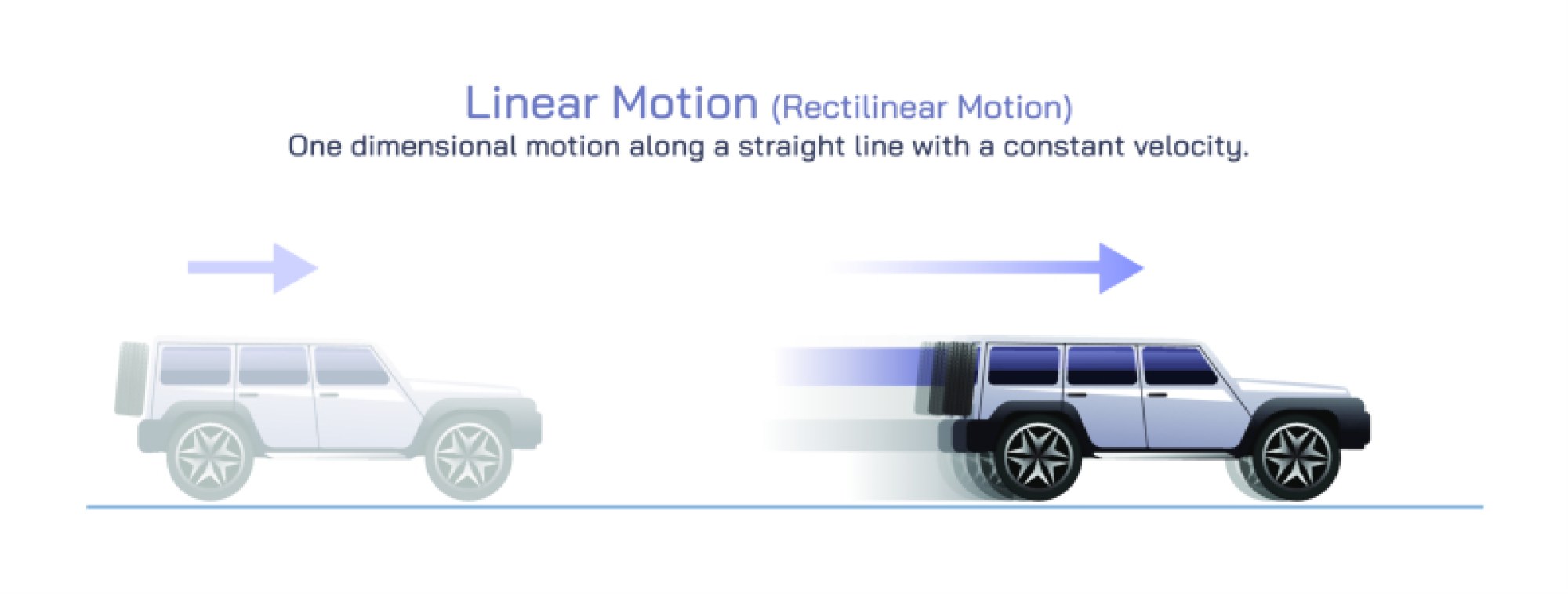
Newton’s first law of motion establishes the concept of inertia, stating that an object remains at rest or continues in uniform motion in a straight line unless acted upon by an external force. This principle overturned earlier beliefs that continual force was needed to maintain motion. In Newton’s framework, motion is not something that requires motivation; it is the natural state of an object unless something interferes. A hockey puck sliding across smooth ice only slows down because friction acts on it, not because motion inherently diminishes over time. A freight train gliding on tracks continues to move forward due to its huge inertia, resisting change in speed unless a significant external force slows or stops it. Even in space, where friction and air resistance are essentially absent, satellites continue to glide for years in steady paths because nothing acts strongly enough to deviate or slow their motion. The first law therefore reveals that motion and rest are not opposites but two different states requiring force to transition between them. Inertia becomes a measure of resistance to change in motion, and its magnitude depends on mass—large-mass objects resist changes more strongly than small-mass ones. With this law, Newton established the idea that forces are not required to maintain motion; rather, forces cause change.
Newton’s second law of motion introduces the quantitative relationship between force, mass, and acceleration. It explains that when a net external force acts on a body, the body accelerates in the direction of the force, and the magnitude of the acceleration is directly proportional to the applied force and inversely proportional to the object’s mass. Although this is commonly expressed mathematically, the conceptual message is that force is not equivalent to motion but the cause of change in motion. A constant force does not produce constant speed; it produces constant acceleration. This distinction reshapes how one understands the world: pushing a car harder produces a greater acceleration than pushing lightly because the change in motion depends on the magnitude of the force. The second law also clarifies why massive objects require greater forces to alter their speed or direction compared with smaller objects. A heavy truck and a light bicycle may both be pushed with equal intensity, but the bicycle accelerates quickly while the truck responds slowly due to its large mass and therefore large inertia. In engineering, this relationship lies behind the design of engines, brakes, machinery, and propulsion systems, in which force must be calculated precisely to achieve the desired acceleration. In aerospace and space travel, propulsion depends on exerting force on spacecraft to create acceleration in an environment where friction does not stop movement but where changes in direction and velocity require carefully controlled thrusts. The second law therefore bridges cause and effect in motion by defining force as the agent that alters the state of motion of a body rather than sustaining it.
Newton’s third law of motion defines the reciprocal nature of forces, stating that for every action there is an equal and opposite reaction. This principle is not an observation limited to collisions but a universal rule governing interactions between objects. Every push, pull, contact, attraction, or repulsion immediately results in an opposing force of equal magnitude acting on the initiator of the force. When a swimmer pushes against water, the water pushes back and propels the swimmer forward. When a rocket expels exhaust gases downward, the gases push the rocket upward, enabling liftoff even in the vacuum of space where there is no air to push against. When a hammer strikes a nail, the nail exerts an equal force on the hammer, which the user feels as resistance. Even when walking, the foot pushes backward on the ground, and the ground responds by pushing forward, allowing the person to move. In each case, motion results from unbalanced forces acting on a specific object, but the interaction always occurs between two bodies in matched force pairs. Newton’s third law reveals that forces are never isolated; they arise through interactions and always involve two participants influencing one another.
Together, these three laws define the full logic of motion. The first law describes the natural persistence of motion in the absence of external forces. The second law explains how motion changes when forces are applied, establishing a direct connection between cause and effect. The third law shows that forces originate in mutual interactions, ensuring that no object can exert force without being affected in return. These laws form a system of thought in which the physical world becomes mathematically predictable and consistent. Every leap, every fall, every collision, every orbit, and every form of movement—whether gentle or violent—is governed by the interplay of these three laws. In practical terms, these laws form the basis for analyzing forces acting on bridges, vehicles, aircraft, construction equipment, robots, sports motions, industrial machinery, planetary motion, and even molecular interactions at larger scales where classical mechanics remains valid. The ability to predict acceleration, balance forces, and manipulate motion lies at the core of all mechanical design and physical modeling.
One of the most profound consequences of Newton’s laws is the recognition that balanced forces produce no change in motion, even when they are large. A book resting on a table experiences a downward gravitational force, but the table exerts an equal upward normal force, leaving the net force at zero and the motion unchanged. A vehicle cruising at constant speed on a highway does so because the forward driving force precisely balances resisting forces such as air drag and rolling friction. Only when these forces become unbalanced does the motion shift. If the engine increases power or the drag decreases, the vehicle accelerates; if the resistance becomes greater than the driving force, it decelerates. Newton’s laws, therefore, do not merely describe motion but reveal the conditions that preserve or modify it, enabling scientists and engineers to diagnose whether an object will remain in equilibrium, gain speed, lose speed, or change direction.
Beyond practical applications, Newton’s laws also shape philosophical understanding of nature. They demonstrate that physical events are not spontaneous or mysterious but the result of the interaction of forces acting according to consistent rules. Movement is never random or arbitrary; it unfolds in response to measurable influences. Although modern physics has since introduced quantum mechanics and relativity to explain reality at extremely small scales and extremely high speeds, Newton’s laws still reign over the everyday physical world humans experience—from falling objects and moving vehicles to mechanical systems and orbital satellites. Classical mechanics remains one of the most successful frameworks ever developed because of the precision and universality of Newton’s insights.
In essence, Newton’s laws of motion and the relationship between force and motion offer a unified description of how the world physically operates. They show that objects do not resist motion out of preference but because inertia is a fundamental property of mass. They show that force is not synonymous with movement but rather the cause of changes in motion. They show that interactions between objects are reciprocal, leaving no action without a corresponding reaction. Through these principles, Newton provided the conceptual and mathematical language that allows humans to interpret motion, predict motion, and engineer motion. Every bridge that stands, every aircraft that flies, every rocket that escapes Earth, and every robot that performs precision movement is ultimately an expression of the laws that were discovered centuries ago yet remain timeless in their relevance. The relationship between force and motion continues to guide the scientific world, reminding us that the behaviors we observe on the grand scale of human experience are governed by fundamental rules woven into the very structure of the physical universe.