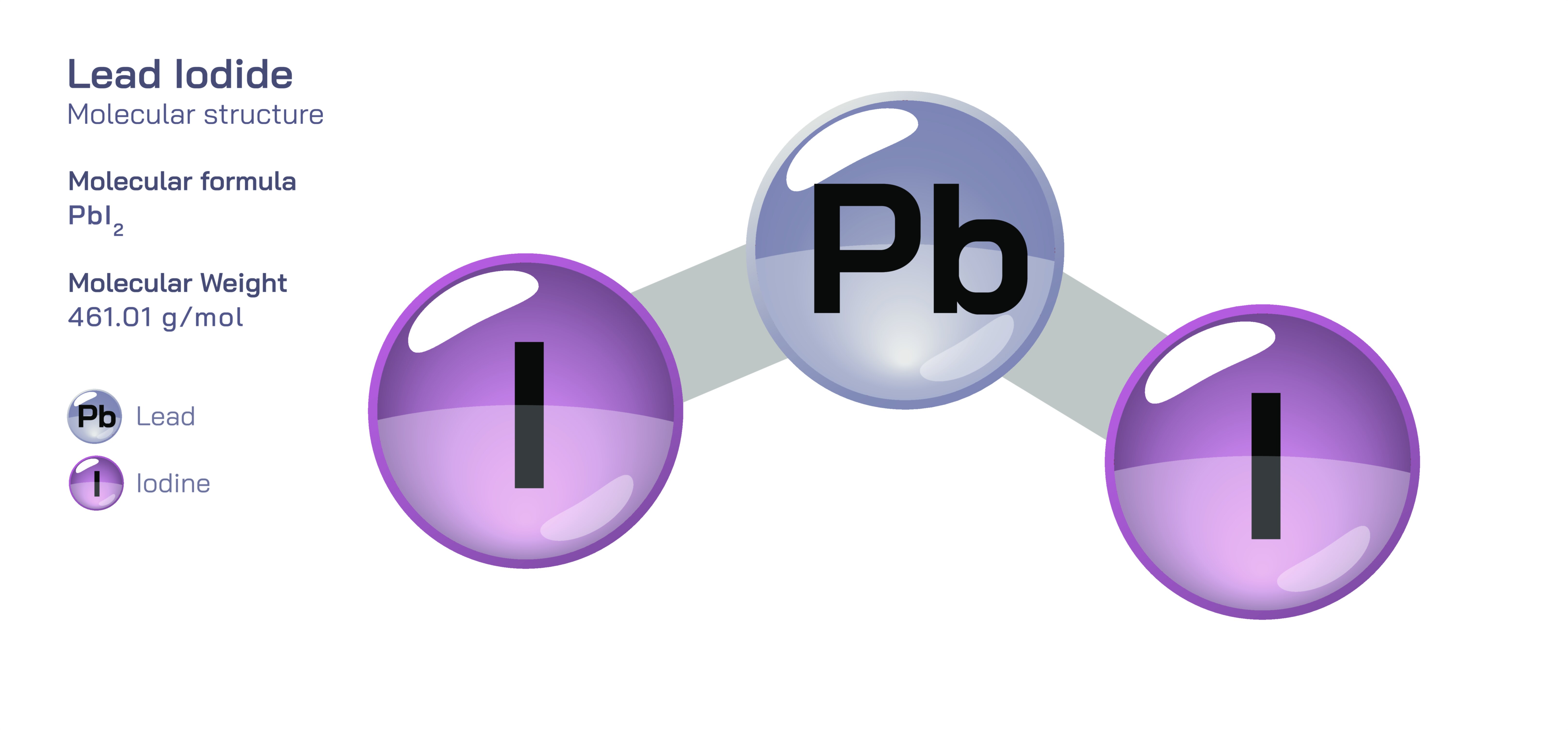
Lead Iodide — Chemical Composition, Crystal Structure, Formation, and Technological Relevance
Lead iodide, represented by the chemical formula PbI₂, is an inorganic compound consisting of one lead atom and two iodine atoms bonded in a highly polar, heavy-metal halide arrangement. Although it appears visually simple as a yellow crystalline powder, its internal structure, bonding behaviour, and thermodynamic properties make it a fascinating and important material in solid-state chemistry, mineralogy, and modern materials science. Lead iodide is well known for its striking colour, sensitivity to light, and its role in precipitation reactions used for qualitative analysis of halide ions in inorganic chemistry. More recently, PbI₂ has become a key precursor in the development of next-generation photovoltaic materials, especially perovskite-based solar cell technology, where it profoundly influences film morphology, microstructure, and optoelectronic behaviour. Understanding its composition and crystalline arrangement provides insight into why PbI₂ behaves the way it does chemically, electronically, and physically.
At the atomic level, PbI₂ contains lead in the +2 oxidation state bound to two iodide ions. Lead in this oxidation state maintains a 6s² electron pair, which plays a critical role in determining the geometry around the embedded metal centre and influences the distortability of the structure. Each Pb²⁺ ion is surrounded by multiple iodide ions in layered sheet-like arrangements that reflect both ionic bonding and polarizability. The I⁻ ions are large and highly polarizable, enabling the formation of strong ionic interactions with Pb²⁺ while also allowing flexibility in lattice geometry. As a result, PbI₂ forms well-defined, extended crystalline structures rather than discrete individual molecules. Unlike volatile metal halides, PbI₂ is highly crystalline because the heavy lead and large halide ions interact strongly through electrostatic and van der Waals forces, producing a layered solid.
The most common and stable polymorph of lead iodide under ambient conditions crystallizes in a hexagonal layered structure, often described using the CdI₂-type lattice as a structural analogue. In this configuration, Pb²⁺ ions occupy octahedral sites sandwiched between sheets of iodide ions arranged in a hexagonal close-packed lattice. Every lead atom is coordinated by six iodide ions in an octahedral geometry, while each iodide ion coordinates with three lead ions. The layered stacking arrangement allows the sheets to slide or cleave easily along the basal plane, giving PbI₂ a characteristic micaceous or plate-like crystal habit. This structural feature also contributes to the material’s optical properties, since the layered lattice influences the movement of charge carriers and the absorption of light.
Lead iodide occurs naturally as the mineral laurionite, although in pure geological deposits it is rare. Most laboratory samples are synthetically produced. PbI₂ often forms immediately upon mixing a soluble lead(II) salt with a soluble iodide salt in aqueous solution, giving a bright yellow precipitate—a classic qualitative test for iodide ions in inorganic analysis. This precipitation reaction illustrates the low solubility of PbI₂ in water at room temperature. However, its solubility increases with temperature, and by heating the solution and allowing it to cool slowly, researchers can grow large, layered single crystals—sometimes used in solid-state radiation detectors or optical experiments. The reversible temperature-dependent precipitation demonstrates the interplay between lattice stability and solvation energy in this compound.
The colour of lead iodide arises from electronic transitions within its lattice. The compound absorbs ultraviolet and blue light strongly while transmitting yellow, giving it its distinctive appearance. Its band gap falls in the visible range, making it responsive to photon excitation. This property, along with the ease of forming smooth crystalline films, has drawn attention in optoelectronics. PbI₂ serves as a precursor for hybrid organic-inorganic perovskites, particularly methylammonium lead iodide (MAPbI₃), which has revolutionized solar cell development due to extraordinary light conversion efficiency. In perovskite synthesis, PbI₂ reacts with organic iodide salts to create continuous semiconducting films with tunable band gaps. The initial structure of PbI₂ directly affects film uniformity, grain size, and defect density, meaning that the nature of the crystals influences final photovoltaic performance. This connection between basic inorganic chemistry and advanced solar technology highlights the scientific relevance of its crystal structure.
The physical properties of PbI₂ also reflect its layered structural arrangement. It melts at high temperatures without decomposing abruptly and sublimes under controlled conditions—a behaviour consistent with layered solids that have strong in-plane bonding but weaker interlayer attractions. PbI₂ is an electrical insulator at room temperature, though under ultraviolet radiation it becomes photoconductive. This sensitivity to light stems from the generation and movement of charge carriers (electrons and holes) within the layered lattice when photons are absorbed. Because of this feature, PbI₂ thin films historically saw use in X-ray and gamma-ray detection, since incident radiation generates charge carriers detectable as electrical pulses. Although more advanced semiconductor materials have become common, PbI₂ remains relevant in academic research for radiation detector prototypes and optoelectronic device studies.
In chemical reactivity, PbI₂ is less oxidizing and less reactive than higher oxidation-state lead compounds such as lead (IV) oxide, but it participates readily in halide exchange and ligand substitution processes. When treated with excess iodide ions, it forms soluble plumbate complexes, demonstrating that coordination around Pb²⁺ can expand through increased ligand interaction. The formation of soluble complexes is useful for purifying, recrystallizing, and studying lead halide materials. PbI₂ can also decompose thermally or react with sulfur compounds to form other lead materials used in electronic, optical, or industrial applications.
Because lead is a cumulative toxicant, PbI₂ must be handled cautiously despite the compound’s usefulness. Ingestion, inhalation of dust, or long-term exposure can lead to neurological, renal, and developmental harm. As a result, laboratory and industrial work involving lead iodide requires ventilation, protective equipment, and proper waste protocols. For environmental safety, recycling and safe reclamation procedures are applied when PbI₂ is used in photovoltaic and electronic manufacturing.
Lead iodide therefore represents a compelling example of how chemical composition and crystal structure govern physical behaviour and technological relevance. The Pb²⁺ cation and two I⁻ anions form a layered lattice that defines colour, solubility, reactivity, mechanical properties, and optical response. A compound once known mainly for its vivid yellow precipitate now stands at the centre of emerging solar energy research and high-performance optoelectronics. Through its structural, electronic, and chemical characteristics, PbI₂ demonstrates how a single inorganic compound can link classical precipitation chemistry to next-generation renewable-energy applications.