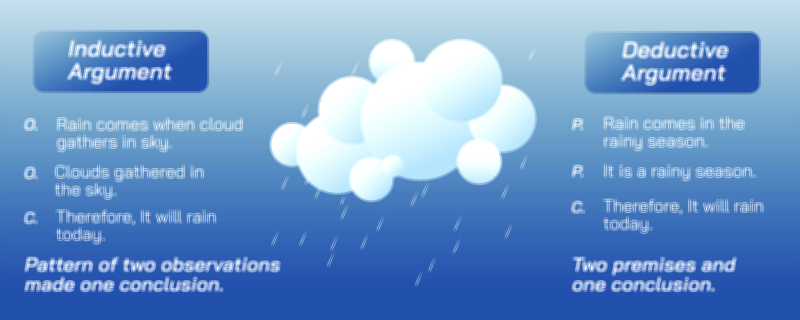
Inductive Argument Logic — Reasoning and Evidence-Based Thinking Concept Explained
Inductive argument logic represents one of the most fundamental ways human beings construct knowledge, form expectations about the world, and expand understanding beyond immediate experience. It is not based on strict deduction from absolute premises but on the gathering of observations, evidence, and patterns that point toward probable conclusions. When we reason inductively, we do not claim certainty in the mathematical or logical sense; instead, we claim that the conclusion is supported strongly by available evidence and is more likely to be true than false. This approach lies at the heart of scientific investigation, everyday decision-making, legal reasoning, and even intuitive judgment. To understand inductive argument logic properly, one must move beyond the simplified definition that “induction generalizes from examples” and appreciate the deeper structure of how observations accumulate, how probabilities strengthen, how patterns suggest broader rules, and how uncertainty is handled responsibly rather than ignored or denied. Inductive reasoning does not pretend to produce unbreakable truths — rather, it advances knowledge through justified probability based on repeated experience.
At the core of inductive logic is the recognition that evidence comes from the world rather than from purely abstract reasoning. Where deductive logic begins with principles and works downward toward guaranteed conclusions, inductive logic begins with concrete data and moves upward toward generalization. When a person observes repeated similarities across multiple cases, the mind infers an underlying principle connecting them. For example, if someone has repeatedly interacted with copper and noticed each time that it conducts heat and electricity, induction suggests that copper in general is a conductor. This conclusion is not automatically certain, because the possibility always exists that a new observation could introduce conflicting evidence, but it becomes rational and defensible based on the accumulated record. In this way, inductive argument logic ties knowledge to real-world experience rather than to purely conceptual assumptions. It reflects the way humans actually expand understanding through repeated contact with the world — seeing patterns, detecting regularities, and forming predictive ideas grounded in evidence.
Scientific inquiry depends on inductive logic at every stage. No scientific law or theory emerges from a single observation; it grows from systematic patterns that become increasingly reliable through repeated testing across varying conditions. When experiments show consistent outcomes, scientists infer broader principles about nature. The strength of the inductive conclusion increases not because it becomes absolutely certain, but because evidence continues to converge around it rather than diverge away from it. A central part of scientific progress is the ability of inductive reasoning to remain open to revision: new evidence can strengthen, weaken, or overturn conclusions. This willingness to update beliefs based on incoming observations distinguishes inductive logic from dogmatic thinking. In this way, inductive reasoning represents the intellectual humility built into the scientific method — knowledge is provisional, but it becomes progressively more trustworthy as evidence accumulates.
Inductive logic is not limited to scientific laboratories; it shapes ordinary life continuously. Every decision a person makes depends on expectation grounded in prior experience: choosing routes based on traffic patterns, trusting relationships based on past behavior, predicting weather based on seasonal familiarity, or estimating success based on previous performance. Humans cannot wait for perfect certainty before acting; life forces decisions under uncertainty, and inductive reasoning provides the best available map. By identifying likely outcomes rather than guaranteed ones, induction guides planning, risk assessment, and problem-solving. Even language learning, cultural understanding, and intuition are built on exposure to patterns that gradually become internalized. When a child learns that fire burns or that night follows day, what is happening is not deductive reasoning but inductive reinforcement — repeated examples build a framework of expectation about the world.
The legal system also depends heavily on inductive logic. Evidence in court does not yield mathematical certainty; instead, jurors infer what most likely happened based on testimony, forensic results, motive, consistency, and probability. A verdict represents an inductive judgment — a conclusion reached because a body of evidence makes one interpretation more plausible than alternatives. Likewise, journalists evaluate sources, historians interpret documents, and economists analyze data trends using inductive structures. These disciplines show that induction is not limited to sensory patterns but extends into the interpretation of complex, abstract, and social evidence. Whenever humans evaluate multiple pieces of information to determine the most likely explanation, they are engaged in inductive reasoning.
One of the most important qualities of inductive logic is that its strength depends on the breadth and quality of evidence rather than on emotional confidence. Weak induction arises when conclusions are drawn from too few cases or from biased observations, such as assuming that all members of a group share a characteristic based on a handful of examples. Strong induction occurs when numerous, carefully observed, and diverse cases support a conclusion. This difference makes inductive reasoning intellectually responsible: strong induction respects the complexity of evidence and the potential for exceptions. Critical thinking requires distinguishing between well-supported inductive arguments and hasty generalizations, where a conclusion is drawn before evidence justifies it. When induction is handled with rigor — gathering varied data, considering alternative explanations, and asking whether new evidence supports or undermines previous expectations — it becomes a powerful tool for reducing uncertainty without succumbing to irrational confidence.
Inductive argument logic also teaches an essential lesson about truth: beliefs should scale with evidence. Instead of viewing ideas as absolutely true or absolutely false, inductive reasoning positions them along a continuum of probability. As evidence increases, confidence increases; as evidence weakens, confidence declines. This approach prevents the errors of dogmatism — belief without evidence — and the errors of nihilism — refusing to believe anything without absolute certainty. Between these extremes lies rational judgment, which treats knowledge as neither rigid nor meaningless but always supported to the degree that evidence warrants. This principle aligns with modern Bayesian thinking, scientific methodology, and rational decision-making frameworks that treat belief as proportional rather than binary.
Perhaps the most illuminating aspect of inductive reasoning is its relationship with uncertainty. Instead of eliminating uncertainty, induction manages it by grounding beliefs in evidence and updating them when information changes. This makes inductive argument logic the cognitive foundation for progress. The history of human knowledge is not a story of unquestionable certainty from the beginning, but a story of gradually improving models of reality tuned by evidence. Each new discovery refines previous beliefs rather than rendering reasoning useless. Induction explains why science advances, why learning evolves, why societies adapt, and why human understanding continuously reorganizes as the world reveals more of itself.
In its deepest sense, inductive argument logic is not merely a technique for forming conclusions — it is an intellectual ethic. It encourages open-mindedness, because new evidence may shift probability. It demands honesty, because conclusions must be based on facts rather than preference. It nurtures humility, because no belief is immune to revision. And it fosters progress, because each new observation enriches collective understanding rather than threatening it. Through induction, human beings acknowledge that knowledge is a living relationship between mind and world, shaped by experience rather than guaranteed by assumption.
Ultimately, inductive reasoning illustrates something profound about the way people grow in knowledge: certainty is not the measure of truth — evidence is. The world reveals itself through patterns, and it is through careful observation, mindful evaluation, and responsible inference that the mind transforms patterns into understanding. Inductive argument logic makes that transformation possible. It allows us to navigate the unknown by grounding belief in the best available evidence, while remaining ready to revise that belief when experience teaches something new.