Inductive vs. Deductive Argument — Logical Reasoning Comparison Explained Visually
Inductive and deductive arguments represent two major pillars of human reasoning, and understanding the difference between them is essential for anyone who wants to think clearly, interpret information responsibly, and avoid confusion between probability and certainty. When portrayed in a vector illustration, the comparison typically shows two reasoning paths side by side: one moving upward from observations to a general conclusion (induction), and the other moving downward from a general rule to a specific conclusion (deduction). But behind this visual structure lies a deeper intellectual story about how knowledge grows, how belief is justified, how evidence supports what we think, and how the human mind navigates the tension between uncertainty and truth.
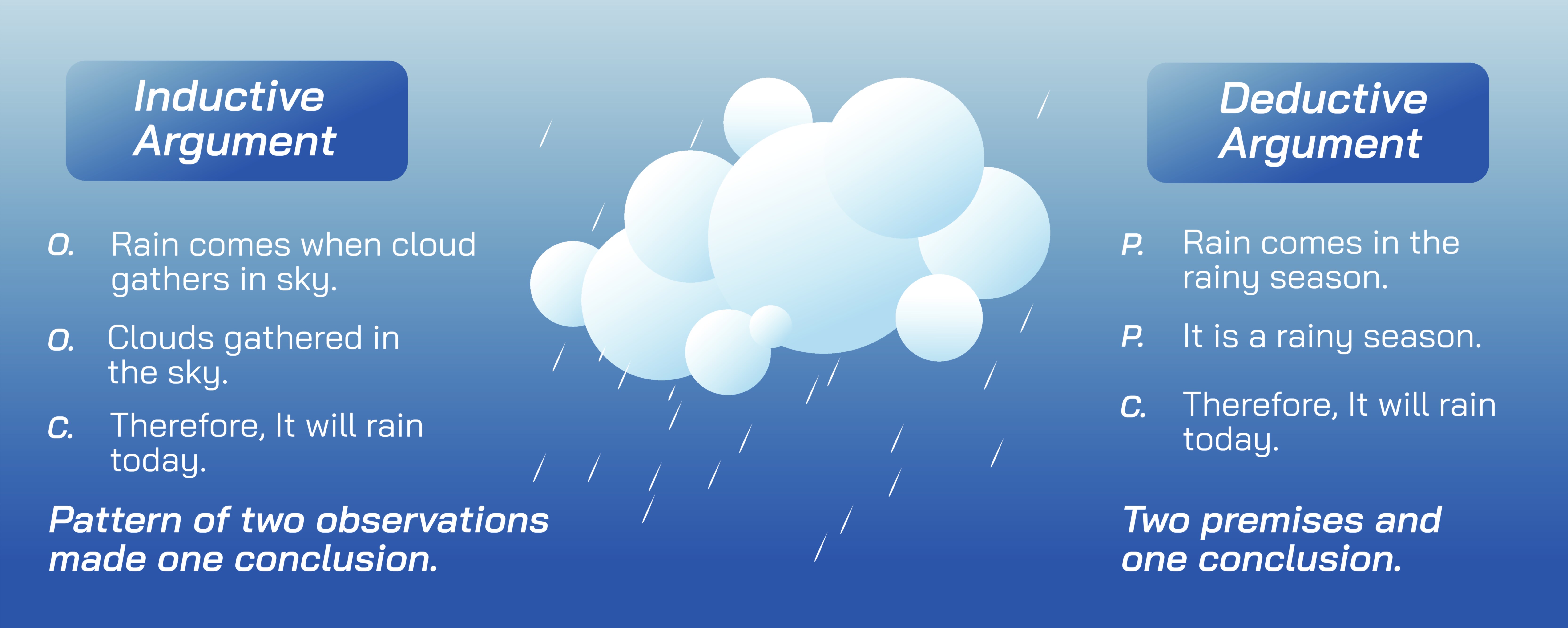
Deductive reasoning begins with a general principle or rule that is assumed to be true and then applies it logically to particular cases to produce a conclusion that must be true if the premises are correct. It moves from the broad to the specific. A classic example is: “All humans are mortal. Socrates is a human. Therefore, Socrates is mortal.” If the premises are true and the logic is valid, the conclusion becomes unavoidable. Deduction does not produce probability; it produces necessity. In a deductive framework, truth flows downward through the structure of logic. A vector illustration of deduction usually shows a clear funnel-like narrowing or a branching tree that starts with a universal statement and ends with a single, precise inference. Deduction is foundational to mathematics, formal logic, and systematic argumentation, where certainty and consistency are indispensable.
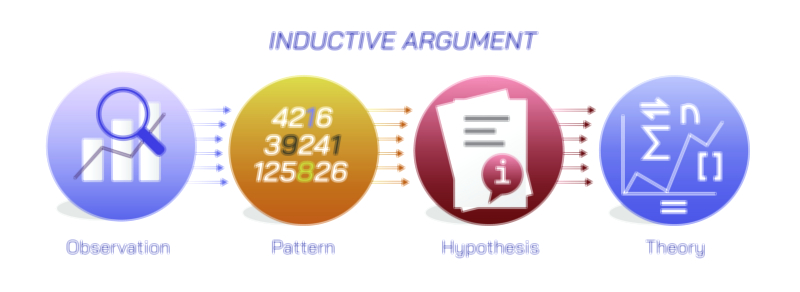
Inductive reasoning moves in the opposite direction. It starts with specific observations, cases, examples, or data and develops a broader conclusion, theory, or prediction based on patterns found within them. Its logic is not about necessity but likelihood — whether the conclusion is supported by evidence rather than demanded by it. For example, if someone has observed copper conducting electricity in many experiments, they might conclude that “all copper conducts electricity.” This conclusion seems highly reliable but is not guaranteed; a new discovery could overturn it. Induction builds knowledge upward from experience, gradually strengthening conclusions as evidence accumulates. A vector illustration typically depicts induction as a progression upward from multiple small data points to a general statement, highlighting how many particular facts converge into a broader inference. Science relies heavily on induction because it builds models of reality by observing nature rather than imposing certainty on it.
A meaningful comparison between inductive and deductive reasoning is not simply a matter of direction — upward versus downward — but of what each type of thinking contributes to human understanding. Deduction preserves truth: if the starting points are correct, the outcome remains logically airtight. Induction expands truth: it stretches knowledge beyond the boundaries of direct experience and creates expectations about the world. Deduction gives structure and consistency to what we already know; induction gives discovery and growth to what we hope to understand. Visual illustrations often contrast these roles by depicting deduction as a stable and internally self-consistent structure and induction as a dynamic pattern-recognition process that evolves as new observations are added.
In real-life reasoning, induction and deduction are not rivals but complementary processes that reinforce each other. Scientific theories begin inductively — patterns are observed, hypotheses form, and potential laws are proposed. But once those laws or models are established, deduction is used to test their internal logic and derive predictions about new cases. When predictions match reality, inductive support grows; when they do not, models are revised. In this sense, the continual interplay between induction and deduction drives scientific progress. A good illustration of their relationship might show a loop or cycle: induction builds theories from evidence, and deduction tests the implications of those theories, which then generate new evidence feeding back into induction.
These two reasoning systems lead to different standards for evaluating arguments. A deductive argument is either valid or invalid — and when its premises are true and its logic valid, its conclusion cannot be otherwise. There is no scale or gradient in deductive strength; the argument succeeds or fails absolutely. An inductive argument, by contrast, is strong or weak rather than valid or invalid. Its strength depends on how much and how good the evidence is. A hasty generalization based on a small number of examples is weak induction. A broad conclusion supported by thousands of consistent and diverse observations is strong induction. Where deductive certainty rests on rigid structure, inductive justification rests on the weight and coherence of evidence.
Both reasoning types play essential roles in daily thinking. Deduction governs situations where rules are already known — following instructions, solving mathematical problems, applying legal codes, or enforcing formal definitions. Induction governs situations where one must learn from experience — predicting behavior, evaluating chances, interpreting patterns, making medical diagnoses, or forming expectations based on history. Human beings do not survive by hesitation, waiting for certainty; instead, life demands decisions based on probability, and induction offers the best possible road in uncertainty. Yet to ensure decisions align with truth rather than bias, deduction provides logical discipline: it prevents the mind from accepting conclusions that do not follow from their premises.
A vector illustration that compares inductive and deductive reasoning visually communicates the difference through direction, shape, and flow. Deduction might be shown as a downward pyramid, branching diagram, or funnel — one general rule narrowing toward a specific case. Induction may be shown as an upward pyramid, mosaic, cluster convergence, or data-to-theory ladder — many individual cases rising toward a generalized principle. The power of such illustrations lies in demonstrating that neither reasoning type is superior; each serves a distinct function in the architecture of thought. Deduction guards correctness. Induction builds understanding.
Deeply considered, the comparison between inductive and deductive arguments reveals not merely academic theory but the foundations of human rationality. Deduction expresses how the mind protects truth from corruption; induction expresses how the mind reaches for truth beyond immediate experience. Deduction safeguards certainty but cannot generate new knowledge on its own; induction discovers new possibilities but requires continual testing to avoid error. Together they form the complete cycle of intellectual growth: observation becomes hypothesis, hypothesis becomes theory, theory generates prediction, prediction meets experiment, and experiment renews observation. The mind advances through the world by balancing these two movements — one grounded in necessity, the other guided by probability.
Understanding inductive and deductive reasoning is therefore not just a matter of memorizing definitions; it is understanding how thought itself works. A visual illustration can clarify the structure, but the deeper meaning lies in recognizing that rationality is a partnership between discovery and validation. Induction stretches knowledge outward into the unknown, and deduction anchors that knowledge in logical certainty. Between them, human beings find both the freedom to explore and the stability to believe responsibly.