Diplacusis Dysharmonica — Auditory Perception Disorder
Diplacusis dysharmonica is one of the more intriguing and complex auditory perception disorders because it reveals how delicate, precise, and finely coordinated the human hearing system truly is. Unlike common hearing conditions that simply reduce volume or clarity, diplacusis dysharmonica reshapes the very character of the sounds a person hears. It creates a perceptual split in which a single sound, especially one with a definite pitch or harmonic structure, is heard as two different tones or two differently tuned versions of the same sound. This distortion does not arise from external acoustic changes; instead, it originates within the auditory system itself—whether in the outer ear, middle ear, inner ear, auditory nerve pathways, or cortical processing centers. Because of this, the condition provides a unique window into how the brain interprets pitch, timbre, and harmonic relationships and how even slight disruptions in the ear's mechanical or neural structures can lead to profound changes in perception. Diplacusis dysharmonica demonstrates that hearing is not merely the detection of sound waves, but a deeply coordinated sensory computation that depends on symmetry between both ears and integrity across multiple biological systems.
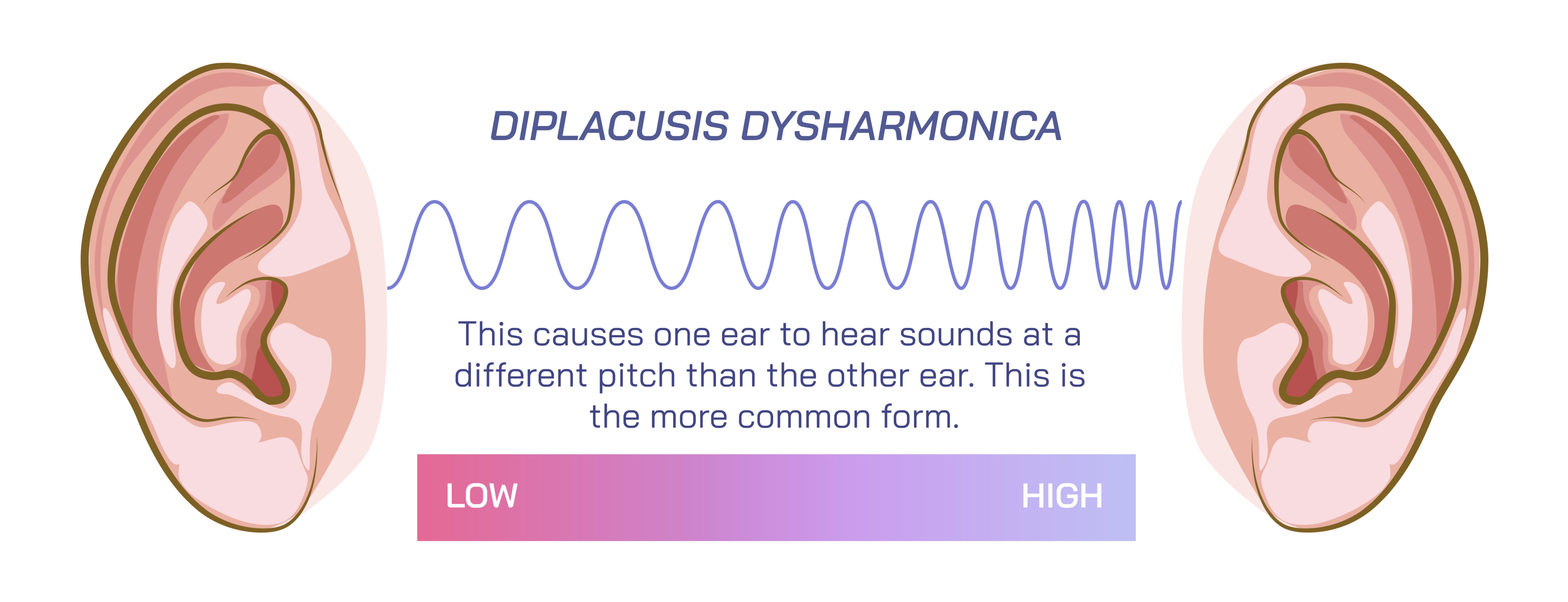
To understand the nature of diplacusis dysharmonica, it helps to consider how healthy auditory perception normally works. When a sound enters the ears, the cochlea—an intricate fluid-filled structure—translates vibration into electrical signals through thousands of tiny hair cells arranged along the basilar membrane. Each region of the cochlea responds to specific frequencies, forming a frequency map the brain interprets as pitch. Crucially, both ears must function in harmony to produce unified auditory perception. When the two ears detect the same sound, they should produce electrical signals with identical frequency representations. In cases of diplacusis dysharmonica, this symmetry breaks down. Damage, disease, or functional disruption modifies how one ear translates incoming sound, causing pitch or harmonic information to shift relative to the other ear. Instead of merging into one coherent auditory experience, the brain receives two conflicting messages. As a result, the person hears one sound as if it were two different tones, two differently “colored” versions, or two pitches separated by an uncomfortable dissonance.
Because the disorder specifically affects the harmonic structure or perceived pitch relationships of sound, it feels especially disruptive for individuals who rely heavily on accurate pitch perception—musicians, audio engineers, singers, composers, and anyone whose professional or personal life depends on precise auditory interpretation. For them, even a slight discrepancy between the ears can make music sound out of tune, speech sound distorted, or everyday noises feel unpleasantly mismatched. However, diplacusis dysharmonica does not exclusively affect musicians; anyone with inner ear damage or illness may experience it. The condition may emerge gradually or suddenly, depending on the underlying cause. It can accompany hearing loss, infections, exposure to loud sounds, head injuries, ototoxic medications, pressure changes, or structural damage within the cochlea. In many cases, the disorder reflects an asymmetry between the ears created by inconsistent hair cell function, uneven cochlear stiffness, inflammation, or fluid imbalance. Because the cochlea encodes frequency with exquisite precision, even slight variations can produce large perceptual distortions.
Diplacusis dysharmonica differs from a related condition known as diplacusis binauralis, in which the same sound is heard at two different pitches across the two ears. In dysharmonica, the mismatch goes beyond pitch alone, extending to differences in timbre and harmonic structure. A tone may sound pure in one ear but raspy or unstable in the other. A musical note may seem slightly sharp or flat on one side, creating a subtle but persistent discord. Complex sounds such as voices or instruments may seem to split into layers or produce internal dissonance that is not present in the external source. This combination of pitch and timbral distortion often makes the experience deeply disorienting. People with diplacusis dysharmonica may describe everyday sounds as “double-layered,” “warped,” “broken,” “buzzing,” or “out of tune.” Some perceive slight delays or echoes, not because of any actual temporal offset, but because the brain receives mismatched frequency patterns that it struggles to integrate.
From a physiological standpoint, diplacusis dysharmonica is frequently associated with cochlear pathology. Because the cochlea contains frequency-specific hair cells, damage or fatigue affecting one region can distort the frequency tuning curve of the affected ear. Noise-induced hearing damage, for example, may cause some hair cells to respond incorrectly or inconsistently, leading the brain to interpret sound differently from that ear. Infections or inflammation may thicken cochlear membranes, alter fluid dynamics, or disrupt ion balances, all of which modify pitch perception. Earwax impaction or middle ear issues may sometimes contribute, though these causes more commonly affect loudness rather than harmonic perception. Ototoxic medications such as certain antibiotics, chemotherapy agents, or diuretics may cause asymmetric hair cell damage, making one ear detune relative to the other. In some cases, sudden sensorineural hearing loss produces immediate diplacusis, with the distorted perception serving as a warning sign of deeper auditory injury.
While cochlear damage is a primary factor, neural and central auditory processing also play roles. The auditory nerve transmits electrical signals from the cochlea to the brainstem, but if nerve fibers are damaged or if the brain’s integration mechanisms are impaired, the signals from both ears may become difficult for the brain to synchronize. Disorders affecting the auditory cortex, such as lesions or neurological degeneration, may distort harmonic interpretation, leading to diplacusis-like symptoms. These central causes highlight how pitch perception is not simply a mechanical function but a complex neural construction requiring precise coordination. Even if both ears collect similar acoustic inputs, disruptions in timing, frequency encoding, or neural synchrony can cause mismatches the brain experiences as separate tones.
The subjective experience of diplacusis dysharmonica varies widely. Some individuals notice only a minor difference noticeable only during musical activities. For others, the distortion affects everyday life, making sounds feel unpleasant, disorienting, or emotionally unsettling. It can lead to frustration, difficulty concentrating, anxiety about hearing decline, or avoidance of sound-rich environments. Musicians may experience profound emotional distress when their internal auditory world becomes unreliable, threatening their sense of musical identity or professional confidence. The disorder can also interact with tinnitus, hyperacusis, or sudden hearing loss, creating complex auditory conditions that affect quality of life. Understanding patient experience is essential, as the psychological and emotional burden of distorted sound often outweighs the severity of the physical damage causing it.
Diagnosing diplacusis dysharmonica involves careful evaluation of hearing function across both ears. Audiologists use a combination of pitch-matching tests, tuning fork assessments, pure-tone audiometry, and speech recognition evaluations to determine asymmetries in frequency perception. Specialized diagnostic tools can measure how each ear processes complex tones or harmonic structures. Because diplacusis often accompanies asymmetrical hearing loss, evaluating cochlear health through otoacoustic emissions or auditory brainstem responses helps identify underlying pathology. Accurate diagnosis is essential for determining whether the diplacusis is temporary, progressive, or indicative of broader auditory dysfunction.
Treatment options depend on the underlying cause. When diplacusis dysharmonica arises from temporary conditions—such as ear infections, fluid buildup, inflammation, or transient cochlear fatigue—symptoms may resolve naturally once the underlying issue heals. Removing earwax, treating infections, or managing allergies can sometimes restore balanced hearing. If the condition results from medication, discontinuation under medical supervision may reduce distortion. For noise-induced or injury-related cases, the focus shifts toward supporting long-term auditory recovery through hearing protection, lifestyle adjustments, and in some cases corticosteroid therapy. When asymmetrical sensorineural hearing loss is present, hearing aids or cochlear implants can improve balance between ears by reestablishing consistent frequency information across the auditory system. Sound therapy, auditory training, and neural retraining techniques may help the brain adapt to the mismatches over time, reducing perceptual distortion even if physical hearing asymmetries remain.
Because diplacusis dysharmonica reflects a mismatch rather than a complete loss of function, rehabilitation often involves helping the brain recalibrate its interpretation of sound. The plasticity of the auditory system allows gradual improvements as the brain learns to compensate for the discrepancies between ears. Musicians may engage in pitch-matching or auditory alignment exercises to retrain the auditory cortex. Some individuals benefit from directional listening strategies, adjusting environmental conditions or using audio equipment to reduce disorienting cues. Counseling and audiological education also help patients understand the nature of their condition, reducing anxiety and improving coping strategies.
The conceptual importance of diplacusis dysharmonica reaches beyond clinical significance, offering insight into the deeper workings of auditory perception. It highlights how the brain constructs pitch not from the physical sound waves alone but from the consistent correspondence of signals across both ears. It underscores the precision required for harmonic perception, where even subtle disruptions can alter the musical or emotional qualities of sound. It reminds us that hearing is not simply a mechanical capacity but a refined neural computation that integrates bilateral input, memory, expectation, and pattern recognition. The disorder demonstrates how intimately we depend on symmetry and stability in our sensory processing, and how quickly our perception can become distorted when that balance breaks.
Ultimately, diplacusis dysharmonica stands as a vivid example of the delicate complexity of the auditory system. It reveals the vulnerability of pitch perception, the interplay between mechanical and neural processes, and the profound impact that small structural or functional asymmetries can exert on our experience of sound. Whether arising from temporary disruptions or long-term auditory damage, the condition illustrates the intricate relationship between the physical ear and the perceptual world it constructs. Through understanding diplacusis dysharmonica, we gain a deeper appreciation for the artistry of hearing itself: a dynamic, bilateral, and exquisitely coordinated sensory process that shapes how we interpret music, speech, emotion, and the sonic landscape of life.