Diplacusis — Binaural Pitch Perception Disorder
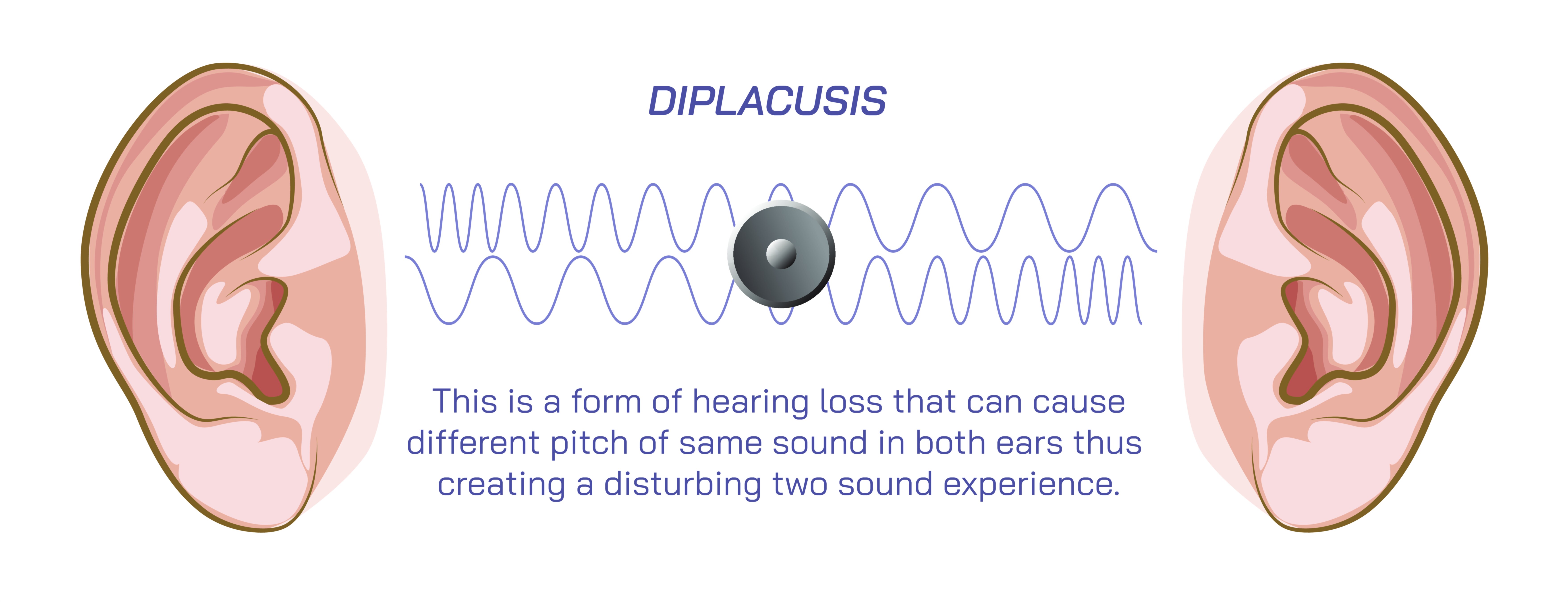
Diplacusis is one of the most revealing and conceptually rich auditory perception disorders because it directly exposes the extraordinary precision with which the human auditory system interprets pitch, timing, and harmonic structure. At its core, diplacusis refers to a condition in which the same sound is perceived differently in each ear. While a healthy auditory system merges the signals from both ears into one unified perception—allowing us to experience music, speech, and environmental sounds as coherent and centered—diplacusis disrupts this symmetry. The sound arriving at one ear is interpreted with a slight alteration in pitch, tone quality, or timing relative to the other. Instead of forming a seamless whole, the brain receives mismatched information, creating the sensation of doubled, detuned, or distorted sound. This disturbance can manifest as hearing two different pitches from the same source, hearing an echo-like delay between ears, or hearing a difference in harmonic richness or sound color. In all cases, the disorder reveals how delicately balanced and finely coordinated the auditory system must be to produce a unified auditory experience. Diplacusis therefore represents a disruption not in the external sound environment but in the internal alignment of ear function and neural processing.
To understand diplacusis, it is necessary to appreciate how the auditory system normally processes pitch. Sound waves entering each ear set off a chain of mechanical and neural events beginning in the outer ear, progressing through the vibration of the eardrum and ossicles, and ultimately activating the cochlea. The cochlea contains thousands of microscopic hair cells arranged along the basilar membrane, each tuned to respond to specific frequencies. This frequency mapping creates an internal acoustic blueprint that the auditory nerve transmits to the brain. When both ears are healthy, this mapping is nearly identical on both sides, allowing the brain to merge the signals smoothly. However, when something disrupts the function of one cochlea—whether through hair cell damage, fluid imbalance, inflammation, pressure changes, injury, or neural conduction issues—the frequency response becomes misaligned. A sound that stimulates a certain group of hair cells in one ear may stimulate a slightly different region in the other. The result is diplacusis: the perception that one consistent sound has been split into two slightly different auditory experiences. This mismatch may be extremely subtle, barely noticeable except in music or quiet environments, or it may be dramatic enough to make everyday listening disorienting.
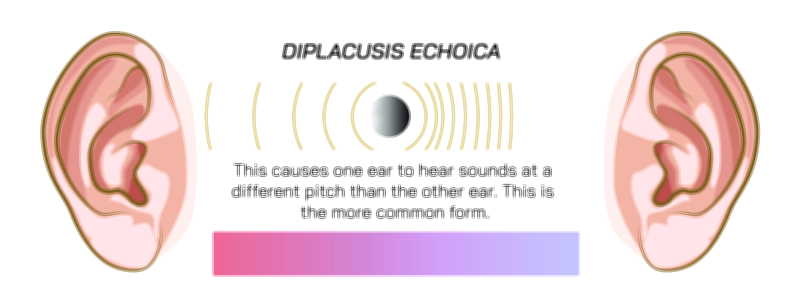
Diplacusis is categorized into several forms depending on how the mismatch manifests, but all forms share the underlying principle of asymmetry between ears. In one form, a single tone is heard at two different pitches across the ears, creating the sensation that the sound is out of tune with itself. In another, the pitch is the same, but the timbre or harmonic richness differs, making one ear hear a purer tone and the other hear a distorted or buzzing version. A third form involves timing differences: the sound reaches one ear normally but arrives perceptually delayed in the other, generating an internal echo or reverberation. These distinctions reveal the complexity of auditory perception. Pitch, timbre, and timing are processed through overlapping but distinct pathways. Any disruption in the mechanical, neural, or perceptual components of these pathways can lead to diplacusis. Regardless of its form, the disorder represents a failure of binaural integration, the process by which the brain aligns the inputs from both ears to create a centered, balanced representation of sound.
The causes of diplacusis are rooted in various forms of auditory asymmetry, most commonly affecting the inner ear. Exposure to loud noise, for example, may damage hair cells in one ear more than the other, altering pitch perception by changing how frequencies are represented. Infections or inflammation may cause fluid pressure changes within the cochlea, affecting how vibrations propagate along the basilar membrane. Earwax buildup or middle ear problems can cause mechanical differences in how sound is delivered to each ear, though these typically influence loudness more than pitch. Sensorineural hearing loss, whether gradual or sudden, frequently produces diplacusis because it disrupts the delicate tuning of cochlear hair cells. Ménière’s disease, which causes fluctuating ear pressure, can produce temporary or chronic diplacusis as the cochlea’s stiffness changes from day to day. Certain medications, particularly ototoxic drugs, may damage hair cells asymmetrically. Additionally, neurological issues affecting the auditory nerve or brainstem pathways may slow or distort signal conduction, creating perceptual mismatches. Even subtler disruptions—such as mild asymmetry in blood flow or metabolic activity within the cochlea—may lead to slight pitch differences that the brain interprets as diplacusis.
The experience of diplacusis varies dramatically depending on the individual, the severity of the underlying condition, and the type of sound being heard. Musicians often notice diplacusis earlier than others because their auditory systems are highly trained to detect small pitch deviations. A note played on an instrument may suddenly sound dissonant inside their own head, with one ear hearing the correct pitch and the other hearing a noticeably sharper or flatter version. For singers, diplacusis can interfere with vocal tuning, as the internal auditory feedback that guides pitch production becomes unreliable. For non-musicians, the first signs may appear during phone calls, in quiet environments, or when listening to everyday tones such as beeping appliances or speech consonants. Some describe sounds as “double,” “split,” “off-key,” “warped,” or “tilted.” Others perceive a slight ringing overlay that seems to belong not to the sound itself but to their internal perception. In timing-related forms of diplacusis, individuals may describe hearing a faint echo or second version of each sound. The internal echo is not caused by the environment but by the ears sending signals at slightly different speeds. This can be unsettling because it creates the sense that external sound is inconsistent, even though the distortion originates entirely within the auditory pathways.
Emotionally and psychologically, diplacusis can be distressing. Because sound is central to communication, music, emotional expression, and spatial awareness, any disruption in auditory coherence may lead to anxiety, frustration, concentration difficulties, and social withdrawal. For individuals who rely heavily on auditory precision—musicians, sound engineers, vocalists—the experience may threaten their sense of professional identity or creative confidence. Many individuals fear that diplacusis signals permanent hearing decline, while others may struggle to explain the symptom to family or clinicians unfamiliar with the condition. Understanding the disorder and recognizing its underlying physiological basis can alleviate some of this distress and encourage timely evaluation.
Diagnosis requires a thorough audiological assessment. Audiologists typically use pitch-matching tests in which the patient adjusts tones until both ears perceive the same pitch. These tests can reveal the exact frequency differences that define diplacusis. Standard pure-tone audiometry may identify asymmetrical thresholds or distortions. Speech recognition evaluations assess whether specific frequency ranges are affected. Otoacoustic emissions testing provides insight into hair cell function, while tympanometry evaluates middle ear mechanics. In some cases, auditory brainstem response testing may be used to detect neural timing issues. If a neurological cause is suspected, imaging such as MRI may be necessary to rule out lesions or nerve compression. Because diplacusis often coexists with tinnitus, hyperacusis, or asymmetric hearing loss, comprehensive evaluation helps distinguish between overlapping conditions and guides appropriate treatment.
Treatment approaches depend on the underlying cause and may include restoring mechanical function, addressing cochlear inflammation, managing fluid imbalances, treating infections, discontinuing ototoxic medications, or supporting natural recovery in cases of sudden hearing trauma. When the root cause is correctable—such as earwax impaction, middle ear blockage, or temporary fluid buildup—diplacusis may resolve almost immediately after treatment. In cases involving sensorineural hearing loss, hearing aids often play a major role in restoring auditory balance. Modern digital hearing aids can adjust frequency response independently for each ear, helping to realign pitch perception and reduce the perceived mismatch. For individuals with severe asymmetrical hearing loss, cochlear implantation may help reestablish neural synchrony and improve pitch alignment. In conditions where the underlying damage cannot be fully reversed, the brain may gradually adapt through neuroplasticity. Over time, the auditory system may learn to suppress or minimize the distortion, even if the physical asymmetry persists. Auditory training exercises, musical pitch therapy, and sound-based neural retraining can accelerate this adaptation. Counseling and audiological education help individuals cope with the perceptual challenges while understanding the mechanisms behind their symptoms.
Beyond its clinical significance, diplacusis offers valuable insight into how the brain constructs auditory reality. It teaches us that hearing depends on the perfect alignment of two separate sensory organs working as one integrated system. The brain does not simply passively receive sound; it compares, merges, synchronizes, and balances inputs from both sides. Even very small disruptions—fractions of a semitone or milliseconds of delay—can fracture this unity. In this way, diplacusis underscores the remarkable precision of human auditory perception. It reveals the vulnerability of pitch processing, the interdependence of mechanical and neural structures, and the intricate computational role the brain plays in making sound coherent. It highlights how the internal experience of sound is shaped as much by symmetry and integration as by external stimuli.
Ultimately, diplacusis stands as a compelling reminder of the subtlety and complexity of binaural perception. It illustrates how delicately tuned the auditory system must be to create a stable, fused auditory world and how easily that stability can be disrupted by injury, illness, or imbalance. Yet it also demonstrates the remarkable adaptability of the brain, which often learns to compensate for disparities over time. Through the lens of diplacusis, we gain a deeper appreciation of hearing not merely as the detection of sound waves but as a sophisticated, bilateral sensory construction that allows us to experience pitch, music, speech, and meaning with extraordinary nuance.