Butt Joints and Weld Types — Understanding a Fundamental Welding Technique
The Foundational Role of Butt Joints in Welding and Fabrication
Butt joints represent one of the most widely used and essential configurations in welding, forming the basis of countless structural, mechanical, and industrial assemblies. A butt joint is created when two pieces of metal are aligned in the same plane and joined along their edges, forming a continuous connection that follows the line where the two surfaces meet. This simple arrangement allows fabricators to create long, strong, and uniform welds that restore the structural integrity of the combined pieces. Because metals in real-world applications must often be joined edge-to-edge—whether in pipelines, pressure vessels, automotive components, machinery, or construction—understanding butt joints becomes a crucial foundation for mastering welding techniques. Their apparent simplicity conceals the complexity of factors that affect weld strength, penetration, durability, and suitability for different load or stress conditions.
How Butt Joints Are Prepared and Why Preparation Matters
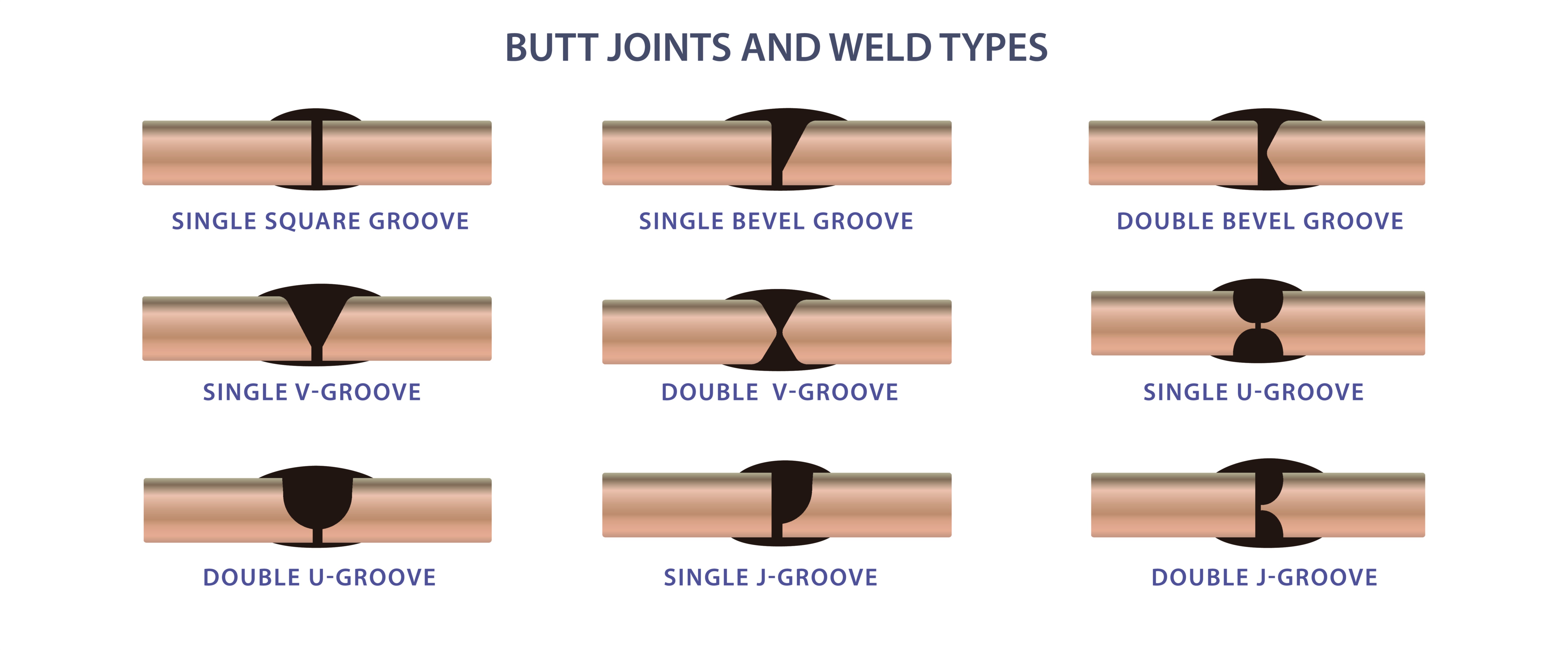
The quality of a butt joint depends heavily on how the edges of the metal pieces are prepared before welding. Clean, smooth, and properly shaped edges encourage better fusion between the metals, reduce the likelihood of defects, and support full penetration welds when necessary. Depending on the thickness of the metal, fabricators may leave the edges square or shape them into beveled profiles that create a larger opening for molten metal to fill. These beveled edges—commonly called grooves—enhance accessibility for the welding arc or flame and allow the filler material to flow more deeply into the joint. Preparation also includes removing contaminants such as oil, rust, paint, or moisture, all of which could weaken the weld or cause porous defects. Through careful preparation, butt joints become capable of handling demanding loads and enduring long-term stress without failure.
Understanding Common Weld Types Used on Butt Joints
Butt joints can be welded using several different weld types, each chosen based on the thickness of the material, the intended strength of the joint, and the specific requirements of the project. The simplest form is the square butt weld, where the two pieces are joined without beveling, typically used for thin materials where deep penetration is not required. For thicker sections, V-groove, double V-groove, J-groove, and U-groove welds are used. These shapes increase access for the welder, allowing the molten metal to fill deeper profiles and creating strong bonds across the thickness of the material. For very thick or high-strength applications, welders may perform the operation from both sides of the joint to ensure complete penetration and structural continuity. Each weld type balances efficiency, weld strength, and material thickness, enabling the welder to tailor the process to the engineering needs of the project.
How Welding Processes Influence Butt Joint Quality
Different welding processes—such as shielded metal arc welding, gas metal arc welding, gas tungsten arc welding, flux-cored welding, or submerged arc welding—produce distinct characteristics in butt joints. Processes using a continuous electrode provide smooth, consistent weld beads ideal for long seams and structural applications. Tungsten-based processes offer greater control, making them suitable for butt joints requiring precision or welds on metals vulnerable to heat distortion. Submerged arc welding, with its deep penetration, is well suited for large-scale butt joints found in heavy steel fabrication. The choice of process affects not only the appearance of the weld but also its strength, depth of fusion, and resistance to cracking or failure under stress. By selecting the proper method, welders ensure that the butt joint meets the mechanical and environmental requirements of its intended application.
The Role of Heat, Penetration, and Weld Pool Control
At the core of every butt joint weld lies the careful management of heat and the molten weld pool. Too much heat can distort the metal, weaken the surrounding region, or produce excessive penetration, while too little heat can lead to incomplete fusion, resulting in a weak or unreliable joint. Achieving the correct level of penetration is crucial for butt joints because these joints often bear significant tensile and bending loads. The welder must maintain a stable arc, consistent travel speed, and controlled filler material deposition to create a uniform weld bead that fully integrates the two edges. Proper heat control also helps reduce residual stresses and prevents defects such as cracks, porosity, or undercuts. Mastery of heat input is therefore one of the key skills that separate high-quality butt joint welding from weaker or less reliable work.
Inspection and Quality Assurance of Butt Joint Welds
Because butt joints are commonly found in structural and pressure-bearing systems, their quality must be verified through rigorous inspection methods. Visual inspection remains the first and most accessible technique, allowing inspectors to evaluate bead uniformity, surface integrity, and potential visible defects. For deeper evaluation, non-destructive methods such as ultrasonic testing, radiography, magnetic particle testing, or dye penetrant inspection are used. These techniques reveal internal flaws, incomplete fusion, or hidden cracks that may compromise performance over time. A well-executed butt joint should demonstrate complete bonding between the two metal sections, smooth transitions between the weld metal and base metal, and a consistent internal structure capable of bearing loads without weakness. Quality assurance ensures that the joint meets safety, engineering, and industry standards.
Applications Across Structural, Industrial, and Mechanical Fields
Butt joints are foundational in industries that depend on welded structures. In pipeline construction, long continuous butt welds ensure leak-free operation under high pressure. In shipbuilding and offshore engineering, large metal plates are joined edge-to-edge to create hulls and structural frameworks. Automotive and aerospace manufacturing rely on butt joints for components where weight distribution and structural integrity are critical. Even artistic and architectural metalwork uses butt joint welding to create clean, seamless forms. The adaptability of butt joints makes them essential in environments that depend on efficient assembly, strong structural continuity, and precise alignment.
Why Butt Joints Remain a Cornerstone of Welding Technique
Despite advances in welding technology, automation, and materials science, the butt joint remains a central technique because of its simplicity, strength, and versatility. It represents the most direct way to join metal pieces along their edges, forming welds that can withstand significant mechanical stresses while maintaining structural alignment. The variety of weld types and processes that support butt joints allow welders to adapt the method to everything from thin sheet metal to massive industrial components. As a result, butt joints continue to form the backbone of countless engineered systems, demonstrating how fundamental welding concepts remain relevant even in the most advanced applications.