Carbon Disulfide — Inorganic Chemical Compound
Carbon disulfide is an inorganic chemical compound whose simple formula hides a remarkably complex and influential presence across industrial chemistry, environmental science, toxicology, and the history of material production. Despite consisting of only one carbon atom bonded to two sulfur atoms, its structural characteristics impart physical and chemical properties that make it simultaneously valuable, hazardous, and scientifically intriguing. Its distinctive molecular arrangement allows it to act as a powerful solvent, a reactive intermediate, and a precursor in several large-scale manufacturing processes. Although carbon disulfide has been overshadowed in everyday life by more familiar compounds, it remains a cornerstone of certain industries and continues to draw scientific interest due to its volatility, reactivity, and interactions within natural and artificial environments. Understanding carbon disulfide requires examining its molecular behavior, industrial importance, environmental implications, and biological effects, all of which stem directly from the way carbon and sulfur interact within the molecule.
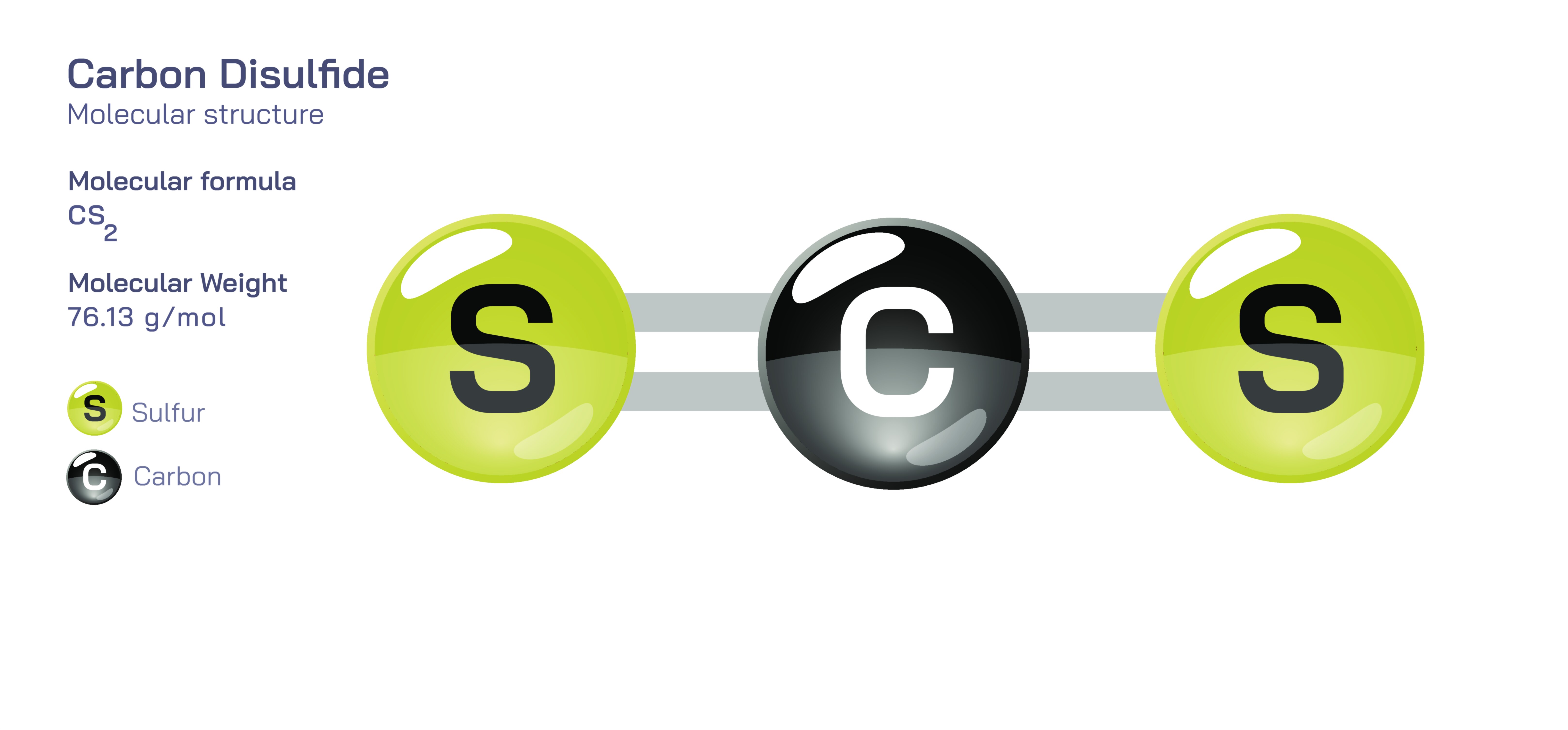
At the molecular level, carbon disulfide consists of a linear structure, with the carbon atom in the center connected to two sulfur atoms on either side. This geometry arises because sulfur, being larger and less electronegative than oxygen, forms long, double-bond-like interactions with the central carbon, arranging the atoms symmetrically and evenly. The symmetry of its molecular shape means that carbon disulfide has no permanent dipole moment, giving it a nonpolar character despite being composed of elements that can form polar bonds in other contexts. This nonpolarity explains its ability to dissolve fats, oils, resins, rubber-based materials, and various organic substances that do not dissolve easily in water. Its physical properties, such as a low boiling point, high volatility, and distinct odor, further reflect the weak intermolecular forces between its molecules. These properties make carbon disulfide easily dispersible into air, contributing to both its usefulness as a solvent and the risks associated with inhalation exposure.
Historically and industrially, carbon disulfide has played a crucial role in manufacturing rayon, a semi-synthetic textile fiber derived from cellulose. In the viscose process, cellulose reacts with carbon disulfide to form cellulose xanthate, a soluble intermediate that later regenerates into rayon fibers once the xanthate decomposes. This method allowed industries to convert natural plant fiber into versatile, silk-like materials, transforming global textile production throughout the nineteenth and twentieth centuries. Carbon disulfide is also central in the production of cellophane, another cellulose-based product that revolutionized packaging by providing a transparent, flexible film. In addition, carbon disulfide contributes to the synthesis of carbon tetrachloride, rubber accelerators, flotation chemicals for mining, and organosulfur compounds used in agriculture. These widespread applications highlight how a single molecule can influence entire sectors of manufacturing, from clothing to packaging to mining technologies.
Beyond industrial chemistry, carbon disulfide appears in nature in small amounts. Certain volcanic gases, marsh environments, and decaying organic matter release trace quantities of the compound, demonstrating that sulfur–carbon interactions are not exclusive to engineered processes. Environmental occurrences are typically minor compared to industrial production, but they contribute to the compound’s long-term atmospheric presence. In the atmosphere, carbon disulfide undergoes gradual oxidation through interactions with sunlight and reactive oxygen species, eventually forming sulfur dioxide and sulfate aerosols. These breakdown products can influence atmospheric chemistry, cloud formation, and regional air quality. Understanding these pathways allows environmental scientists to model how emissions from industrial sources contribute to broader ecological cycles and to develop strategies for reducing harmful impacts.
Toxicology is another critical dimension of carbon disulfide’s scientific profile. Because it is highly volatile, inhalation is the most common route of exposure, especially in occupational settings. Historically, workers involved in rayon production faced significant health risks due to prolonged exposure, as carbon disulfide can affect the nervous system, cardiovascular function, and metabolic processes. Symptoms of exposure range from headaches, dizziness, and irritability to more severe consequences such as nerve damage or heart complications if concentrations remain high and prolonged. Modern industrial practices have significantly reduced these risks through better ventilation systems, exposure limits, monitoring technologies, and safer production methodologies. The history of carbon disulfide toxicity underscores the importance of marrying chemical innovation with occupational safety and regulatory oversight, ensuring that the benefits of production do not undermine worker well-being.
In physical chemistry and materials science, carbon disulfide draws interest for its refractive index, rapid evaporation rate, and ability to dissolve otherwise insoluble substances. It has been used in spectroscopy and optical experiments, especially in early research into light–matter interactions, because its transparency to a wide range of wavelengths allows scientists to study subtle spectral phenomena. Its reactivity also makes it a useful reagent for synthesizing thiocarbonyl compounds and sulfur-containing heterocycles, which serve as building blocks in pharmaceuticals, agrochemicals, and complex organic molecules. The combination of nonpolarity, high reactivity under controlled conditions, and strong solvating ability gives it a unique profile compared to many other inorganic compounds.
Agriculture has also incorporated sulfur chemistry derived from carbon disulfide, though direct use of the compound itself has diminished due to safety concerns. Historically, it acted as a fumigant for stored grains, soils, and insect control, exploiting its ability to penetrate deeply into stored products. Over time, safer and more stable sulfur-based pesticides replaced carbon disulfide, yet its influence remains embedded in the development of agricultural chemistry. Today, carbon disulfide is more frequently used indirectly, as a precursor to compounds that play pivotal roles in crop protection and soil treatment.
In environmental science, understanding carbon disulfide also means examining how it behaves in water, soil, and air. Because of its low solubility in water and strong volatility, it tends to escape into the atmosphere rather than remain dissolved, resulting in minimal accumulation in aquatic systems. However, its rapid evaporation can lead to localized air pollution near industrial areas if not properly managed. Once in the atmosphere, its chemical transformations can influence sulfur cycles and regional air chemistry. In soils, carbon disulfide breaks down relatively quickly due to microbial activity, converting into simpler sulfur-containing species that integrate into natural biogeochemical processes.
The complexity of carbon disulfide’s behavior also draws attention in forensic science, environmental monitoring, and industrial emissions tracking. Measuring its presence in the environment helps determine compliance with regulations, assess workplace safety, and identify leaks or improper disposal. The compound’s detectability, combined with its volatility, makes it an indicator of specific industrial processes, helping agencies pinpoint sources of contamination or emissions more efficiently.
Ultimately, carbon disulfide stands as a compound that bridges historical industrial innovation with modern scientific inquiry. Its simple linear molecular structure masks a spectrum of interactions that influence textile manufacturing, chemical synthesis, atmospheric chemistry, environmental cycles, and human health. It serves as a reminder of how an inorganic compound can shape entire technologies while requiring careful attention to safety, environmental stewardship, and sustainable practice. Understanding carbon disulfide involves appreciating both its valuable roles and its risks, recognizing that its place in the world is defined by both its molecular nature and its broad impact across human and natural systems.