Benzene — Understanding the Aromatic Hydrocarbon Molecular Structure
The Fundamental Nature of Benzene as an Aromatic Compound
Benzene is one of the most iconic and influential molecules in organic chemistry, serving as the foundation for countless compounds found in nature, industry, and everyday materials. Classified as an aromatic hydrocarbon, benzene contains only carbon and hydrogen atoms arranged in a uniquely stable circular form. This circular arrangement gives benzene its distinctive properties, allowing it to behave in ways that differ significantly from other hydrocarbons. Its structure influences how it reacts, how it bonds, and how it contributes to more complex chemical systems. Because of its stability and versatility, benzene stands at the crossroads of chemical science, connecting simple molecular patterns with highly sophisticated organic frameworks.
The Ring Structure That Defines Benzene’s Identity
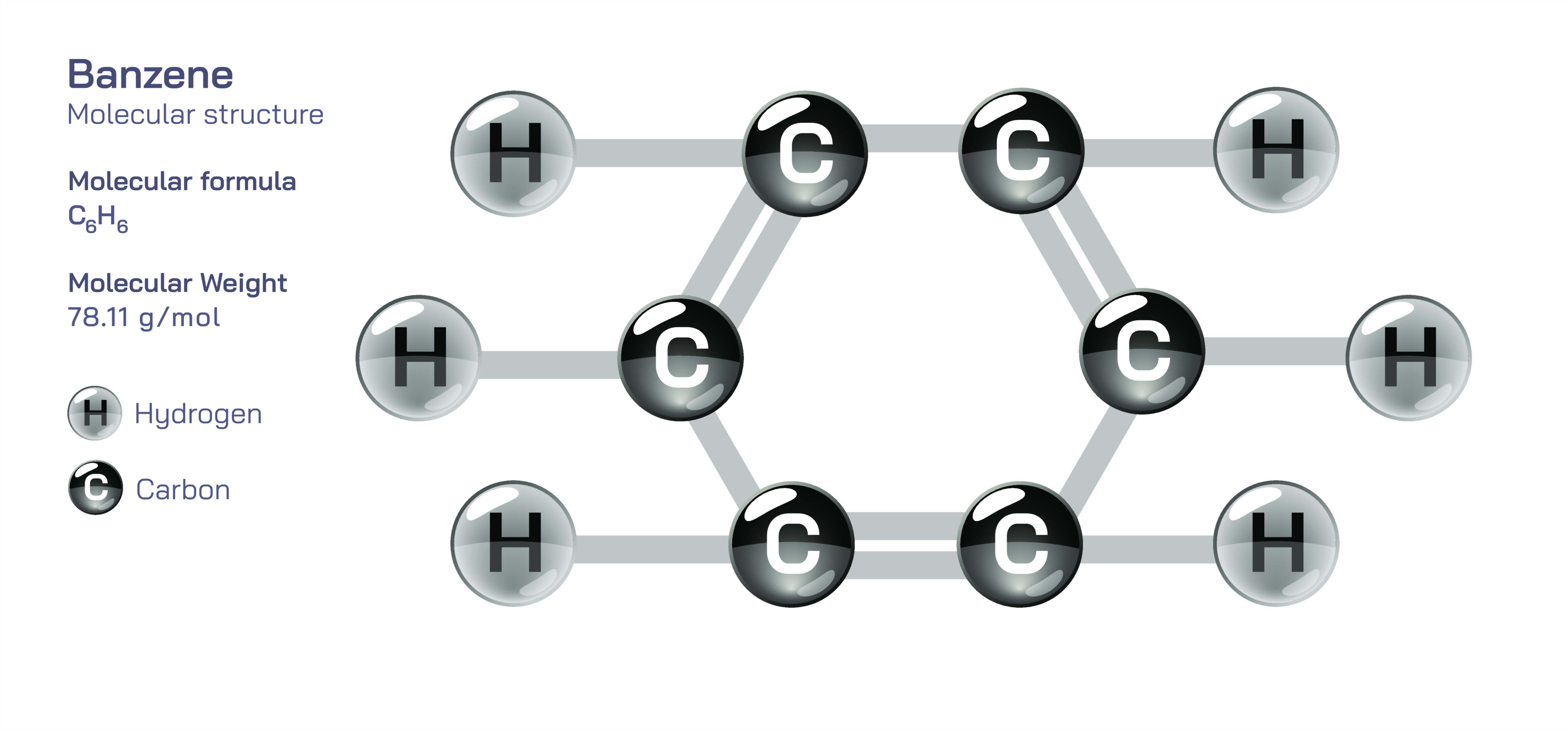
At the heart of benzene’s structure is a six-carbon ring arranged in a perfect hexagon. This ring forms the foundation of the molecule and gives benzene its characteristic symmetry. Each carbon atom is connected to two neighboring carbon atoms, creating a continuous loop that maintains a balanced and uniform shape. Attached to each carbon is a single hydrogen atom, extending outward from the ring. This arrangement is simple in appearance yet powerful in function. The circular design provides a stable platform that resists breaking and rearranging, which is one of the defining traits of aromatic compounds. Illustrations of benzene often highlight this hexagonal shape, representing its symmetry and the way its atoms share structural responsibilities within the ring.
How Electron Distribution Supports Stability and Reactivity
One of the most remarkable aspects of benzene is the way electrons behave within its ring. Instead of being confined to specific bonds between individual carbon atoms, electrons are spread evenly across the entire ring in a continuous, unified region. This even distribution creates a stable internal environment that strengthens the entire molecule. Because of this shared electron cloud, benzene does not behave like a typical ring of alternating single and double bonds. Instead, it forms a structure that is more balanced and less reactive, acting as a foundation for other chemical systems. This stability allows benzene to maintain its shape during reactions that would normally disrupt less stable molecules. Yet its electron distribution also gives it the ability to form strong connections when reacting under the right conditions, making it useful in creating more complex structures.
How Benzene’s Structure Influences Its Chemical Behavior
The circular arrangement of benzene creates a molecule that is both stable and selective in its interactions. While many hydrocarbons readily undergo reactions that break their primary bonds, benzene resists such changes, preferring reactions that preserve its ring. This tendency makes benzene a cornerstone in organic synthesis, as it provides a strong structural base that can be modified without losing its core identity. Scientists and industries rely on this predictable behavior when synthesizing dyes, polymers, pharmaceuticals, and many aromatic materials. The structure allows benzene to undergo substitution reactions—changes that allow new groups to replace hydrogen atoms on the ring without disrupting the ring itself. This flexibility forms the foundation of aromatic chemistry, where substitution patterns create an immense variety of compounds.
Why the Aromatic Ring Is Central to Organic Chemistry
Benzene’s structure is more than a simple molecular shape; it is a model that influenced how chemists understand bonding, stability, and molecular behavior. The concept of aromaticity—first revealed through benzene’s unusual stability—transformed the study of chemistry by showing that ring-shaped molecules can behave in ways not explained by earlier bonding theories. Benzene’s ability to maintain stability under conditions that break other molecules demonstrated a new type of structural resilience. This discovery paved the way for understanding other aromatic systems found in nature, such as those in plant pigments, DNA bases, neurotransmitters, and countless life-supporting molecules. The aromatic ring is now recognized as one of the most important frameworks in organic and biological chemistry.
Role of Benzene as a Building Block for Larger Structures
Because of its stable and adaptable structure, benzene serves as a core component in many complex chemical products. Its ring forms the backbone of numerous industrial materials, including plastics, synthetic fibers, detergents, dyes, and pharmaceuticals. Many natural molecules also contain benzene-like rings, demonstrating how deeply this structure is embedded in the chemistry of life. The benzene framework provides strength and durability, making it ideal for materials that require long-lasting performance. Its versatile nature allows it to participate in modifications that transform it into entirely new compounds while still retaining the stabilizing influence of its original ring.
How Understanding Benzene’s Structure Enhances Scientific Insight
The study of benzene’s molecular structure offers important lessons about how matter behaves on the smallest scale. It reveals how symmetry, stability, and electron distribution shape the properties of substances, influencing everything from reactivity to strength and durability. Learning about benzene deepens scientific understanding of how molecular structures determine chemical behavior and how nature uses similar patterns to build essential molecules. The hexagonal ring of benzene has become one of the most recognizable symbols in chemistry because it represents both simplicity and complexity—a framework that is easy to visualize yet rich in meaning.
Why Benzene Remains a Foundational Concept in Chemistry
Benzene’s molecular structure continues to be a central topic in chemistry because it forms the basis for understanding aromaticity, chemical stability, and molecular design. It provides a starting point for exploring how complex organic molecules function, how they are synthesized, and how they interact with their environment. Its elegant hexagonal arrangement reflects the beauty and logic of molecular architecture, demonstrating how order at the atomic level gives rise to the diversity of materials and life around us. Understanding benzene is not just a lesson in structure—it is an entry point into the broader world of chemical science.