Benford’s Law — Understanding the Probability of Leading Digits
The Fundamental Idea Behind Benford’s Law
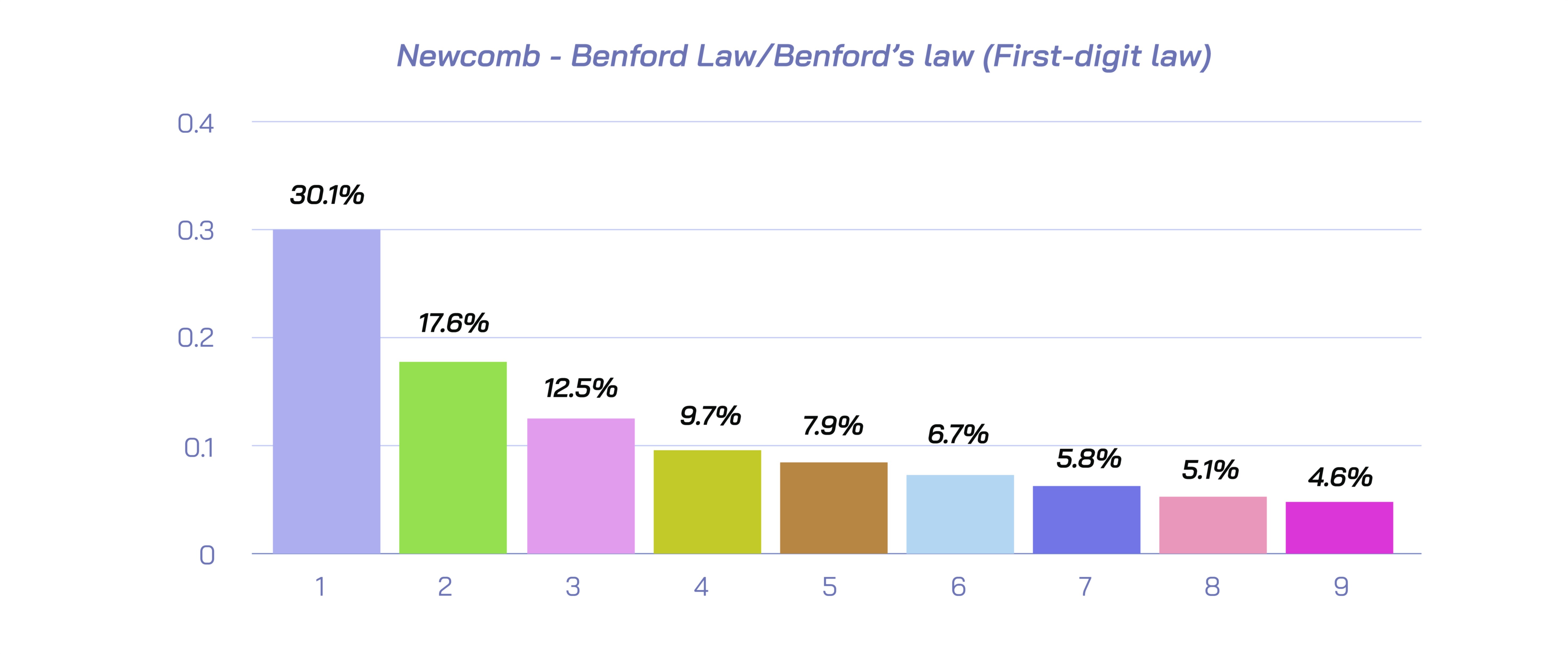
Benford’s Law describes one of the most intriguing and unexpected patterns in numerical data: the tendency for smaller digits, especially the digit one, to appear far more often as the leading digit in naturally occurring numbers than larger ones. Instead of each digit from one through nine appearing with equal frequency at the front of numbers, real-world datasets show a strong bias toward lower leading digits. This pattern emerges in a wide range of situations, from financial records and population statistics to scientific measurements and geographical data. What makes Benford’s Law so remarkable is that it appears consistently across vastly different fields, revealing a hidden order within numerical information that seems, at first glance, completely random.
How the Leading Digit Distribution Reveals Its Bias
The intuition behind Benford’s Law begins with the recognition that many quantities in nature grow and vary across wide ranges. When numbers span several orders of magnitude, smaller leading digits naturally occur more frequently because they occupy the first portion of each scale. For example, values that grow from single digits to tens, hundreds, or thousands spend more “time” beginning with a one before eventually reaching numbers that begin with two, then three, and so on. This expansion creates an uneven distribution of leading digits that remains consistent no matter the scale being measured. The result is a pattern in which the digit one appears far more often at the front of numbers, while higher digits such as eight or nine appear increasingly rarely. This unexpected skew occurs not because of human influence or intentional design, but because of how quantities expand and distribute themselves across natural ranges.
Why Benford’s Law Appears Across Different Types of Data
One of the most striking characteristics of Benford’s Law is its universality. The law holds true for measurements involving prices, distances, populations, scientific constants, earthquake magnitudes, and even file sizes stored on digital devices. It appears whenever numbers arise from processes that evolve multiplicatively or span broad intervals rather than narrow, fixed ranges. Because such processes are common in nature, economics, and daily human activity, the pattern emerges again and again, regardless of the specific field producing the data. This universality makes Benford’s Law a powerful tool for researchers who study natural distributions or analyze datasets for anomalies. It reflects a deeper mathematical property of scale-invariant quantities, meaning that no matter how a dataset is resized, multiplied, or transformed proportionally, the leading-digit pattern remains intact.
How Benford’s Law Helps Detect Anomalies and Fraud
The predictable distribution of leading digits allows Benford’s Law to be used as a tool for identifying unnatural irregularities in data. In financial auditing and forensic accounting, analysts compare the leading digits of reported values with the expected pattern. When numbers deviate sharply from the distribution that typically appears in authentic records, it may indicate manipulation, fabrication, or errors. This method does not prove wrongdoing by itself, but it helps investigators identify suspicious entries in large datasets that warrant closer examination. Its ability to reveal unnatural patterns makes it useful not only in accounting but also in election data analysis, scientific research verification, and oversight of regulatory filings. Benford’s Law thus becomes a form of statistical fingerprinting, showing where human-generated distortions might break the natural flow of numerical data.
Connection to Real-World Growth and Measurement Systems
Benford’s Law echoes the way humans measure, categorize, and record information. Many datasets involve values that increase exponentially or grow proportionally, such as populations, financial gains, or chemical concentrations. When numbers evolve through proportional increments rather than fixed steps, they traverse lower digit ranges more gradually. This slow progression near the beginning of each magnitude allows leading digits like one and two to dominate. At the same time, the absence of a fixed scale means that the same patterns appear whether numbers are measured in dollars, kilometers, kilograms, or seconds. This consistency across measurement systems shows how deeply the law is tied to the organic growth of quantities rather than to human choice or numerical formatting.
Why Benford’s Law Challenges Intuition About Randomness
To many people, randomness suggests that every digit should appear with equal likelihood as a leading value, yet Benford’s Law shows that natural randomness behaves differently from human expectations. The law reflects a deeper structure to numerical patterns, revealing that randomness in the real world often comes from growth, scaling, and multiplicative processes rather than simple additive steps. This challenges the notion that uniformity is the hallmark of randomness. Instead, the natural world reveals its own statistical tendencies, where lower leading digits dominate not by coincidence but by mathematical necessity arising from how quantities spread across magnitudes. Understanding this distinction deepens appreciation for the complex interplay between mathematics and real-world phenomena.
Role in Mathematics, Data Science, and Statistical Theory
Benford’s Law has become a foundational concept in fields that require deep insight into numeric distributions. In mathematics, it highlights how logarithmic patterns underlie many natural processes. In data science, it helps identify anomalies in large databases and ensures the integrity of datasets. In scientific research, it offers a way to test whether reported measurements behave naturally or show signs of fabrication. Its principles extend even into computer science, where it explains why some file sizes and algorithm outputs show consistent digit patterns. The law’s broad reach reinforces the idea that statistical signatures can reveal profound truths about how information evolves and organizes itself.
Why Benford’s Law Continues to Fascinate and Influence Modern Analysis
The enduring appeal of Benford’s Law lies in its combination of simplicity, universality, and surprising predictive power. It reveals that beneath the apparent chaos of numbers lies a subtle yet consistent structure shaped by the way real-world quantities grow and distribute themselves. It bridges mathematics with natural processes, human behavior, and technological systems, offering a window into how the world organizes numerical information. Whether used for scientific exploration, financial oversight, or theoretical study, Benford’s Law continues to illuminate the hidden patterns of reality, reminding us that even the smallest details—like the first digit of a number—can reveal deep insights about the nature of data.