Bromothymol Blue — pH Indicator Chemical Compound
Bromothymol Blue is one of the most widely recognized and scientifically valuable pH indicators, known for its vivid color transitions and its ability to reveal subtle chemical changes in aqueous environments. Although it may appear at first glance to be just another dye-like substance used in laboratories, its importance extends far beyond simple coloration. Bromothymol Blue is crafted from an intricate molecular framework that responds sensitively to the presence of hydrogen ions, allowing scientists, educators, environmental professionals, and medical researchers to interpret the acidity or basicity of a solution through direct visual observation. Its transformation from one color to another embodies the core concept of acid–base chemistry, demonstrating how even a small shift in the environment surrounding a molecule can alter its electronic structure enough to change its perceived color. This elegant relationship between molecular form and optical expression places Bromothymol Blue at the center of many experiments, demonstrations, and analyses where clarity and reliability are essential.
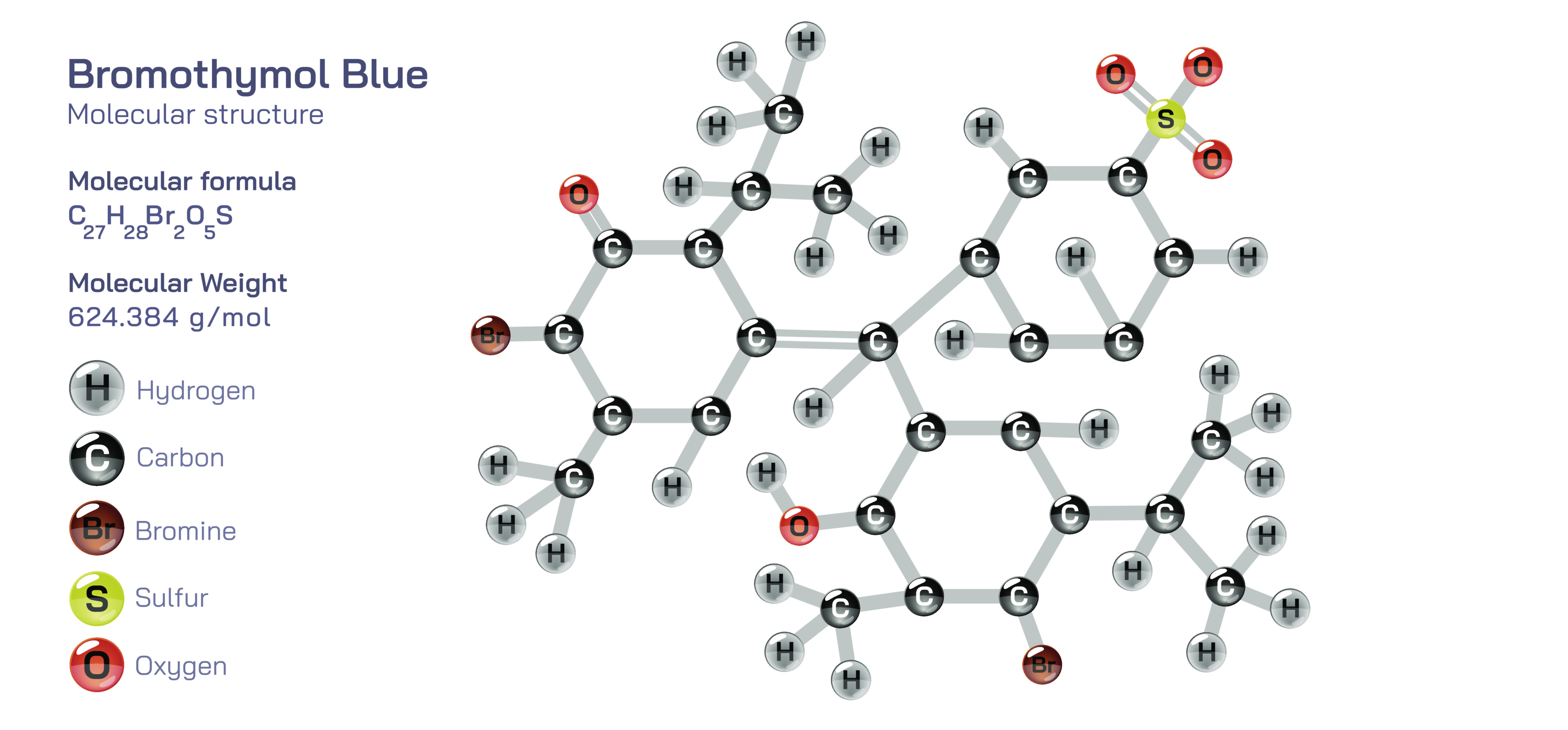
At the molecular level, Bromothymol Blue exists in several structural forms, each associated with a distinct color. These forms depend on the chemical surroundings, particularly the concentration of hydrogen ions present in the solution. In more acidic conditions, the molecule adopts a structural arrangement that produces a yellow hue. As the environment shifts toward neutrality, the molecule transitions through structural states that reflect greenish tones due to partial protonation. In basic or alkaline conditions, the molecule transforms into a different electronic configuration, generating the characteristic deep blue color that gives the compound its name. Although these structural changes are not expressed mathematically here, the conceptual understanding is that the indicator senses the chemical environment and adjusts its molecular framework accordingly. These transitions are reversible and repeatable, making Bromothymol Blue an excellent tool for studying dynamic pH processes and observing changes over time.
Because of its clear and easily distinguishable color transitions, Bromothymol Blue has become an essential component in educational chemistry, where students learn about acid–base reactions, buffering systems, and the relationship between molecular behavior and macroscopic properties. Demonstrations involving this indicator often help bridge the gap between theoretical chemical principles and real-world observation. For example, adding carbon dioxide to water lowers the pH and shifts the indicator toward its yellow form, providing a vivid illustration of how gases dissolved in water influence acidity. Such experiments allow learners to visualize the invisible processes taking place at the molecular level, making complex chemical concepts more accessible.
In biological studies, Bromothymol Blue is widely used in experiments involving cellular respiration and photosynthesis. When organisms respire, they release carbon dioxide, which dissolves into aqueous environments, forming carbonic acid and lowering the pH. By incorporating Bromothymol Blue into the experimental setup, researchers can track these processes visually. In photosynthesis experiments, the indicator may shift back toward the blue range as plants remove carbon dioxide from the solution, raising the pH. These shifts provide a clear and immediate way to monitor biological activity without the need for sophisticated instrumentation. This ease of use makes the indicator a favorite in classrooms and research labs for demonstrating the chemical footprint of living systems.
Environmental science also benefits greatly from Bromothymol Blue because pH plays a critical role in water quality, ecological balance, and the functioning of natural systems. Streams, lakes, aquifers, and coastal waters must maintain certain pH ranges for aquatic organisms to survive. The indicator becomes a practical tool for preliminary field assessments, allowing scientists or students to evaluate whether water systems may be experiencing acidification or alkaline shifts. Although more advanced equipment is used for formal measurements, Bromothymol Blue provides a fast, inexpensive, and visually intuitive method for evaluating environmental conditions. Its color transitions help communicate complex environmental chemistry concepts to audiences who may not have scientific training, making it a valuable resource in community outreach and ecological education.
The use of Bromothymol Blue extends into medicine and diagnostic sciences, where pH-sensitive environments provide critical information about physiological processes. In certain tests, the indicator can help detect changes in respiratory gases, metabolic imbalances, or other biochemical shifts that influence acidity in bodily fluids. Though medical applications rely more heavily on precise instruments today, the conceptual understanding provided by pH indicators remains foundational, and Bromothymol Blue helped pave the way for more advanced measurement systems. By illustrating the sensitivity of biological environments to small chemical changes, the indicator reinforces the importance of pH regulation in maintaining human health.
In industrial and laboratory chemistry, Bromothymol Blue plays a vital role in analytical techniques. It is used in titrations, buffer preparation, fermentation monitoring, chemical synthesis, and experimental calibration. Its ability to respond consistently across narrow pH ranges allows chemists to judge the progress of reactions and maintain the stability of sensitive solutions. In titrations, for instance, the indicator helps identify the endpoint where the chemical balance shifts into a new pH zone. Because Bromothymol Blue’s transition range falls near neutrality, it is especially useful for analyzing processes involving weak acids and weak bases or reactions that require careful monitoring of near-neutral conditions.
Beyond its functional use, Bromothymol Blue offers insight into the broader principles of chromophore behavior, molecular resonance, and electron distribution. When the molecule changes color, what is fundamentally happening is a shift in how electrons are distributed across its framework. These shifts alter the wavelengths of light that the molecule absorbs and reflects, which the human eye interprets as different colors. This interplay between structure and perception illustrates a larger theme in chemical science: molecular identity is not fixed but adaptable, and properties such as color, solubility, and reactivity emerge from how molecules interact with their surroundings. Bromothymol Blue thus serves as a gateway to understanding how chemical indicators translate invisible molecular events into visible macroscopic outcomes.
In summary, Bromothymol Blue stands as an indispensable tool across scientific disciplines due to its responsiveness, clarity, and conceptual richness. Its behavior reflects the dynamic nature of aqueous environments and the delicate balance between acidic and basic conditions. Whether used in classrooms, research laboratories, environmental monitoring, biological studies, or industrial processes, the indicator reveals chemical truths through vivid and immediate visual changes. Its molecular structure, though complex beneath the surface, operates through straightforward principles that exemplify the harmony between chemical form and function. Bromothymol Blue does more than measure pH; it illuminates the invisible shifts that govern reactions, biological systems, and environmental feedback cycles, creating a bridge between the microscopic world of molecules and the tangible world we can see, understand, and explore.