Analog vs Digital — Signal Examples and Key Differences Explained
Understanding the Two Fundamental Types of Signals
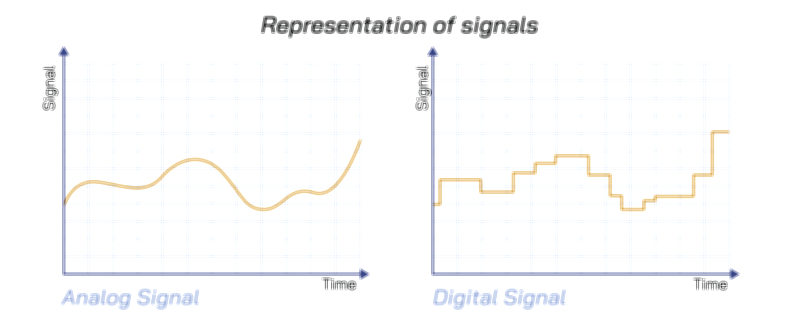
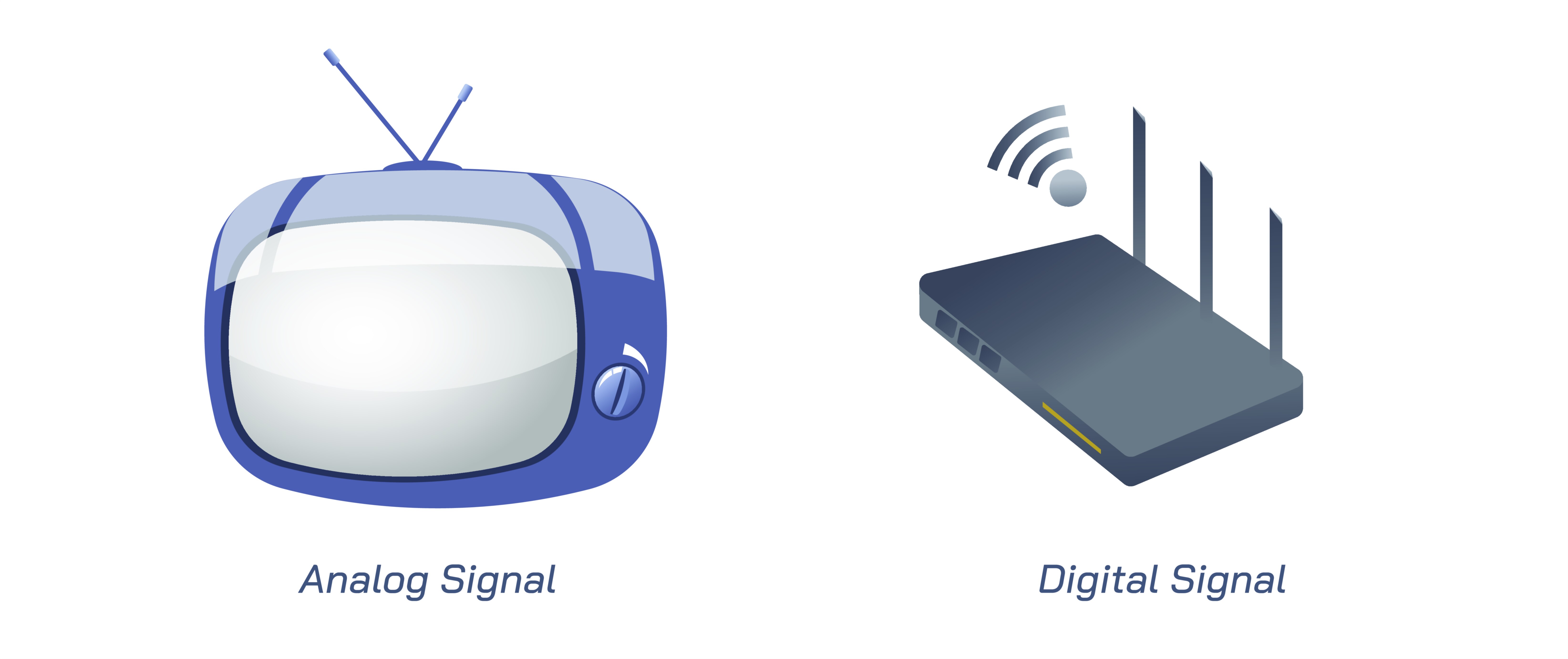
Analog and digital signals form the backbone of all communication, electronics, and information-processing technologies. Although they both serve the purpose of transmitting data from one point to another, they operate in fundamentally different ways that determine their strengths, weaknesses, and ideal uses. Analog signals vary continuously, changing smoothly with time, while digital signals represent information through discrete steps or levels. This difference is the core distinction that shapes how each type behaves when exposed to noise, how each interacts with electronic circuits, and how each is stored or transmitted. A vector illustration comparing analog and digital signals typically places a flowing, sinusoidal waveform beside a sharply stepped rectangular pulse pattern, making the contrast between continuous and discrete representation visually immediate. Understanding these differences is essential because modern technology relies heavily on both signal types—sometimes separately, sometimes together in hybrid systems that convert back and forth between analog and digital forms.
Analog Signals — Continuous, Natural, and Sensitive to Disturbance
An analog signal is characterized by its continuous variation in amplitude and time. This means it can take on an infinite number of values within its range, closely mirroring real-world phenomena. Sound waves, light intensity, temperature changes, mechanical vibrations, and electrical voltages naturally adopt analog behavior as they vary smoothly. Because analog signals do not require discrete steps, they preserve fine details and subtle variations that digital representation might compress or approximate. This makes analog ideal for high-fidelity recordings, certain types of sensors, and applications where natural smoothness is crucial. However, the same continuity that gives analog its richness also makes it vulnerable to noise and distortion. Any small interference—electromagnetic disturbances, impurities in circuits, or environmental fluctuations—directly alters the signal’s waveform. Over long distances or repeated processing stages, analog signals degrade, losing accuracy and clarity. A vector illustration of analog signals often shows a perfect sine wave next to a slightly distorted one, visually demonstrating their sensitivity to external influences.
Digital Signals — Discrete, Reliable, and Error-Resistant
Digital signals encode information using distinct levels, typically represented as binary 0s and 1s. This discrete nature gives digital signals exceptional resilience against noise and interference because minor fluctuations do not change the meaning of the data unless they cross the threshold between recognized levels. Digital systems can incorporate error detection and correction algorithms that further preserve signal integrity during transmission or storage. This reliability is what makes digital technology the foundation of modern computing, telecommunications, multimedia, and data storage. Digital signals also allow for high-speed processing, lossless duplication, and efficient compression, making them ideal for smartphones, computers, digital video, the internet, and cloud systems. The trade-off is that digital signals represent information in steps rather than continuous flows, which may sacrifice extremely subtle variations unless high sampling rates and bit-depths are used during analog-to-digital conversion. A digital signal in a vector illustration typically appears as a square wave with crisp transitions, visually showing how binary representation simplifies interpretation and transmission.
Real-World Examples Highlighting Signal Differences
Everyday experiences highlight why analog and digital systems coexist rather than compete. Analog microphones produce continuous electrical voltages corresponding to sound pressure, while digital audio processors convert these incoming waves into streams of binary data for editing, transmission, or storage. Analog radio broadcasts transmit smoothly varying signals across the airwaves, but digital radio compresses sound into binary formats that reduce noise and preserve clarity. Analog thermometers show temperature changes through fluid expansion, while digital thermometers convert these changes into numerical readings. These examples reflect the broader theme: analog captures real-world variation naturally, while digital offers precision, stability, and compatibility with computational devices. A vector illustration comparing both signal types often shows analog examples (sine waves, audio oscillations) next to digital examples (binary pulses, sampled points), highlighting how different forms serve different technological needs.
Noise, Distortion, and Signal Integrity Across Systems
Noise affects analog and digital signals in dramatically different ways. In analog systems, noise continuously alters the waveform, often accumulating and creating distortions that reduce accuracy. Whether it appears as hiss in audio recordings, flicker in analog video, or irregular voltages in sensor outputs, noise directly interferes with analog information. Digital signals, however, are protected by their discrete nature. A digital bit remains clear and error-free unless interference is strong enough to push the signal past its threshold. This makes digital communication extremely reliable over long distances, especially when paired with error-correcting codes. However, digital signals can experience sudden, catastrophic degradation if noise becomes severe—whereas analog signals degrade gradually. Vector graphics often show a noisy analog wave with jitter and random spikes, contrasted with a digital waveform that stays intact except in extreme cases, reinforcing how robustness differs across formats.
Conversion Between Analog and Digital Domains
Since the physical world is inherently analog while digital systems dominate modern electronics, conversion between the two domains is essential. An analog-to-digital converter (ADC) samples analog signals at fixed intervals and converts the values into binary form. The accuracy of the digital representation depends on both sampling rate and resolution. A digital-to-analog converter (DAC) performs the reverse, reconstructing smooth waveforms from discrete values so speakers, screens, sensors, and actuators can interact with the natural environment. These conversions enable smartphones to record sound, digital cameras to capture images, streaming services to encode media, and industrial machines to process sensor readings. A vector illustration often depicts sampling points plotted over an analog curve, followed by a stepped digital signal, showing clearly how continuous information becomes digitized.
Technological Applications of Each Signal Type
Analog signals continue to dominate areas such as sensor interfaces, radio waves, audio transduction, and electromagnetic measurements because real-world phenomena inherently vary continuously. Digital signals, however, govern data storage, computing, encryption, communication protocols, multimedia processing, and internet technology. Hybrid systems—where analog input is digitized, processed, and then converted back—are now standard across medical devices, automotive systems, aviation instruments, and consumer electronics. Understanding both signal types is key to mastering modern technology because they are deeply interdependent and mutually supportive in nearly every advanced electronic system.
Illustrating Analog and Digital Concepts Through Vector Graphics
A vector illustration comparing analog and digital signals typically features a smooth sinusoidal curve labeled as the analog waveform and a block-like rectangular pattern representing digital data. Additional overlays might include sampling points, time markers, or amplitude labels that highlight the differences between continuous and discrete representation. These visuals simplify the complex technical distinctions by presenting both signal types in their most recognizable graphical form, allowing learners to grasp the contrast at a glance.