Types of Resolution – Understanding Pixel Density, Display Clarity, Screen Detail, Image Sampling, Human Visual Perception, and How Modern Devices Use Resolution for Best Visibility and Real-World Image Quality
Resolution is one of the most important concepts in digital imaging and display technology because it determines how clearly visual content appears on a screen or through an optical device. Whether the viewer is looking at a smartphone, a television, a camera output, a computer monitor, or a virtual reality headset, resolution forms the backbone of how sharply details are reproduced. The term refers to the number of distinct pixels or sampling points used to create an image. When resolution is high, large numbers of pixels work together to represent fine visual information, so edges appear smooth, textures remain crisp, text is easy to read, and small elements preserve their shape without blurring or blockiness. When resolution is low, fewer pixels must represent the same visual space, causing distortion, graininess, and a loss of detail. Understanding the different types of resolution shows not only how displays generate sharp images but also how device manufacturers optimize screen performance based on viewing distance, screen size, battery efficiency, brightness, and user comfort.
Spatial Resolution – Pixel Count and Screen Sharpness
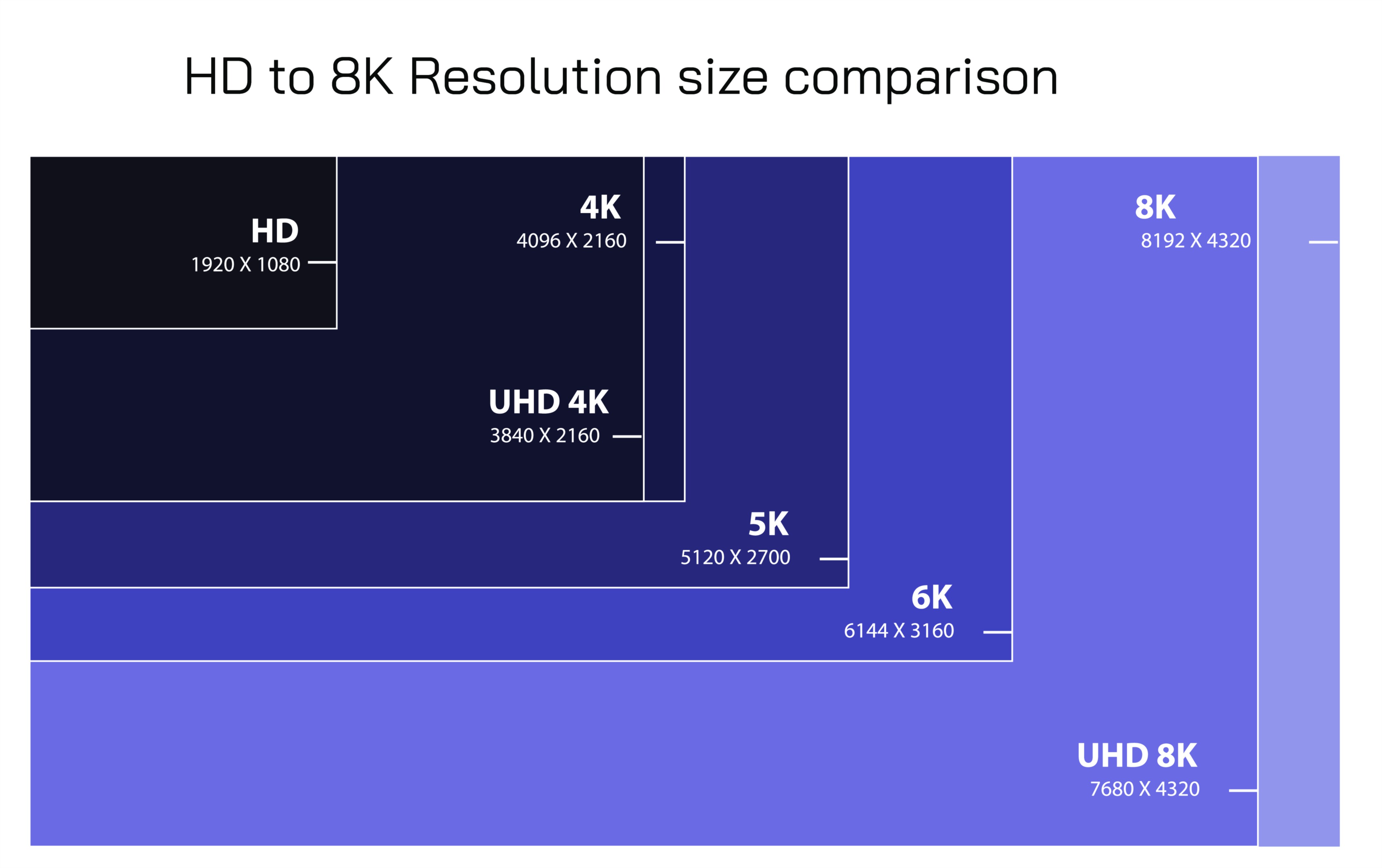
Spatial resolution describes the total number of pixels that make up an image or screen. It is usually expressed in dimensions such as 1920 × 1080 (Full HD), 2560 × 1440 (Quad HD), or 3840 × 2160 (4K UHD). The first number represents horizontal pixels, and the second represents vertical pixels. Higher pixel counts naturally increase detail because each pixel occupies a smaller portion of the screen and therefore depicts a finer segment of the visual content. This is why 4K screens on large televisions appear sharper than older 1080p screens of the same size—the increased pixel density prevents the viewer from seeing individual pixel boundaries. Spatial resolution is especially important for large monitors, televisions, and projection screens, where crisp detail is expected even at close viewing distances. As the number of pixels rises, the limit shifts closer to what the human eye can distinguish, creating a lifelike, high-fidelity image.
Pixel Density – Resolution Converted Into Human Visual Experience
A screen can have a high resolution but still look blurry if its size is too large for the pixel count. Therefore, pixel density, measured in pixels per inch (PPI), becomes an equally important measure of display quality. Pixel density describes how tightly pixels are packed into a physical area. Smartphone screens commonly exceed 400 PPI, which produces extremely sharp text and images because the human eye cannot distinguish individual pixels at an average viewing distance. In contrast, large televisions rely on lower PPI values because users sit farther away; from a distance, the eye perceives smoothness even at pixel densities that would look coarse up close. Pixel density connects display technology to human biology, demonstrating that resolution is not a fixed number but a relationship between pixel count, screen size, and human perception. For the best visibility, devices must balance resolution and PPI to match how they are used in real-world viewing conditions.
Temporal Resolution – Frame Rate and Image Motion Clarity
Resolution does not apply only to spatial detail; motion also has its own quality measure called temporal resolution. Temporal resolution refers to how many unique frames are displayed per second (fps) during video playback or gaming. A display with high spatial resolution may still appear blurry during fast movement if its frame rate is too low. At 24 or 30 fps, moving objects may show motion blur or judder, whereas frame rates of 60, 120, or 144 fps generate smoother motion that supports sports, fast gaming, and high-speed video. Temporal resolution allows devices to present motion realistically instead of as a sequence of slow, choppy images. High frame rate displays are especially critical in virtual reality headsets, where low temporal resolution can cause motion sickness because the eyes and brain detect a mismatch between visual feedback and physical head movement. Temporal resolution therefore combines the science of animation, perception, and display electronics into a metric essential for natural-looking motion.
Optical Resolution – Lenses, Sensors, and Detail in Cameras and Scanners
Resolution also applies to how visual information is captured, not just displayed. Optical resolution refers to the smallest detail that a camera lens, scanner, or microscope can distinguish in the real world. In photography and videography, a high optical resolution ensures that the camera sensor receives clear details before digital processing or compression takes place. Even if a sensor contains many pixels, an inferior lens may not focus enough spatial detail onto the pixel grid, limiting final image clarity. In scientific imaging such as microscopy, optical resolution determines how closely two objects can appear together before they become indistinguishable. This measurement depends on wavelength of light, lens quality, aperture, and the physical distance between the lens and sample. Optical resolution demonstrates that the sharpness of recorded images depends on the whole optical chain, not just pixel count.
Sampling and Print Resolution – Digital-to-Physical Image Representation
When visual content transitions from screens to printed media, resolution takes on another form known as print resolution. Instead of pixels per inch, print resolution is measured as dots per inch (DPI). While PPI describes the pixel grid on screens, DPI represents how many ink or toner dots are placed within a given area on paper. For high-quality printing, 300 DPI is widely considered the standard for crisp images and text, whereas lower DPI values can cause jagged edges and grainy photographs. The concept works similarly in scanning: a scanner with a higher DPI samples more points from a physical image, producing a digital file with greater clarity and less loss of detail. In this way, print and sampling resolution show how digital images gain or lose sharpness when translated into physical form.
Why Resolution Matters for Best Visibility Across Devices
Every modern digital device — from smartphones and gaming monitors to projectors and augmented-reality glasses — integrates resolution strategically to achieve the best visibility for its intended purpose. A phone held close to the eyes benefits from extremely high pixel density to preserve text clarity and prevent eye strain. A large television across a room needs high pixel count but not extreme PPI, balancing clarity with energy consumption and processing efficiency. Professional monitors for designers and video editors push both spatial resolution and color accuracy because fine details and smooth gradients must remain visible under magnification. Virtual and augmented-reality devices prioritize both spatial and temporal resolution simultaneously, ensuring that high detail and smooth motion together prevent visual fatigue. Cameras rely on optical resolution to encode fine details before any digital enhancement begins. Printers rely on DPI to reproduce the precision of digital imagery.
Resolution is not a single universal number but a family of interconnected measurements that define visibility, clarity, and realism. Spatial resolution shapes the foundation of sharpness; pixel density integrates human perception; temporal resolution delivers smooth motion; optical resolution controls captured detail; print resolution governs physical reproduction. The interplay among these types of resolution is what makes visual technology feel natural, vivid, and lifelike. Through these principles, modern devices transform electrical signals and digital data into experiences that align with human visual expectations, proving that the science of resolution sits at the core of every display we use.