Xylene — Structure, Properties, and Industrial Applications
Fundamental Identity and Structural Characteristics of Xylene
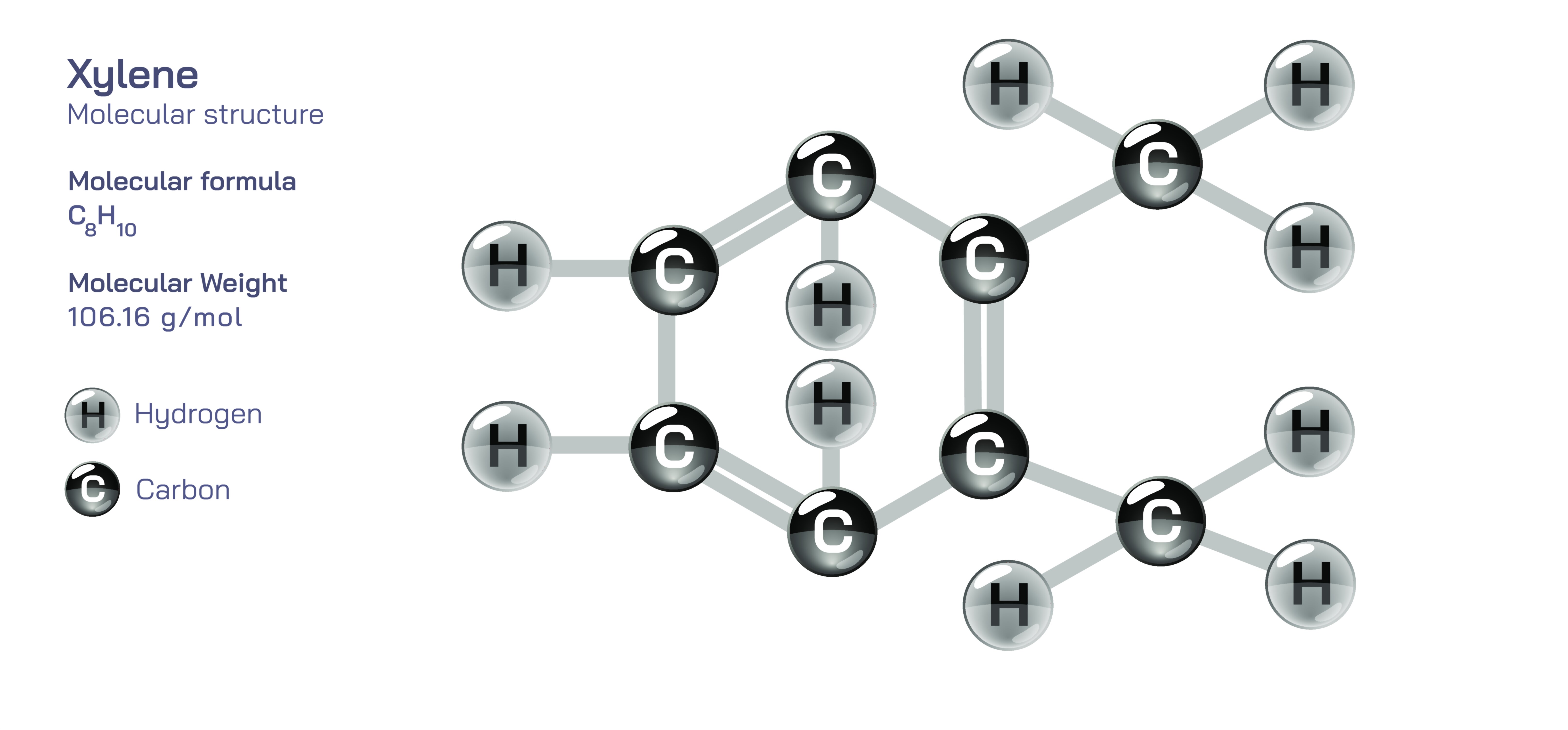
Xylene is a widely used aromatic hydrocarbon belonging to the family of benzene derivatives, known for its structural simplicity and broad industrial relevance. The term “xylene” refers collectively to three structural isomers—ortho-xylene, meta-xylene, and para-xylene—each of which shares the molecular formula C₈H₁₀ but differs in the spatial arrangement of two methyl groups attached to a benzene ring. These isomers exhibit similar aromatic behavior but possess distinct boiling points, melting points, and industrial preferences due to differences in symmetry and molecular interactions. Structurally, each xylene molecule consists of a benzene ring that provides resonance stabilization and aromatic character, while two methyl substituents contribute electron-donating effects that influence reactivity and solvent properties. The planar geometry of the benzene ring, combined with the flexibility of the attached methyl groups, allows xylene to dissolve organic materials efficiently, participate in electrophilic substitution reactions, and serve as a precursor for industrial chemicals. As a liquid at room temperature with moderate volatility and strong solvency, xylene plays an integral role in chemical processing, coatings, manufacturing, and laboratory work.
Chemical Behavior, Reactivity, and Aromatic Substitution
Xylene exhibits the typical chemical reactivity of aromatic hydrocarbons, particularly in electrophilic aromatic substitution reactions such as nitration, sulfonation, halogenation, and alkylation. The two methyl groups on the benzene ring act as electron-donating substituents, increasing electron density and making the ring more reactive toward electrophiles compared to benzene itself. These methyl groups also direct incoming substituents to the ortho and para positions, influencing product distribution in chemical synthesis. Under oxidation conditions, the methyl groups can be converted into carboxylic acids, producing compounds such as phthalic acid (from ortho-xylene) or terephthalic acid (from para-xylene), which are foundational chemicals in polymer and resin production. Xylene is stable under normal conditions but combustible, reacting readily with oxygen in the presence of heat or ignition sources. It resists reaction with mild acids and bases but dissolves many organic substances due to its nonpolar character. This reactivity profile, combined with its solvation ability, makes xylene valuable in organic synthesis, petrochemical refining, and materials formulation.
Physical Properties and Solvent Characteristics of Xylene
Xylene appears as a colorless, sweet-smelling liquid with moderate viscosity and high solvency for greases, oils, resins, polymers, and certain organic compounds. Its boiling point varies among isomers—ortho-xylene, meta-xylene, and para-xylene exhibit distinct thermal properties due to differences in substituent orientation—but the mixture known as “technical xylene” typically boils within a narrow range around 138–144°C. Xylene is less dense than water and immiscible with it, forming separate layers when combined. Its moderate vapor pressure contributes to controlled evaporation rates, making it useful in coatings and industrial processes that require a balance between drying speed and workability. As an aromatic solvent, xylene enhances the solubility of hydrophobic materials and promotes uniform film formation in paints, varnishes, and adhesives. Its ability to dissolve paraffin wax, dyes, and synthetic polymers supports numerous applications in manufacturing, laboratory procedures, and cleaning operations. Despite its utility, xylene’s flammability and vapor hazards necessitate careful handling, adequate ventilation, and adherence to occupational safety guidelines.
Industrial and Commercial Applications Across Multiple Sectors
Xylene is a cornerstone chemical in the petrochemical and manufacturing industries, serving as a precursor, solvent, and processing agent. One of its largest uses is in the production of plastics and synthetic fibers. Para-xylene, the most commercially valuable isomer, is oxidized to form terephthalic acid, a critical component in the production of polyethylene terephthalate (PET), used in beverage bottles, food packaging, and polyester textiles. Ortho-xylene is converted into phthalic anhydride, which is essential in plasticizer production, alkyd resins, and high-performance polymers. Meta-xylene finds use in producing isophthalic acid, which enhances polymer durability and heat resistance in specialized resins and coatings.
As a solvent, xylene plays a major role in paint formulation, automotive coatings, printing inks, varnishes, and rubber processing. It dissolves pigments and resins effectively, ensures smooth application, and contributes to durable, high-quality finishes. In the electronics industry, xylene is used in cleaning processes, semiconductor manufacturing, and the preparation of specialty chemical films. In laboratories, it functions as a clearing agent in histology, helping to prepare tissue samples by removing wax and enhancing optical clarity under microscopes. Xylene’s solvency also supports degreasing operations, adhesive formulations, pesticide manufacturing, and various chemical synthesis pathways, demonstrating its broad industrial value.
Environmental, Biological, and Safety Considerations
While xylene is essential to industry, it must be managed carefully due to its environmental and health implications. Xylene vapors can cause respiratory irritation, dizziness, and neurological effects when inhaled at high concentrations, making proper ventilation and protective equipment critical in industrial and laboratory settings. The chemical is readily absorbed through inhalation but is metabolized efficiently by the human body, which reduces long-term accumulation. Environmentally, xylene can contaminate soil and groundwater if improperly disposed of, but it degrades relatively quickly through microbial action and atmospheric oxidation. Nonetheless, safe storage, responsible waste management, and adherence to regulatory standards are essential to minimize ecological impact. Fire safety measures are particularly important, as xylene vapors form flammable mixtures with air and can ignite easily in the presence of sparks or open flames.
Role of Xylene in Petrochemical Refining and Global Manufacturing
In the petrochemical industry, xylene forms a crucial part of the aromatic hydrocarbon group known as BTX—benzene, toluene, and xylenes—which are extracted from petroleum refining and catalytic reforming processes. These aromatics serve as building blocks for polymers, resins, and synthetic materials that define modern industrial production. Xylene’s contribution to global manufacturing extends across packaging, automotive parts, textiles, consumer goods, electronics, pharmaceuticals, and construction materials. Its versatility, solvency, and capacity for transformation into high-value chemicals make it indispensable to both large-scale industrial operations and precision chemical synthesis.
Illustrating the Structure and Industrial Uses of Xylene
A vector illustration of xylene typically highlights the benzene ring with two methyl groups placed in ortho, meta, or para configurations. Visuals may include separate diagrams for each isomer, showing how substituent position influences symmetry and physical properties. Additional illustrations often depict the transformation of para-xylene into terephthalic acid, or xylene being used as a solvent in paints, inks, and industrial formulations. In histology-related visuals, xylene is shown interacting with tissue samples, demonstrating its clearing effect. These illustrations help link molecular structure to functional behavior, showcasing why xylene remains a fundamental chemical across sectors and technologies.