Wien’s Law — Blackbody Radiation and Temperature Relationship
Fundamental Meaning of Wien’s Law in Thermal Radiation
Wien’s Law represents one of the most elegant and insightful principles in thermal physics, describing how the temperature of a blackbody determines the wavelength at which it emits radiation most intensely. A blackbody is an idealized physical object that absorbs all incoming radiation and re-emits energy based solely on its temperature, not its material composition. As its temperature increases, the distribution of emitted radiation shifts systematically toward shorter wavelengths. Wien’s Law captures this shift by stating that the wavelength at which peak emission occurs is inversely proportional to temperature. This relationship explains why cooler objects emit radiation predominantly in the infrared region, why heated metal glows red before transitioning to yellow or white as temperature rises, and why stars exhibit different colors depending on their surface temperature. The law reveals that temperature is not merely a measure of heat but a determinant of spectral character, linking thermodynamics to electromagnetic radiation in a single elegant insight.
The Blackbody Spectrum and the Origin of Peak Wavelength
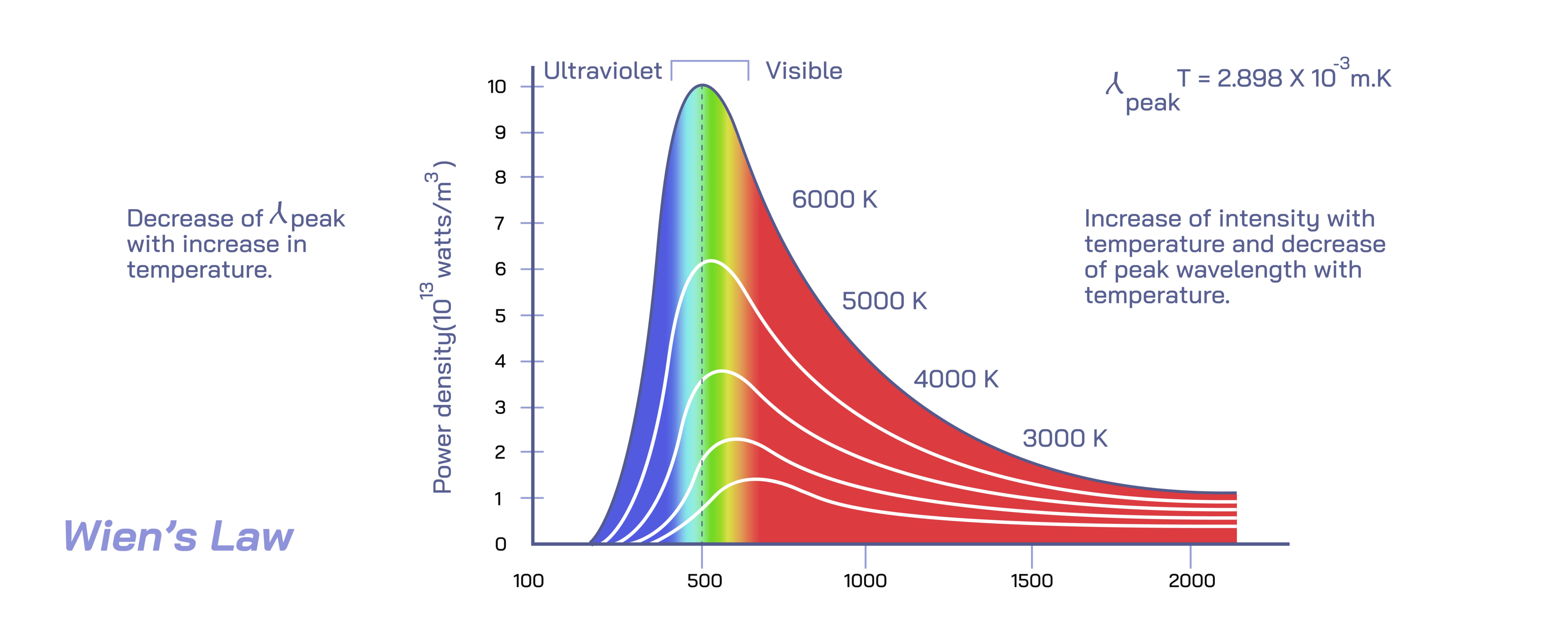
A blackbody emits a continuous spectrum of electromagnetic radiation, with intensities spread across many wavelengths. The distribution is not uniform; instead, it forms a smooth curve with a single peak that represents the wavelength of maximum emission. As temperature changes, the shape of this curve alters dramatically: at lower temperatures, the peak lies in the infrared, producing radiation invisible to the human eye; as temperature rises, the peak shifts progressively toward visible wavelengths. Wien’s Law isolates this peak behavior, telling us where the maximum intensity occurs, while the full Planck distribution explains the detailed shape of the curve. The origin of the peak and its movement lie in the interplay between quantized electromagnetic modes and thermal energy. At higher temperatures, the system excites higher-frequency modes more effectively, causing the curve to shift toward shorter wavelengths. This shift is not gradual in appearance—it transforms the quality of the emitted light entirely, illustrating the profound sensitivity of radiation spectra to temperature.
Temperature and Wavelength: The Inverse Relationship Explained
The central insight of Wien’s Law is the inverse relationship between temperature and peak wavelength. If a blackbody becomes twice as hot, its peak radiation moves toward wavelengths half as long. This relationship encapsulates the idea that hotter objects emit more energetic radiation because shorter wavelengths correspond to higher-energy photons. As this relationship unfolds across nature, a clear pattern emerges: cold objects radiate in long infrared wavelengths, moderately warm objects radiate in visible red or orange, and extremely hot bodies radiate in blue or ultraviolet light. This explains why human skin radiates infrared, why a heated stove glows red at first, and why the hottest stars shine in brilliant blue. Wien’s Law thus serves as a bridge connecting thermal energy to electromagnetic emission, revealing how heat translates directly into photon behavior.
Role of Wien’s Law in Stellar Temperatures and Astrophysics
Wien’s Law plays an essential role in astrophysics, where it functions as a non-invasive thermometer for celestial objects. By measuring the wavelength at which a star’s spectrum peaks, astronomers can calculate its surface temperature with remarkable accuracy. A star that peaks in the red or orange region is cooler than one that peaks in white or blue. This insight forms one of the foundational pillars of stellar classification, helping categorize stars into types such as red dwarfs, yellow main-sequence stars, and hot blue giants. Wien’s Law also aids in understanding cosmic microwave background radiation, which peaks in the microwave region due to the extremely low temperature of the early universe’s residual energy. Across astrophysics, Wien’s Law transforms the color of light into direct temperature measurement, providing a simple yet powerful analytical tool for understanding cosmic bodies.
Technological and Scientific Applications of Wien’s Law
Beyond astronomy, Wien’s Law finds practical use in diverse fields. In thermography, infrared cameras operate on principles closely tied to blackbody behavior, using the spectral distribution of radiation to visualize temperature differences. Engineers rely on Wien’s Law when designing furnaces, incandescent bulbs, and thermal sensors, ensuring that devices emit radiation at appropriate wavelengths. In climate science, the law assists in modeling Earth’s thermal emission characteristics, helping researchers study energy balance, atmospheric absorption, and planetary temperature regulation. In industrial settings, pyrometers automatically estimate temperatures of hot metals or molten materials by examining emitted light, a direct application of Wien’s insight. Across scientific and technological realms, Wien’s Law becomes a diagnostic gateway that converts light into thermal knowledge.
Wien’s Law as a Foundation for Quantum Theory and Modern Physics
The emergence of Wien’s Law contributed significantly to the development of quantum physics. Before Planck’s law unified the entire radiation spectrum with quantized energy levels, Wien’s early radiation law provided an approximation that hinted at deeper physical principles. The discovery that classical physics could not fully explain blackbody radiation led to the introduction of quantization—Planck’s revolutionary idea that energy is exchanged in discrete units. Wien’s Law fits naturally within this framework, highlighting how thermal behavior at high frequencies anticipates quantum behavior. Its success in describing the shorter-wavelength portion of blackbody radiation signaled the limitations of classical thermodynamics and helped inspire the quantum revolution. Thus, Wien’s Law is more than a mathematical relation; it is a historical stepping stone that connects classical thermal physics to the foundations of quantum mechanics.
Illustrating the Relationship Between Temperature and Radiation Peaks
A visual illustration of Wien’s Law typically depicts several blackbody radiation curves, each representing a different temperature. The curves shift leftward on the wavelength axis as temperature increases, demonstrating how hotter objects emit peak radiation at shorter wavelengths. These diagrams often highlight a vertical line at the peak of each curve, reinforcing the inverse relation between temperature and peak wavelength. Additional illustrations may show star colors corresponding to their blackbody peaks, or thermal objects transitioning visually from dull red to bright white as temperature rises. Through such representations, the abstract relationship defined by Wien’s Law becomes strikingly clear: temperature directs the color and energy distribution of emitted radiation, weaving together light and heat in a beautifully structured pattern.