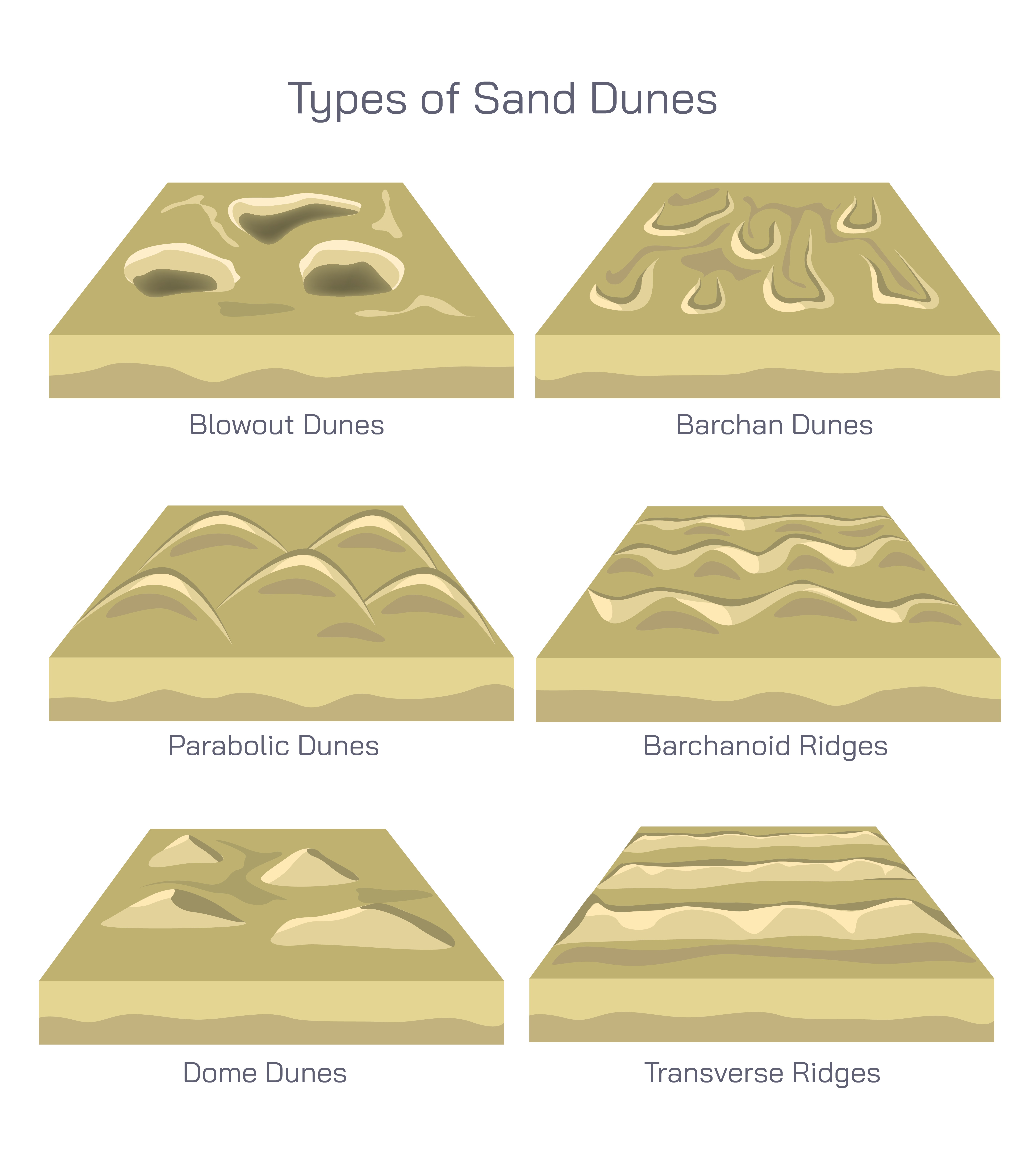
Sand dunes are dynamic landforms created by the action of wind on loose sand particles. They are among the most recognizable features of desert and coastal environments and serve as visible evidence of continuous interaction between wind, sediment supply, surface conditions, and vegetation. The study of sand dunes is an important part of physical geography and earth science because dunes record wind direction, climatic conditions, and environmental changes over time. Different types of sand dunes form depending on factors such as wind strength, wind direction consistency, sand availability, surface moisture, and the presence or absence of vegetation.
Understanding Sand Dune Formation
Sand dunes form through aeolian processes, which involve the erosion, transportation, and deposition of sand by wind. When wind blows across a sandy surface, it lifts and carries sand grains until the wind speed decreases or encounters an obstacle. As wind energy drops, sand particles settle and accumulate, gradually building up mounds that evolve into dunes. Over time, continuous wind action shapes these mounds into distinct forms. Each dune type reflects specific environmental conditions and wind patterns.
Barchan Dunes
Barchan dunes are crescent-shaped dunes commonly found in hot, dry deserts where there is a limited supply of sand and a single dominant wind direction. These dunes have gently sloping windward sides and steep leeward sides known as slip faces. The horns of barchan dunes point in the direction of wind movement, making them excellent indicators of prevailing wind direction. Barchan dunes migrate across desert surfaces as sand is eroded from the windward side and deposited on the leeward side. Their movement demonstrates the dynamic nature of desert landscapes.
Parabolic Dunes
Parabolic dunes are similar in shape to barchan dunes but have a reversed orientation. Their arms or horns point upwind rather than downwind. These dunes commonly form in semi-arid regions and coastal areas where vegetation partially anchors the sand. The central part of the dune moves forward while the vegetated arms remain fixed, creating a U-shaped form. Parabolic dunes highlight the role of vegetation in stabilizing sand and modifying dune shapes. They are often associated with coastal dunes and regions where moisture supports plant growth.
Transverse Dunes
Transverse dunes are long ridges of sand that form perpendicular to the prevailing wind direction. They develop in areas with abundant sand supply and strong, consistent winds. These dunes often appear as a series of parallel ridges stretching across desert plains. Transverse dunes can cover vast areas and represent one of the most common dune types in large sandy deserts. Their uniform shape reflects stable wind patterns over long periods.
Barchanoid Dunes
Barchanoid dunes are transitional forms between individual barchan dunes and continuous transverse dunes. They form when multiple barchan dunes merge laterally due to increased sand availability. The result is a scalloped ridge with crescent-shaped segments. Barchanoid dunes demonstrate how dune forms evolve as environmental conditions change. They often occur in deserts where wind direction remains constant but sand supply increases over time.
Longitudinal or Linear Dunes
Longitudinal dunes, also known as linear dunes, are long, narrow ridges aligned parallel to the prevailing wind direction. They form in regions where wind direction varies slightly around a dominant trend. These dunes can extend for many kilometers and are common in large desert interiors. Their elongated shape reflects the balance between wind strength and directional variability.
Dome Dunes
Dome dunes are rounded or mound-shaped dunes without a clear slip face or dominant orientation. They form in areas where wind direction is highly variable and sand supply is moderate. Because wind comes from multiple directions, no single side becomes dominant. Dome dunes are often smaller and less organized than other dune types, representing environments with complex wind patterns.
Blowout Dunes
Blowout dunes develop when wind erodes a depression in sandy terrain, often due to the removal of vegetation. These dunes commonly occur in coastal areas and semi-arid regions. As wind removes sand from a localized area, it creates a hollow or blowout, with sand deposited downwind. Blowout dunes highlight the importance of vegetation in preventing wind erosion and stabilizing sandy landscapes.
Environmental and Climatic Significance of Sand Dunes
Sand dunes are not just desert features; they play important ecological and climatic roles. Dunes act as natural barriers against wind erosion and can protect inland areas from sand movement. Coastal dunes shield land from storm surges and sea-level rise. Dune systems also provide habitats for specialized plant and animal species adapted to sandy environments.
From a climatic perspective, dune shapes and orientations provide valuable information about past and present wind patterns. By studying dune formations, scientists can reconstruct historical climate conditions and understand how desert environments respond to changes in wind and moisture availability.
Importance in Geography and Earth Science Education
The classification of sand dunes is a key topic in physical geography and earth science curricula. It helps students understand how natural forces shape the Earth’s surface and how landforms reflect environmental conditions. Visual diagrams of dune types enhance comprehension by linking theoretical concepts with real-world examples.
Human Interaction and Conservation
Human activities such as deforestation, overgrazing, and construction can disrupt dune systems, leading to increased erosion and desertification. Understanding dune types and their formation processes is essential for sustainable land management and conservation efforts. Protecting vegetation and managing land use helps maintain stable dune systems and prevents environmental degradation.
Conclusion
Sand dunes are dynamic and diverse landforms shaped by wind, sand supply, and environmental conditions. Types of sand dunes such as barchan, parabolic, transverse, barchanoid, dome, and blowout dunes each represent specific combinations of wind direction, vegetation, and sediment availability. Studying these dune types provides valuable insight into desert geomorphology, climate patterns, and Earth’s surface processes. Understanding sand dunes not only enhances geographical knowledge but also highlights the importance of preserving fragile desert and coastal environments.