Vibratory Motion in Tuning Forks: A Clear Vector Illustration Concept
A vector illustration that focuses on vibratory motion in tuning forks serves as an essential visual tool for understanding how sound is generated and transmitted through mechanical oscillation. The tuning fork stands as one of the most iconic instruments used in physics demonstrations due to its clean, predictable vibratory behaviour and its ability to produce a stable tone. When rendered in vector form, the mechanics of its motion can be shown with clarity, demonstrating how a simple metallic object transforms motion into sound energy in a way that is easy to interpret for educational, scientific and instructional purposes.
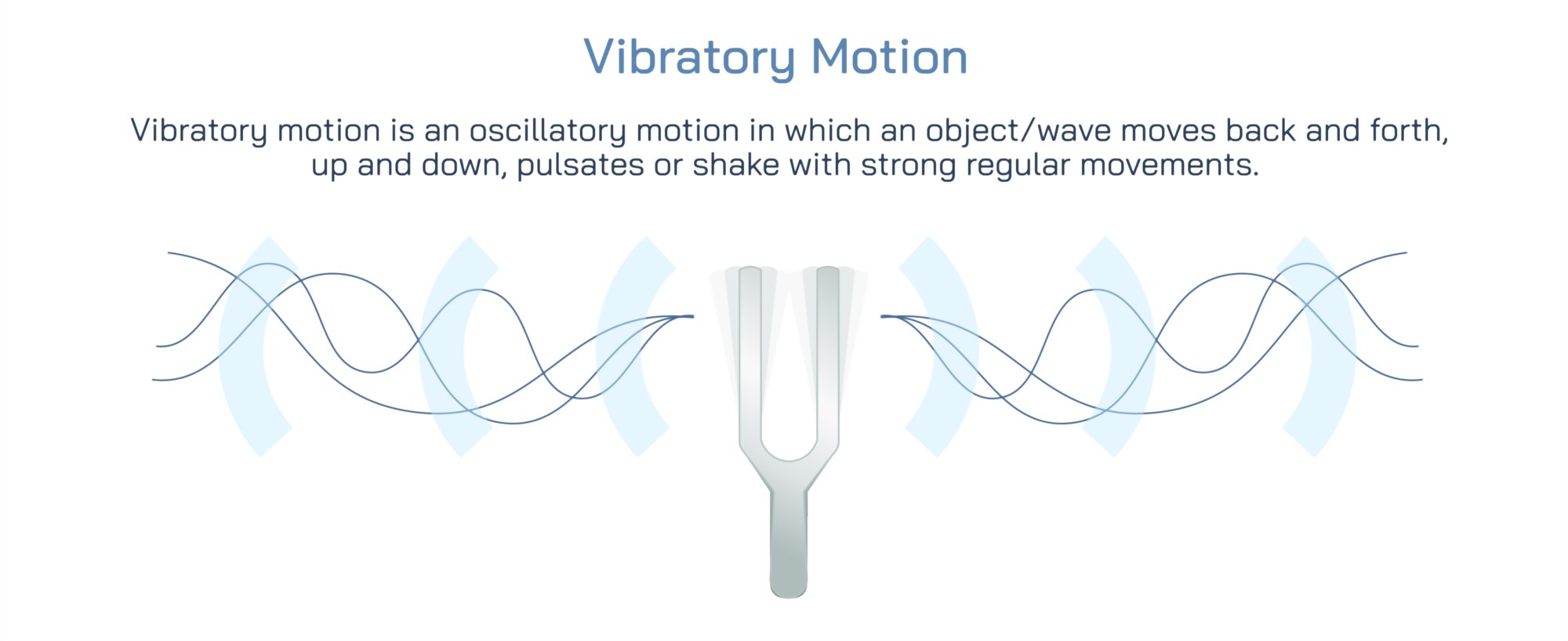
The tuning fork consists of two prongs, known as tines, and a base that stabilizes the structure. When struck, the tines move back and forth rapidly, creating a pattern of vibration that forms the foundation of the sound we hear. A vector illustration reveals this action by showing the tines in different positions of their oscillatory cycle, emphasizing how they bend inward and outward with rhythmic regularity. These motions occur so quickly in real life that they cannot be seen with the naked eye, which is why a clean vector depiction becomes valuable. It allows the invisible process to be visualized through simplified yet accurate forms that highlight the essence of the motion.
The vibratory motion produces alternating compressions and rarefactions in the surrounding air. These changes in air pressure propagate outward from the tuning fork, eventually reaching the listener’s ear. A well-designed vector illustration can represent this through a sequence of expanding wave patterns radiating from the ends of the tines. These waves visually communicate the idea that sound is not a material object but rather a travelling disturbance in a medium. The smooth curves, gradient shading and evenly spaced wave lines typical of vector art help convey this effect with clarity and precision, avoiding clutter and emphasizing the elegance of physical behavior.
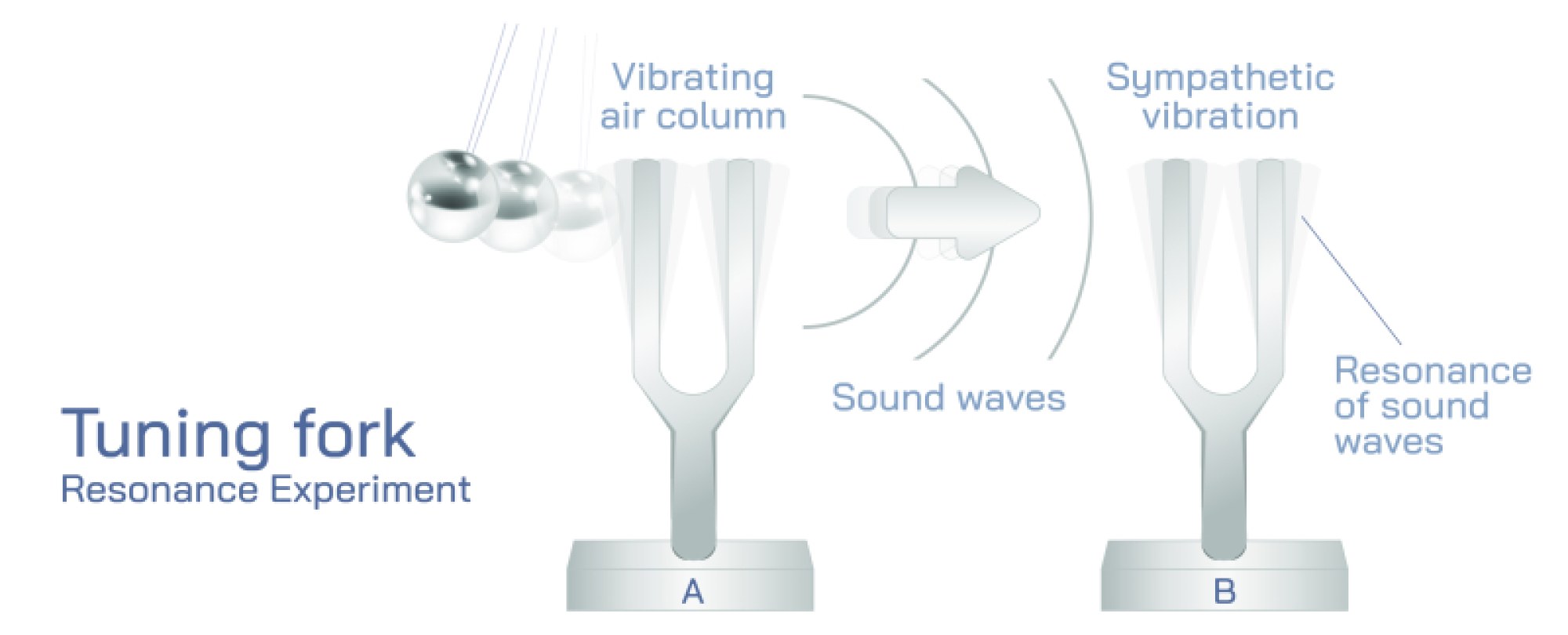
Another important aspect of tuning fork motion is resonance. When the tines vibrate, the entire fork interacts with the surface it touches. If placed on a suitable medium such as a wooden table, the fork transfers part of its energy into that surface, amplifying the sound. A vector illustration can show this interaction through symbolic lines or soft expansions around the base of the fork, indicating energy transfer without resorting to complex diagrams. This visualization helps viewers understand why a tuning fork sounds louder when it is pressed against an object compared to when it vibrates freely in the air.
The design can also highlight the symmetry inherent in tuning fork behaviour. The tines move in opposite directions, but always mirror each other perfectly. This controlled symmetry is what enables the fork to maintain a pure tone with minimal distortion. A vector drawing can emphasize this through parallel motion lines, balanced composition and equal spacing around each tine, reinforcing the idea that stable resonance requires precise physical structure. The contrast between the rigid metal form and the smooth visual representation of motion creates a compelling educational image.
Tuning forks are also used to study vibration transfer in various media. They may be placed in water, near sand patterns, or next to objects that react to acoustic energy. A vector illustration of vibratory motion can include subtle environmental indicators that show how the fork influences nearby materials. Ripples in water, light shifts or soft texture changes demonstrate how vibration extends beyond the fork itself, making the concept of mechanical motion more tangible for learners.
The beauty of vector art lies in its ability to maintain clarity at any scale. Whether used in a small physics booklet, a classroom poster, a digital learning platform or a scientific presentation, the image of a vibrating tuning fork remains crisp and informative. It supports a wide range of educational applications, from introductory science lessons to advanced discussions about acoustics and material behaviour.
By combining structural accuracy, expressive motion lines and clean design language, a vector illustration of vibratory motion in tuning forks becomes a powerful learning aid. It offers a vivid interpretation of how a simple mechanical object transforms energy into sound, guiding viewers toward a deeper appreciation of acoustic phenomena and the elegant principles that govern vibratory motion.