Detailed Explanation of DNA Deoxyribonucleic Acid Using a 3D Rendered Illustration
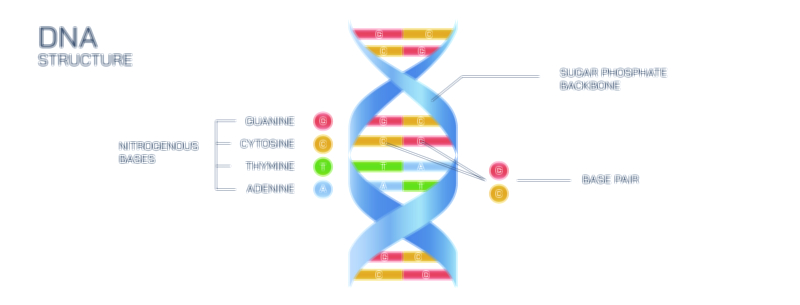
A three dimensional illustration of DNA Deoxyribonucleic Acid offers an exceptional way to explain one of the most fundamental structures in biological science. This type of visual representation transforms the microscopic complexity of the double helix into an accessible form that learners, educators, and professionals can easily interpret. The smooth twists, balanced symmetry, and clearly defined paired segments help reveal how the structure encodes essential information within living organisms. When presented through a 3D rendered view, each component becomes more visible, giving viewers a sense of depth, proportion, and spatial arrangement that traditional flat diagrams cannot deliver.
The double helix arrangement consists of two long strands that wind around one another. A 3D render allows each strand to appear as a clean, curved surface, while the paired units connecting them are shown with accurate spacing. This clarity helps learners understand how genetic information is stored and transmitted. By highlighting segments in varying textures or controlled lighting, the illustration provides visual separation between the structural elements, making the concept easier to grasp for students who are encountering molecular biology for the first time. Educators can use the visual to demonstrate how the structure maintains stability while still allowing essential processes such as replication and repair.
Scientific explanations benefit greatly from the ability to zoom in and analyze specific portions of the illustration. For example, the 3D render can emphasize the twist rate, the repeating pattern along the spiral, or the placement of structural units. These focused views can be used to teach subjects ranging from inheritance to cellular function. Because the structure plays a central role in so many biological systems, the visual serves as a foundation for lessons in genetics, molecular interactions, and biochemical pathways. When paired with clear verbal or written explanations, the render helps learners connect individual details with broader scientific themes.
Medical and research environments also depend on accurate depictions of molecular forms, and the 3D rendered helix is especially effective in these settings. Presenters can use the model to explain genetic behaviors, mutation points, or interactions with other molecular elements. A realistic render can enhance presentations in academic conferences, training workshops, and laboratory discussions by offering a polished and credible image. Its clean appearance and structural accuracy make it suitable for scientific posters, digital publications, online courses, and educational videos.
Another advantage of 3D rendering lies in its ability to simulate lighting and depth. Subtle shadows and smooth highlights emphasize the curvature of the helix, giving the structure a more lifelike sense of space. This realism helps viewers understand how tightly the strands wrap, how evenly segments repeat, and how consistent the spacing remains throughout the length. This form of clarity encourages deeper engagement because the viewer is not simply observing a drawing—they are exploring a three dimensional structure that behaves as it would in a digital or conceptual space.
The illustration also supports animated and interactive uses. When the helix rotates, unfolds, or zooms inward, viewers can observe transitions and relationships that remain hidden in static images. These dynamic perspectives allow educators to demonstrate how the structure behaves during replication, how sections are read during molecular processes, or how surrounding elements interact with the spiral. This versatility ensures that the same illustration can be reused in various educational materials, enhancing both comprehension and retention.
Beyond learning and research, the 3D helix has symbolic and communicative power. It is frequently used to convey ideas related to discovery, innovation, health, and scientific advancement. When displayed in a modern, polished render, it becomes an effective visual component for branding materials in biotechnology, medical laboratories, research institutions, and educational platforms. The render communicates professionalism, precision, and clarity, making it suitable for brochures, websites, institutional banners, or digital media campaigns.
Overall, explaining DNA Deoxyribonucleic Acid through a 3D rendered illustration offers a rich combination of scientific accuracy, visual appeal, accessibility, and instructional usefulness. It turns an abstract microscopic structure into a comprehensible and compelling form, helping learners and professionals interpret the principles of life with deeper understanding and confidence.