Extensive Overview of a 3D Rendered DNA Deoxyribonucleic Acid Helix Illustration for Scientific Visualization
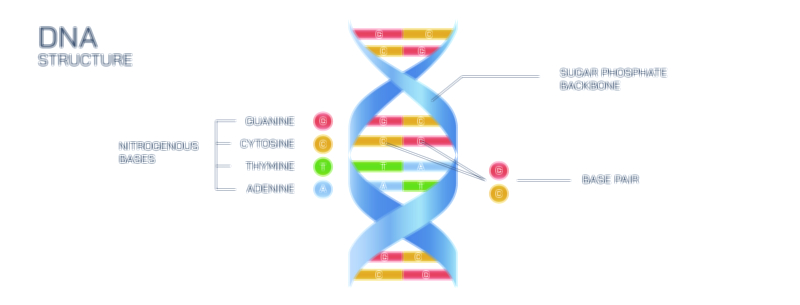
A three dimensional representation of the DNA Deoxyribonucleic Acid helix stands among the most powerful tools for bringing molecular science into clear visual form. This type of illustration translates microscopic complexity into a clean and accessible model that allows viewers to explore the elegant twist of paired strands with remarkable clarity. When rendered with balanced lighting, smooth shading, and structured depth, the familiar spiral becomes both scientifically accurate and visually captivating. This makes the illustration a valuable resource for science learning environments, medical presentations, research communication platforms, and educational media.
The strength of a 3D helix illustration lies in its ability to reveal the arrangement and curvature of the intertwined form. Each turn of the structure is presented with precise alignment, and the paired segments appear with clear definition. Instructors can use the image to introduce concepts related to molecular organization, hereditary information, and cellular processes. Because the digital model can highlight particular segments, it supports step-by-step explanations where educators guide learners through specific structural features. This clarity helps reduce confusion that often arises when students first encounter flat, abstract diagrams.
Beyond the classroom, the render is highly effective in medical and research settings. Presentations, conference slides, laboratory charts, and scientific posters benefit from a graphic that communicates complexity with simplicity. Viewers can immediately grasp the twisting form and its role in biological information transfer. A polished render enhances scientific storytelling by providing a visually coherent structure that integrates seamlessly with text, data, or procedural explanations. In environments where clarity is crucial—such as medical training, genetic counseling, or public exhibitions—a three dimensional helix becomes an indispensable asset.
In addition, the illustration supports digital and multimedia applications. When incorporated into animations, the helix may rotate, expand, or shift to demonstrate molecular behavior, replication, or interaction with various elements. These dynamic sequences enrich learning materials by allowing viewers to observe structural motion and spatial relationships. Online courses, science documentaries, and interactive learning platforms frequently adopt such visuals to deliver content that maintains attention while enhancing comprehension.
The aesthetic appeal of the helix also plays a significant role. The balanced curves, consistent rhythm, and recognizable symmetry contribute to the design’s strength in branding for science-related fields. Biotechnology firms, research institutes, academic publishers, and medical organizations often use the helix as a symbol of innovation, discovery, and precision. A high-quality render amplifies these themes, giving professional materials a refined appearance that communicates expertise and modernity. Whether placed on brochures, official websites, laboratory displays, or educational banners, the illustration supports a strong and credible visual identity.
A three dimensional DNA Deoxyribonucleic Acid rendering can also adapt to varied color schemes and surface textures to emphasize functional segments. This flexibility allows designers and educators to tailor the illustration to the needs of a given subject, whether the focus is molecular bonds, sectional regions, or general structure. Such customization improves accessibility for learners at different stages, from basic biology students to advanced medical practitioners.
Overall, a 3D rendered DNA Deoxyribonucleic Acid helix illustration stands as a versatile and highly effective visual representation of one of biology’s most important structures. Its clarity, adaptability, scientific accuracy, and aesthetic distinction make it an essential resource for education, research, communication, training, branding, and public science engagement. It transforms a microscopic concept into a vivid and understandable form, helping learners and professionals interpret molecular science with confidence and clarity.