The Seasons and Earth Movement Around the Sun — Causes, Effects, and Solar Dynamics
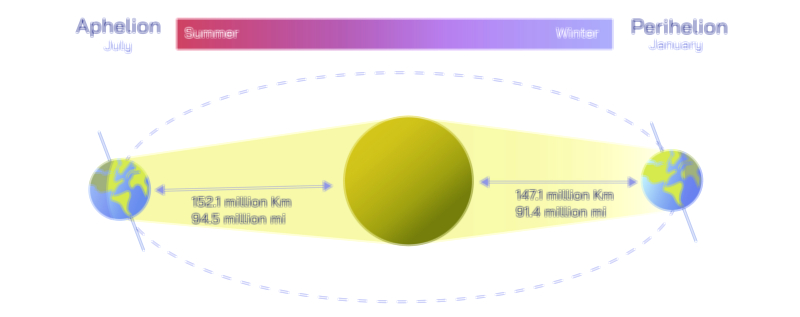
The Earth experiences seasons due to its movement around the Sun combined with the tilt of its rotational axis. This axial tilt of approximately 23.5 degrees relative to the plane of Earth's orbit causes different regions of the planet to receive varying amounts of sunlight throughout the year. As Earth revolves around the Sun, this variation in solar exposure leads to seasonal changes in temperature, daylight duration, and climate patterns, shaping ecosystems and human activities worldwide.
The Earth completes one revolution around the Sun in about 365.25 days, while simultaneously rotating on its axis every 24 hours. During this orbital journey, the Northern and Southern Hemispheres alternately tilt toward and away from the Sun. When a hemisphere tilts toward the Sun, it experiences summer, characterized by longer days, higher solar angles, and warmer temperatures. Conversely, when it tilts away from the Sun, winter occurs, with shorter days, lower solar angles, and colder temperatures. The spring and autumn equinoxes mark the points when the Earth's axis is not tilted toward or away from the Sun, resulting in nearly equal day and night lengths across the globe.
The solstices are key markers of seasonal extremes. The summer solstice represents the longest day of the year for a given hemisphere, while the winter solstice corresponds to the shortest day. These events are caused by the maximum tilt of the hemisphere toward or away from the Sun. Seasonal shifts influence not only temperature and daylight but also agriculture, animal behavior, weather patterns, and ecological cycles. The tilt and orbit of Earth ensure that different latitudes experience varying climates, contributing to the diversity of environments across the planet.
Understanding Earth's movement around the Sun is essential in astronomy, geography, and climate science. The relationship between axial tilt, orbit, and solar radiation explains the cyclical nature of seasons and allows humans to predict weather patterns, plan agricultural activities, and comprehend the broader dynamics of the Earth-Sun system. Solar energy distribution, temperature variation, and daylight changes are all direct consequences of Earth's position relative to the Sun throughout the year.
In conclusion, the seasons are a result of Earth's axial tilt and orbital movement around the Sun. Summer, winter, spring, and autumn occur due to the varying angles of sunlight received in each hemisphere, affecting temperature, daylight, and ecological patterns. By understanding these movements and solar dynamics, we gain insight into climate variation, day-night cycles, and the natural rhythm that governs life on Earth.