Center of Gravity — Physics Balance Concept
The center of gravity is one of the most foundational concepts in physics and engineering, embodying the idea that every object, no matter its size, shape, or composition, possesses a single point at which its entire weight can be considered to act. This concept becomes essential for understanding balance, stability, motion, structural design, and the physical behavior of bodies under the influence of gravity. Although gravity acts on every particle within an object, the combined effect of these countless tiny forces can be simplified to this single point, known as the center of gravity. The beauty of this concept lies in its ability to condense a complex distribution of internal forces into a single representative location, enabling physicists, architects, athletes, engineers, and designers to analyze motion and stability with clarity and precision. From towering skyscrapers to human postures, from bridges that span miles to compact consumer products, the idea of a center of gravity helps determine whether something stands firm, topples, tilts, rotates, or remains balanced under different conditions.
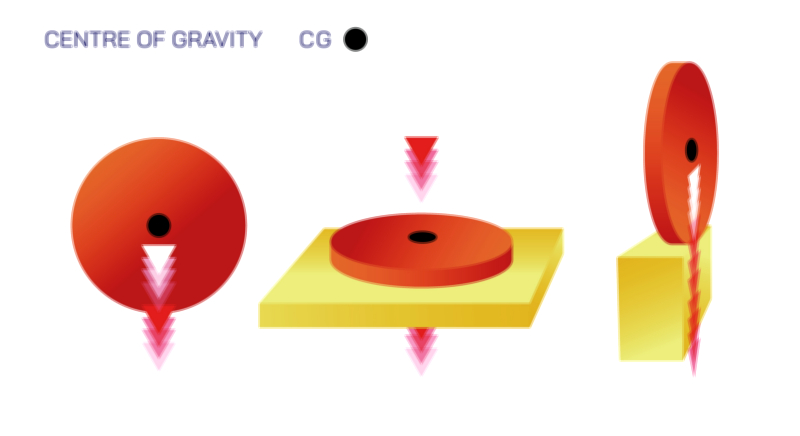
At its core, the center of gravity can be visualized as the average location of all the weight within an object. In uniform, symmetrical shapes—such as a perfect sphere, cube, or cylinder—the center of gravity naturally lies at the geometric center because the weight is evenly distributed in all directions. In irregular shapes, however, the center of gravity may shift toward whichever region contains greater mass or density. This is why objects with uneven weight distribution can feel deceptively heavy on one side or why certain tools or equipment are designed with intentional imbalances to improve handling. In the human body, the center of gravity is not fixed; it shifts with posture, movement, and changes in limb position. When a person stretches upward, bends, squats, or lifts an object, their center of gravity moves accordingly, affecting balance and stability. Ballet dancers, athletes, gymnasts, and martial artists study how to manipulate their center of gravity to achieve fluid motion, hold difficult poses, prevent falls, generate force, or maintain stability under dynamic conditions.
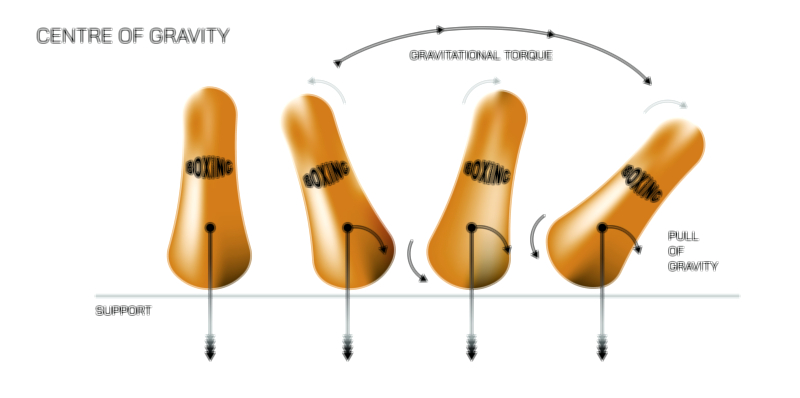
The concept plays an essential role in stability, which depends on how the center of gravity aligns with the base of support. When the center of gravity lies directly above or within the base of support, an object remains stable. If the center of gravity shifts outside this base, gravity produces a rotational effect that causes the object to tip over. This principle explains why wide-bottomed containers resist toppling, why tall structures require broader foundations, and why walking becomes more difficult on narrow surfaces. It also illustrates why carrying a heavy load can alter balance, as the added weight shifts the center of gravity, making deliberate adjustments necessary to prevent falling. In sports, this principle allows athletes to perform feats that appear to defy physics. A sprinter leans forward at the starting line to position the center of gravity for explosive acceleration. A high jumper manipulates body position midair so the center of gravity passes below the bar, even as the body passes above it. A football player lowers their center of gravity to maintain balance during a tackle. Each example demonstrates how mastery of this concept transforms physical ability.
In engineering and architecture, understanding the center of gravity is essential for designing structures that can withstand environmental forces such as wind, earthquakes, and uneven loads. Bridges, towers, and buildings rely on precise calculations to ensure that their center of gravity remains in a position that maximizes stability. A skyscraper, for instance, must have a center of gravity low enough and aligned such that wind forces cannot topple it. This requires engineers to consider mass distribution, foundation design, and the structure’s shape. Cranes and heavy machinery incorporate counterweights that carefully align the center of gravity so that massive loads can be lifted safely without tipping. Vehicles, both large and small, are designed with a deliberately positioned center of gravity to improve handling and reduce the risk of rollover accidents. Sports cars, for example, are built with low centers of gravity to allow sharp turns at high speed, while trucks and buses have higher centers of gravity, making them more prone to tipping during sudden maneuvers.
In aviation and aerospace, the center of gravity becomes even more critical, as it directly affects how aircraft and spacecraft behave in flight. Pilots must ensure that passengers, cargo, and fuel are distributed properly so that the aircraft’s center of gravity stays within a safe range. A forward or aft shift could make the aircraft difficult to control, unstable during takeoff, or dangerously unbalanced during landing. For rockets and spacecraft, maintaining proper center of gravity ensures stability during ascent, attitude control in orbit, and safe re-entry. Even satellites rely on this principle, as their orientation systems must be designed with mass distribution in mind to ensure smooth rotation and stabilization.
The center of gravity also influences rotational motion. When an object spins, the path of rotation centers on its center of gravity. This explains why an object thrown into the air tumbles around a specific internal point and why performers who spin batons, knives, or staffs hold them near their center of gravity for easier control. Even seemingly chaotic motions follow predictable patterns once the center of gravity is considered, making it a powerful analytical tool in understanding complex mechanical systems.
In biomechanics, the concept helps explain human movement, posture, and ergonomics. The way we stand, walk, carry loads, or lift objects depends heavily on the position of our center of gravity. Individuals with good posture maintain their center of gravity in a way that minimizes strain on muscles and joints. When lifting heavy objects, keeping the load close to the body and maintaining a low center of gravity reduces the risk of injury by decreasing the torque acting on the spine. Designers of assistive devices, prosthetics, and mobility aids study the center of gravity to create tools that improve balance and reduce physical effort. Athletes use specialized training to control their body’s center of gravity during rapid changes in movement, allowing for agility, speed, and precision.
The center of gravity also shapes everyday objects. Furniture is designed with stable centers of gravity to prevent tipping. Tools like hammers, wrenches, and kitchen knives are weighted so they feel natural in the hand. Children’s toys, such as dolls and figurines, are weighted at the base to help them stand upright. Even wearable items, such as backpacks, helmets, or safety gear, rely on thoughtful mass distribution to avoid discomfort or instability. These everyday examples illustrate how deeply the center of gravity influences design choices meant to enhance usability, safety, and comfort.
In robotics, controlling the center of gravity becomes vital for creating machines that can walk, climb, or mimic human motion. Humanoid robots must continually adjust internal mass distribution or artificial joints to maintain balance. Quadruped robots use similar principles, shifting weight strategically to navigate rough terrain. Self-balancing devices, such as hoverboards or autonomous stabilizing platforms, use sensors and algorithms that constantly monitor their center of gravity and rapidly adjust motion to maintain equilibrium.
The center of gravity also influences artistic expression. Dancers use their understanding of balance to create visually stunning movements, sculptors craft pieces that appear impossible yet remain stable, and acrobats rely on precise internal positioning to achieve complex maneuvers. Even in martial arts, practitioners learn to control their center of gravity to generate power, maintain balance, and destabilize opponents.
Ultimately, the center of gravity is more than just a point—it is a principle that unites physics, engineering, biology, art, and daily life. It reveals the delicate balance that governs both the stability of a towering structure and the grace of a moving body. It shows how weight distribution influences motion, how design shapes performance, and how natural laws permeate even the most ordinary objects. Whether shaping a skyscraper’s foundation, guiding a gymnast’s leap, balancing a robot, or enabling a child to stand on one leg, the center of gravity remains a fundamental and universal concept. Understanding it means understanding balance itself—one of the most essential ideas in the physical world.
Center of Gravity — Physics Balance Concept Vector Illustration
Center of gravity vector illustration showing equilibrium, stability, and balance concepts for physics, mechanics, and educational study.

Summary
Related Images








File Details
File Type
-
EPS
File Size
-
5.18 MB
File Dimension
-
Scalable vector file
Your contribution helps us create more resources, but please support only if it's comfortable and affordable for you.❤️️
