Memory Cell vs Plasma Cell Vector Illustration Showing Immune Response, Antibody Production, and Long-Term Immunity Functions
The immune system is a highly coordinated network of cells and molecules designed to protect the body from pathogens. Within adaptive immunity, B lymphocytes differentiate into plasma cells and memory cells, each performing distinct roles in immune defense. Plasma cells are responsible for immediate antibody production following antigen exposure, while memory cells enable long-term immunity, allowing a faster and more robust response upon subsequent infections. A vector illustration comparing memory cells and plasma cells typically integrates cell differentiation, antibody secretion, antigen recognition, and immune memory mechanisms, providing a comprehensive and visually intuitive explanation of their functions. By combining labeled cell types, antibody pathways, and functional outcomes, such diagrams allow learners to understand both immediate and long-term components of the humoral immune response.
At the center of the illustration is a B cell undergoing activation. The B cell is depicted interacting with an antigen-presenting cell (APC) or directly recognizing free antigens via B cell receptors (BCRs). Labels identify key features, such as the BCR, antigen binding site, and signaling pathways leading to activation. Arrows illustrate the differentiation pathway, showing how activated B cells can develop into either plasma cells or memory B cells, visually connecting initial antigen exposure to functional outcomes. Color coding may differentiate the two lineages—plasma cells in one color (e.g., blue) and memory cells in another (e.g., green)—to clearly distinguish their roles.
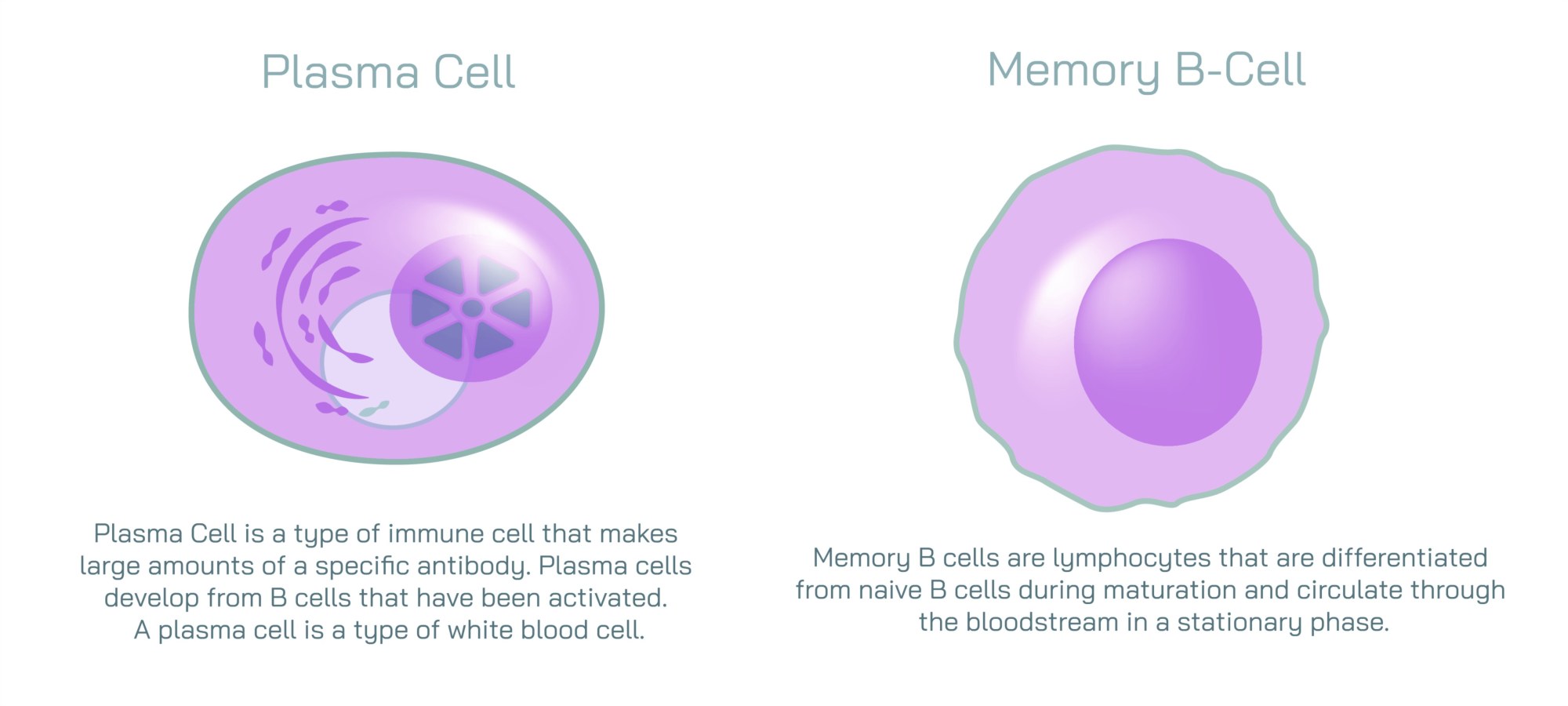
Plasma cells are depicted as large, antibody-secreting cells with expanded cytoplasm filled with endoplasmic reticulum, emphasizing their role in massive antibody production. Arrows extend outward from the plasma cell to indicate antibody molecules (IgG, IgM, or IgA) being secreted into circulation. Labels highlight the function of these antibodies, including neutralizing pathogens, opsonization, and complement activation, connecting structural features to immune function. Magnified insets may show antibodies binding antigens on pathogens, visually demonstrating the mechanism of pathogen neutralization.
Memory B cells are illustrated as smaller, long-lived cells that persist after the initial immune response. Labels indicate that memory cells circulate in the blood and lymphatic system, remaining primed for rapid activation upon re-exposure to the same antigen. Arrows demonstrate their capacity to quickly differentiate into plasma cells when a subsequent infection occurs, highlighting the enhanced secondary immune response. Insets may show faster antibody production during re-exposure, illustrating the principle of immune memory and long-term protection.
Vector diagrams often include a comparative panel showing the functional differences between plasma and memory cells. Plasma cells are associated with immediate but short-lived antibody production, while memory cells provide rapid, potent, and sustained immune protection during subsequent infections. Arrows may indicate timelines: initial exposure triggers plasma cell response within days, whereas memory cells enable rapid antibody production upon reinfection, demonstrating the efficiency of adaptive immunity. Color-coded timelines and labels reinforce these temporal differences, providing learners with an intuitive understanding of immune kinetics.
Additional educational features may include pathogen illustrations, showing bacteria or viruses being neutralized by antibodies secreted from plasma cells. Arrows indicate the binding and neutralization mechanism, while labels identify immune pathways such as antigen-antibody interaction, immune complex formation, and pathogen clearance. Magnified insets may show plasma cell organelles (e.g., rough endoplasmic reticulum) responsible for high-volume antibody synthesis, linking cell structure to function.
The illustration may also include activation signaling pathways, highlighting how BCR engagement and helper T cell signaling drive differentiation into plasma or memory cells. Arrows indicate cytokine signals, transcription factor activation, and cell proliferation, connecting molecular mechanisms to cellular outcomes. Color-coded overlays may distinguish signaling pathways leading to short-term antibody production versus long-term immune memory.
By combining B cell activation, differentiation into plasma and memory cells, antibody secretion, antigen interaction, and immune memory mechanisms, a vector illustration provides a comprehensive understanding of humoral immunity. Labels, directional arrows, magnified insets, color coding, and timeline panels allow learners to visualize both immediate and long-term immune responses, connecting structural features of cells to their functional outcomes.
Ultimately, a memory cell versus plasma cell vector illustration demonstrates the complementary roles of B cell lineages in adaptive immunity, linking cellular differentiation, antibody production, and long-term protection. Through labeled B cell structures, plasma and memory cell pathways, secreted antibodies, and pathogen interactions, the diagram transforms complex immunological processes into an educational, visually engaging, and intuitive tool for students, medical professionals, and immunology learners.