Hand Skeleton Anatomy Vector Illustration Showing Bones, Joints, and Detailed Human Hand Skeletal Structure
The human hand is an extraordinarily complex skeletal structure, consisting of 27 bones arranged in a highly organized framework that enables precision, dexterity, and strength. Understanding the hand’s skeletal anatomy is essential for medical education, orthopedics, physiotherapy, and anatomical studies. A vector illustration of hand skeleton anatomy typically integrates all bones, joints, and articulations, with labels and magnified insets, providing a detailed visual guide for learning human hand structure. By combining dorsal and palmar perspectives, color-coded bones, and directional annotations, such illustrations make the intricate relationships of the hand skeleton accessible and educational.
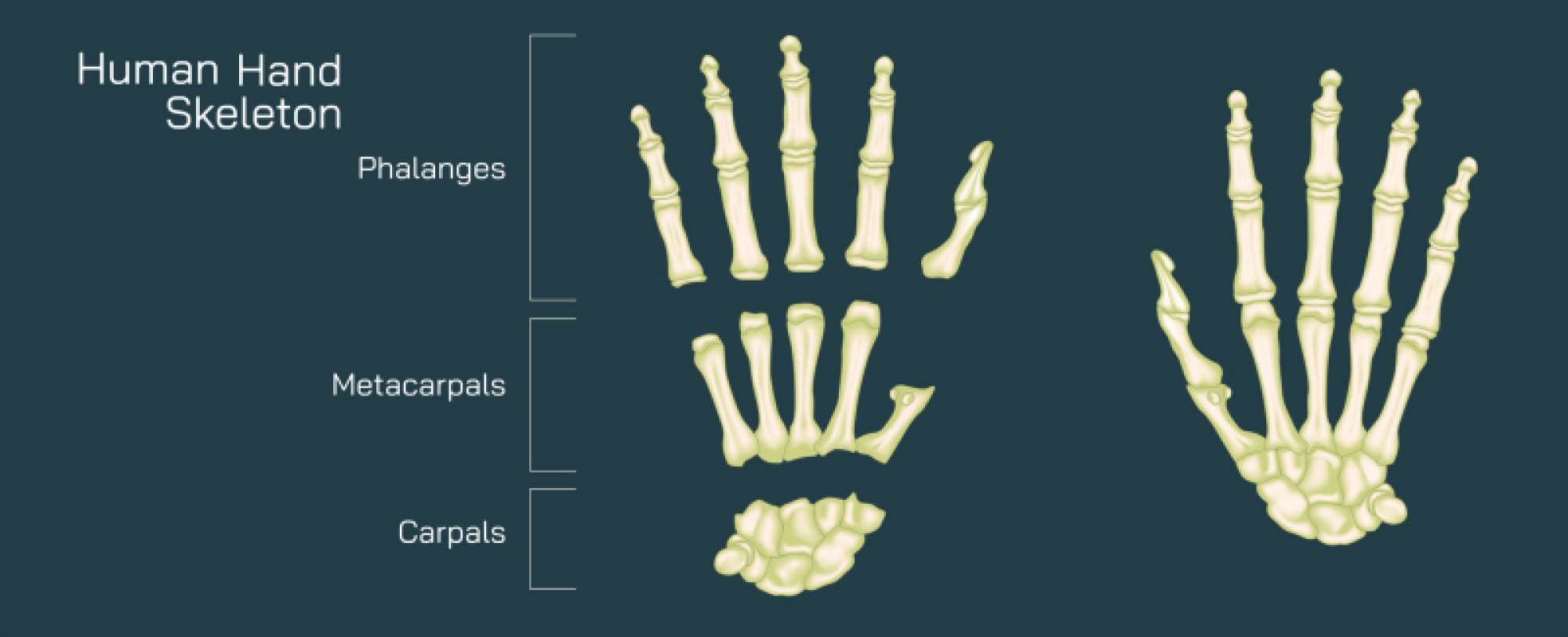
At the center of the illustration is the complete hand skeleton, depicted in a slightly angled perspective to provide depth and clarity. The hand is divided into three primary regions: the carpals (wrist bones), metacarpals (palm bones), and phalanges (finger bones). Each region is color-coded for visual distinction, for example, carpals in blue, metacarpals in green, and phalanges in yellow or orange. Arrows and labels identify each bone, its anatomical orientation, and its articulation with neighboring bones, providing an immediate visual understanding of the hand’s skeletal organization.
The carpal bones are depicted as two rows of irregular bones forming the wrist. The proximal row includes the scaphoid, lunate, triquetrum, and pisiform, while the distal row includes the trapezium, trapezoid, capitate, and hamate. Vector diagrams often feature magnified insets to show the shape, surface, and articulation of each carpal bone with adjacent metacarpals and the radius and ulna. Arrows indicate axes of movement for flexion, extension, and radial/ulnar deviation, visually linking carpal structure to wrist mobility.
The metacarpals form the palm of the hand and are numbered I through V, from the thumb to the little finger. Each metacarpal is illustrated with a base, shaft, and head, and labeled for easy identification. Arrows may indicate articulation with the carpal bones at the carpometacarpal (CMC) joints and with the proximal phalanges at the metacarpophalangeal (MCP) joints. Magnified views may show the concave and convex surfaces that facilitate precise joint movement, emphasizing the structural foundation of hand dexterity.
The phalanges are shown for all five digits, with three phalanges per finger (proximal, middle, distal) and two for the thumb (proximal and distal). Vector diagrams label each phalanx and illustrate the interphalangeal (IP) joints, including proximal interphalangeal (PIP) and distal interphalangeal (DIP) joints, with arrows showing the axes of flexion and extension. Color coding or subtle shading helps distinguish proximal, middle, and distal phalanges while maintaining clarity in complex overlapping structures.
Joints throughout the hand skeleton are clearly labeled. The illustration highlights CMC joints, MCP joints, PIP and DIP joints, and the thumb interphalangeal joint, emphasizing their roles in hand motion and grip mechanics. Arrows indicate movement axes, such as flexion, extension, abduction, adduction, and circumduction, linking skeletal anatomy to functional biomechanics. Magnified insets may show joint surfaces, cartilage, and ligament attachment sites, providing a more detailed understanding of structural support.
Vector illustrations often include dorsal and palmar perspectives, showing both the posterior and anterior views of the hand skeleton. This dual view allows learners to observe the relationship between carpal alignment, metacarpal articulation, and phalangeal positioning from multiple angles. Color gradients or highlights indicate anatomical features such as the thumb saddle joint, rotation axis of the fingers, and alignment of metacarpal heads relative to the phalanges.
Additional features may include clinical and educational annotations, highlighting common fracture sites (e.g., scaphoid, distal radius), anatomical landmarks, and functional regions relevant to grasping, manipulation, and fine motor control. Arrows may indicate load transmission through the wrist and palm, linking skeletal arrangement to hand strength and biomechanical efficiency. Magnified insets can show individual carpal bones, joint articulations, or alignment of phalanges for enhanced clarity.
By combining carpals, metacarpals, phalanges, detailed joint labeling, movement axes, and magnified insets, a hand skeleton vector illustration provides a thorough and comprehensive understanding of human hand anatomy. Color coding, arrows, and labeled regions facilitate learning by clearly distinguishing skeletal regions, joint types, and functional relationships, offering a complete framework for students and professionals.
Ultimately, a vector illustration of the hand skeleton demonstrates the integration of bones and joints that support complex hand movements, showing how structure enables dexterity, strength, and precise motor function. Through labeled bones, articulated joints, color-coded regions, and directional arrows, the diagram transforms intricate skeletal information into an accessible, educational, and visually engaging tool for anatomy study, medical education, and biomechanical understanding.