Male and Female Symbol Vector Illustration Showing Gender Icons, Biological Sex Representation, and Identity Concept for Education and Design
The male and female symbols are universally recognized icons representing biological sex, gender identity, and broader societal concepts of masculinity and femininity. These symbols are foundational in educational materials, scientific diagrams, and design contexts, providing a simple yet powerful means of visual communication. A vector illustration of male and female symbols typically integrates traditional gender icons, associated biological context, and identity concepts, providing a clear and educational representation of sex differentiation and identity. By combining labeled symbols, proportional layouts, and visual context, such illustrations allow learners and viewers to understand both the anatomical and conceptual significance of male and female representation.
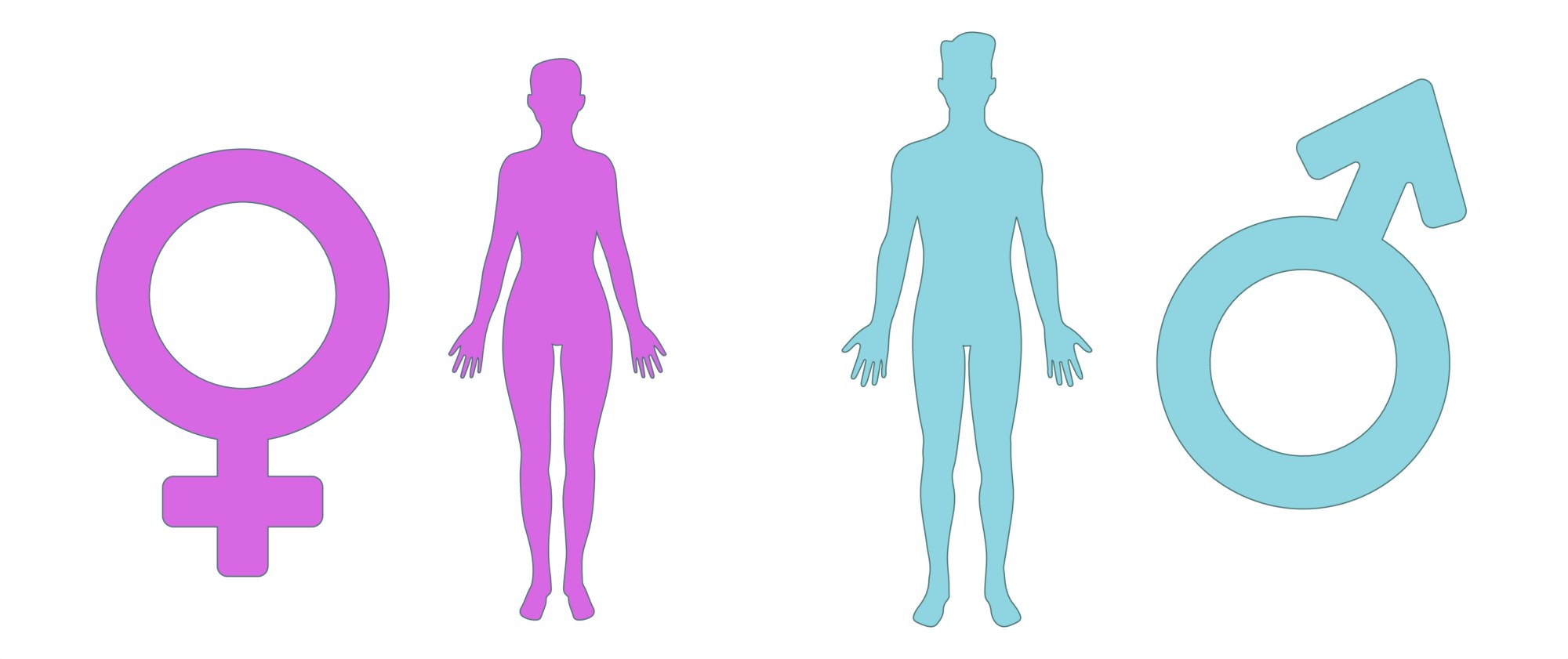
At the center of the illustration are the classic gender symbols. The male symbol (♂) is depicted as a circle with an arrow pointing diagonally upwards to the right, traditionally associated with Mars and representing masculinity. Labels indicate its meaning as male, masculine, or XY chromosome-associated biological sex. The female symbol (♀) is depicted as a circle with a cross extending downward, traditionally associated with Venus, representing femininity. Labels highlight its meaning as female, feminine, or XX chromosome-associated biological sex. Color coding often distinguishes the two symbols, with blue or dark tones for male and pink or lighter tones for female, though neutral palettes may be used to support inclusivity and modern design aesthetics.
Vector illustrations may also include biological context elements. Insets may show chromosome pairs (XY for male, XX for female), reproductive organs (testes and ovaries), or secondary sexual characteristics to connect abstract symbols to anatomical reality. Arrows indicate relationships between symbols and biological sex, emphasizing that these icons represent underlying physiological and genetic differences. Labels identify relevant structures, such as sperm and egg production, hormonal influences, and reproductive system components.
The illustration often includes identity and conceptual applications. The symbols may be combined or placed alongside gender-neutral or non-binary icons to represent diverse gender identities, highlighting the spectrum of human experience beyond biological sex. Arrows or overlays may indicate intersection between biological sex, gender identity, and societal roles, providing a nuanced view suitable for educational purposes. Color-coded pathways may illustrate inclusion and equality, visually linking traditional symbols with modern understanding of gender diversity.
Additional features in vector diagrams include symbol interaction and usage context. For example, male and female symbols may be overlaid on human silhouettes to indicate sex differentiation in anatomical diagrams or positioned near medical instruments, educational charts, or restroom signage. Arrows may indicate symbolic meaning, historical origin, or societal association, bridging visual recognition with educational explanation. Magnified insets may focus on historical symbolism, showing Mars and Venus mythological references or astronomical connections, enhancing cultural literacy alongside scientific understanding.
Vector illustrations may also demonstrate design versatility, showing symbols in different orientations, sizes, and combinations for logos, infographics, or educational charts. Arrows and labels guide viewers on correct visual interpretation, while color palettes and shading demonstrate depth, 3D effects, or flat design principles suitable for modern graphical applications. Symbols may be combined in sets or sequences to illustrate population demographics, health statistics, or identity distributions, supporting applied educational or design contexts.
By combining classic male and female symbols, labeled biological context, identity representation, and design applications, a vector illustration provides a comprehensive educational tool. Color coding, directional arrows, magnified insets, and comparative panels allow learners to understand both the biological basis of sex differentiation and the broader conceptual application in gender identity. Side-by-side or overlay layouts enhance clarity, demonstrating relationships between symbols, anatomy, and cultural meaning.
Ultimately, a male and female symbol vector illustration demonstrates the intersection of biological representation, gender identity, and educational design, linking universally recognized icons to scientific, cultural, and societal understanding. Through labeled symbols, chromosome and reproductive references, identity overlays, and design examples, the diagram transforms abstract concepts of sex and gender into a visually engaging, educational, and intuitive tool for students, educators, designers, and the general public.